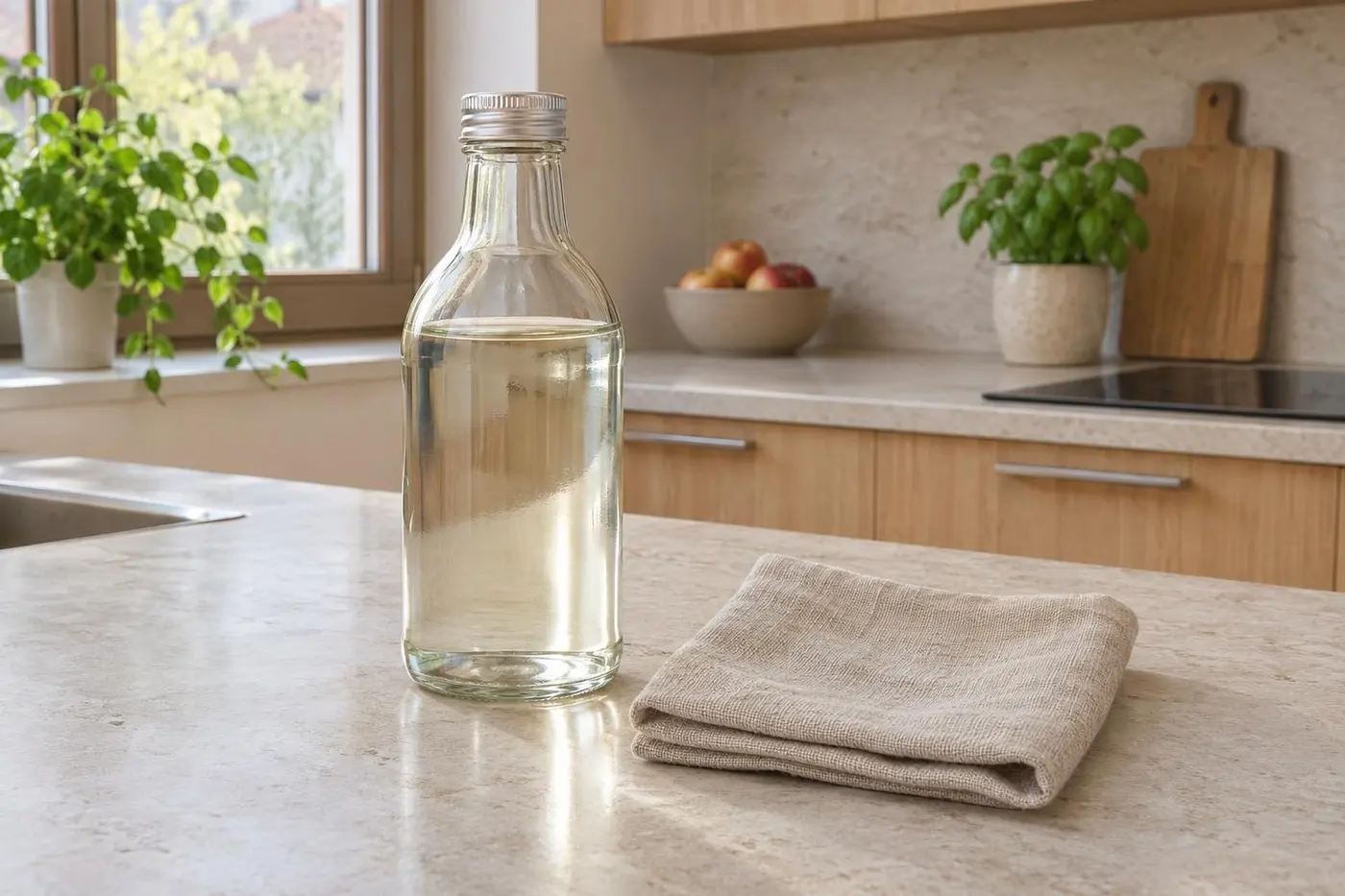
If you want the short answer on surfaces not to clean with vinegar, keep it away from calcareous stone, cement grout, wood finishes, waxed or oiled furniture, appliance seals, coffee-machine internals, coated screens and some bare metals. Vinegar can dissolve limescale. The same acidity that makes it useful can also etch a mineral, strip a finish or shorten the life of a small component you cannot see. In plain terms, this is what not to clean with vinegar: match the product to the material, not to a generic household recipe.
Still deciding which bottle you have? Our guide to white and spirit vinegar for cleaning explains the labels and concentrations. This article starts where that comparison ends: knowing when not to use either one.
Why an acid does not clean every material safely
Household vinegar is diluted acetic acid. It reacts with alkaline mineral deposits, which is why it can remove limescale from suitable glass or ceramic surfaces. The reaction is not selective, though. If the surface itself contains an acid-sensitive mineral, vinegar may attack the material along with the deposit.
A drop wiped up straight away may leave no visible mark. Repeated cleaning is different. A weak solution used every Friday can slowly dull a finish, make grout powdery or age a rubber part. That delay is what catches people out. Six months later, the floor or seal looks worn and the homemade cleaner gets none of the blame. That delayed change is the pattern behind vinegar cleaning damage.
Stronger is not smarter. Czech shops sell vinegars and cleaning concentrates at different strengths, and some must be diluted before use. More acid speeds up a chemical reaction; it does not somehow aim it at dirt. If you cannot identify the material and its finish, start with a pH-neutral product and test it in a hidden spot.
Natural stone and cement-based grout
1. Marble, limestone, travertine and some terrazzo
Vinegar on natural stone can become a costly mistake. Marble, limestone and travertine contain calcium carbonate, which reacts with acid. On polished stone, the result is often a pale, dull patch with a different feel. It is etching, not a stain that another cleaner will remove. A sealer may slow staining, but it does not make calcium-based stone acid-proof. The Natural Stone Institute recommends a neutral stone cleaner, stone soap, or a small amount of mild dishwashing liquid in warm water.
I once saw a marble windowsill in a Vinohrady flat with a white ring exactly the size of a spray bottle. The owner had tried a second round of vinegar to “even it out”. It only made the patch wider. If stone turns dull after contact with acid, rinse away the residue, dry it and stop. A stone specialist may be able to repolish it; more household chemistry will not.
Granite needs a more careful answer because mineral composition and sealers vary. Unless the supplier confirms compatibility, I would still choose a neutral stone product. It is a cheap decision compared with refinishing a kitchen worktop.
2. Cement grout and cement terrazzo
Grout looks tough, yet its cement binder is vulnerable to acids. One brief spill may not destroy sound, fully cured grout. Regular scrubbing with vinegar can roughen the surface and gradually remove binder. Older Prague bathrooms often have hairline cracks already. Acidic liquid can travel deeper through those gaps.
Try warm water, a soft brush and a pH-neutral bathroom cleaner approved for the tile. Black marks that return from inside the joint may point to mould or moisture below the surface. That is not a cue to use stronger vinegar.
Wood, waxed finishes and oiled surfaces
3. Finished wood floors
Wood has two problems here: acid and excess water. Repeated vinegar use may degrade certain floor finishes, while a wet mop pushes liquid between boards. The edges can swell before the loss of shine becomes obvious. The National Wood Flooring Association advises dry dust removal, immediate attention to spills and a cleaner made for the floor's actual finish.
Wring the cloth until it no longer drips, then leave no standing moisture behind. If you do not know whether the floor is lacquered, oiled or factory-finished, check the installer paperwork. In a rented flat, ask the landlord before testing a viral cleaning recipe in the middle of the room.
4. Waxed and oiled wood
An oiled dining table and an old waxed cabinet do not behave like laminate. Acid can remove the protective layer unevenly and leave pale patches; water may then enter the grain. Diluting the vinegar is not a reliable fix.
Remove dust dry. For everyday marks, use a barely damp cloth and the care product specified by the oil or wax manufacturer, then dry the surface. Photograph a deep grease or dye stain on valuable furniture before doing anything else. A joiner can often treat a local mark. A failed home experiment may turn it into a full sanding job.
Appliances, displays and rubber seals
5. Washing-machine and dishwasher seals or hoses
“Can I put vinegar in the washing machine?” does not have one universal answer. The manual for the exact model decides. Repeated acid exposure can weaken some rubber seals and hoses over time. Both Whirlpool and Bosch advise using approved care products and following the appliance instructions.
Use the same logic for a dishwasher. A stainless-steel tub surviving one acidic cycle tells you nothing about a pump, dispenser or hidden gasket. Do not add vinegar to the same wash as detergent either: changing the pH can reduce the detergent's cleaning performance. For odours, clean the filter, dispenser and folds of the door seal as directed, then let the open machine dry.
6. Coffee-machine internals and steam appliances
Limescale plus vinegar sounds sensible until the manufacturer explicitly bans it. Coffee machines may contain seals, valves and metal parts designed for a particular descaling product. Bosch, for example, tells owners of many models not to use vinegar or vinegar-based agents and to run the machine's own programme with approved tablets. Other machines may differ, which is precisely why a general internet recipe cannot outrank a model-specific manual. Our guide to citric acid for cleaning explains when that alternative has a place.
When the descale warning appears, follow the measured dose and every rinse step. Never leave vinegar sitting in a reservoir overnight. If the appliance leaks, makes a new noise or remains blocked after its approved cycle, stop and arrange service.
7. Displays, televisions and coated glass
A mild vinegar mix may work on an ordinary window. A phone or television screen is not ordinary glass. It may have an oleophobic or anti-reflective coating, and liquid can creep into the edge of the device. Do not spray any cleaner onto a display. Turn the device off and begin with a clean, dry microfibre cloth. If a mark remains, follow the manufacturer's cleaning directions. Where damp cleaning is allowed, apply the liquid to the cloth, never near a speaker, port or button.
8. Bare aluminium, cast iron and carbon-steel blades
Acid can react with unprotected metal. Aluminium may discolour or turn dull. Vinegar removes rust from cast iron, but a long soak can attack sound metal and strip the seasoned layer as well. Carbon steel corrodes readily. A controlled vinegar bath can have a place in a restoration project; it is not everyday care for a frying pan or knife.
For ordinary grease, use warm water and a small amount of dishwashing liquid where the manufacturer permits it. Dry cast iron immediately and renew its oil layer according to its care instructions. Choose a metal-safe product for aluminium parts and carbon-steel blades. These are safe vinegar alternatives when the material cannot tolerate acid.
Dangerous mixtures and a quick guide to alternatives
Never mix vinegar with chlorine bleach or any cleaner containing hypochlorite. Acidifying bleach can release chlorine gas, which irritates the eyes and airways and can injure the lungs. Poison Control advises against the combination. If cleaners are mixed accidentally and you notice a harsh chlorine smell, do not add anything else. Leave the room and get into fresh air. Call emergency services for shortness of breath, chest pain or a cough that does not settle.
Baking soda and vinegar do not usually create a toxic gas, but they mostly neutralise one another. The dramatic foam is not proof of better cleaning. And never pour vinegar into a bottle or bucket that still contains an unidentified product. One job, one product, one clean container.
| Surface | Main risk | Safer first choice | |---|---|---| | Calcareous natural stone | Permanent etching and dull patches | pH-neutral stone cleaner | | Cement grout or terrazzo | Roughening and binder loss | Neutral cleaner and soft brush | | Finished wood | Finish damage and moisture in joints | Finish-specific cleaner, barely damp cloth | | Oiled or waxed wood | Patchiness and loss of protection | Care product specified for that oil or wax | | Washer or dishwasher | Ageing seals and impaired detergent performance | Approved machine cleaner and manual | | Coffee or steam appliance | Damage to seals, valves or metals | Manufacturer-approved descaler | | Display | Coating damage and liquid ingress | Dry microfibre cloth, device instructions | | Bare reactive metal | Dulling, corrosion or lost seasoning | Mild product approved for that metal |
Stop when a surface changes colour, turns dull, feels tacky, becomes powdery or starts to flake. Crumbling grout, a deeply etched stone and water-swollen wood are no longer jobs for another homemade mixture. If you have a Prague home with several sensitive finishes and would rather avoid trial and error, ČistýKout offers a no-obligation cleaning enquiry through its contact form. Add a few photographs and note the materials so the cleaning method can be chosen before anyone reaches for a bottle.