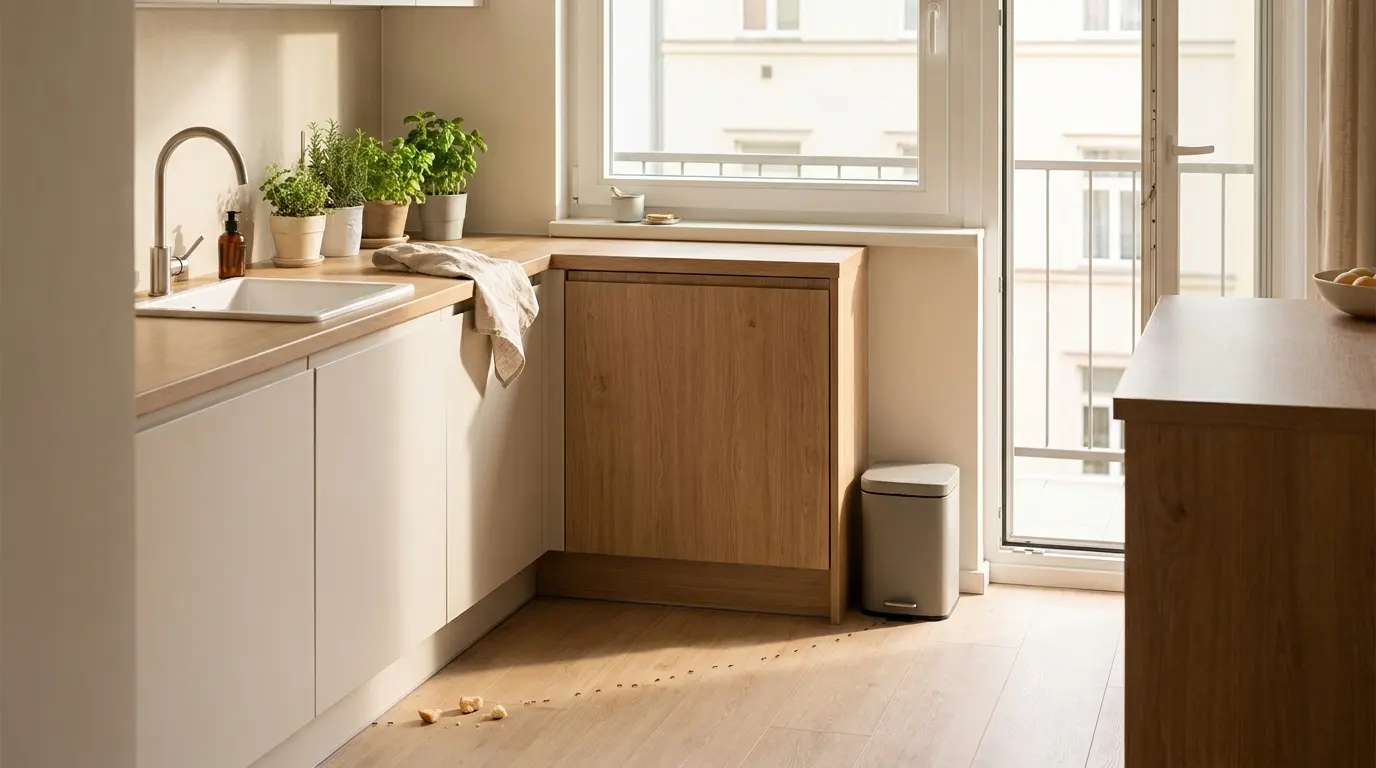
Ants in kitchen spaces are annoying because they often show up after you have cleaned, not before. The counter is wiped, the floor smells fresh, the dishes are away, and then in the morning there is a thin line moving near the bin, the pantry, or the balcony door. I see this pattern most in spring and summer, especially in Prague flats with a loggia, ground-floor homes, and kitchens where people bake, pack children’s snacks, or keep a pet bowl near the cabinets. It does not mean the home is dirty. A crumb near the baseboard, a dried drop of syrup under a cabinet edge, or a sweet-smelling cleaner left as a sticky film can be enough.
This article is not about pest extermination. It is about the cleaning triggers that make ants at home keep returning to a kitchen that looks perfectly fine to a human eye. Ants are not judging the shine of your worktop. They are looking for sugar, starch, grease, water, and a reliable route inside. Once you understand that, it is easier to clean kitchen against ants in a practical way, even if the phrase itself sounds a bit clumsy in natural English.
Why ants appear even in a clean kitchen
The trap with ants is that we clean what we notice. We wipe the counter, take out the rubbish, run a mop over the floor, and call it done. Fair enough. But ants work at the scale of cracks, edges, thresholds, and tiny food traces. If a bread crumb sits along the baseboard, or if a few grains of sugar fall under the toe-kick, that can matter more than the spotless middle of the floor.
I once heard a version of the same complaint twice in one week from Prague clients: “We cleaned yesterday, and they are back by the kitchen unit.” In both homes the visible kitchen was tidy. The source was at the edge. In one flat, the trail came from the balcony threshold after the doors had been open during warm weather. In the other, ants were moving behind a freestanding fridge where old cereal crumbs had collected. Nothing dramatic. Just a narrow strip nobody normally sees.
Ants also follow moisture. That is why they may appear around the sink, dishwasher, damp cloth, or a small leak under the cabinet rather than around a sugar jar. A kitchen can be freshly mopped and still offer exactly what they need: warmth, water, a safe route, and a few invisible food residues.
Places you easily miss during normal cleaning
The weak spots are rarely the obvious messes. They are the edges. Crumbs near baseboards, the gap under the kitchen unit, the floor behind the bin, the lower pantry shelves, the narrow space between cooker and cabinet. Flour, sugar, cereal dust, fruit peel, and greasy dust settle there. A quick mop often pushes the residue closer to the edge instead of removing it.
Pet feeding areas deserve their own check. A dog or cat can spread dry food and water further than you think. Under a silicone mat, you may find a sticky outline that has been there for days. High chairs create the same problem. Half a biscuit ends up on the floor, a piece slides under the cabinet plinth, and the room still looks clean once the main surface has been wiped.
Look around the coffee machine, toaster, honey jar, syrup bottles, and snack boxes as well. A coffee machine leaves a damp edge. Syrup runs down the side of a bottle. Honey sticks to the underside of a lid. Toaster crumbs are so normal that people stop seeing them. For ants, these are dependable food points, especially if they are in the same place every day.
The bin is another common miss. Replacing the bag is not the same as cleaning the bin. Sweet liquid can sit on the lid, around the pedal, in the back corner, or on the floor behind it. Pull-out bins can hide residue on runners and cabinet walls. If melon juice, yoghurt, or fruit syrup leaks there, it keeps smelling and sticking long after the bag is gone.
How to clean a kitchen without leaving a sweet trail
Order matters. Vacuum or sweep dry crumbs first, then mop. If you start with a wet mop, sugar and flour can dissolve into a thin film. The floor may look shiny and smell clean, but a sticky layer remains. On pale tile, especially in newer flats, you might not see it. A bare foot often feels it immediately.
For sweet spills on floor surfaces, go directly at the spot. Wipe it with a damp cloth, rinse with clean water, then dry it. Syrup, honey, lemonade, and fruit juice usually need hand cleaning at the exact edge where they dried. A mop is useful for an open area. It is not great at removing a hardened sweet line under a cabinet.
Be careful with heavily scented cleaners. A vanilla, citrus, or fruit fragrance does not feed ants by itself, but it can hide the real issue and leave a tacky film that collects dust. In a kitchen, less perfume usually works better: correct dilution, clean rinse, and a dry finish. That is especially true on counters where food is prepared.
If ants keep coming back after you clean, do one slower edge clean. Use the narrow vacuum attachment along the baseboards. Pull the bin out. Wipe the plinth, lower cabinet edges, and the threshold near balcony doors. If your kitchen opens onto a balcony, clean the bottom of the door frame too. Soil from planters, pollen, crumbs from summer eating, and a spilled sweet drink can all gather there.
What to change in food storage
A pantry looks tidy until you inspect the lower shelf. That is where open bags of flour, sugar, oats, cereals, biscuits, sweets, or pet food often end up. A paper bag folds badly. A plastic sleeve never quite closes. A cereal box drops dust into the corner. You brush it away with your hand and move on. Ants do not.
The most useful change is simple: put sugar, flour, cereals, biscuits, and sweets into containers that close properly. They do not need to be expensive matching jars. Practical tubs with firm lids are enough, as long as you can wash them. For honey and syrups, wipe the neck of the bottle whenever it drips. A sticky jar put back on a shelf creates a trail without any obvious spill.
Check the lower shelves and back corners first. In smaller Prague flats, pantry storage often shares space with shopping bags, pet food, spare paper towels, and other household supplies. When the shelf is crowded, an open packet gets pushed to the back. Taking everything out once a month is not overdoing it. It is ten minutes that often explains why ants keep returning.
Do not leave dishes with sweet residue in the sink overnight. A mug with honey tea, a yoghurt bowl, a pancake plate, a child’s juice bottle. During the day these feel like harmless leftovers. At night the kitchen is quiet, and the scent is easier to follow. Closing bread bags and removing overripe fruit from the counter also helps during hot spells.
When it is time for a deeper kitchen clean
One ant after an open balcony door is not a disaster. A deeper clean makes sense when ants return after repeated mopping and follow the same route. At that point, the source is usually not in the open centre of the room. It may be under the cabinet plinth, behind an appliance, at the back of a pantry shelf, or around the bin.
Try a simple check before doing anything drastic. Watch the trail. Where do they disappear? At the threshold? Under the plinth? Behind the fridge? Near the syrup shelf? Clean from that point outward, not just across the visible floor. Move what can be moved safely. Wipe lower edges. Check whether the bin closes properly, whether the bag has torn, and whether something fell behind it last week.
In rented flats or busy households where cooking happens every day, a focused kitchen clean can be worth booking. Not because you “cannot clean.” More because a fresh pair of eyes will look at the areas you no longer notice. With ČistýKout, you can send a no-obligation cleaning request and mention that you are dealing with ants in kitchen areas. Add the details: baseboards, kitchen plinth, bin area, pantry, and balcony door threshold. The more specific the request, the better the cleaner can target the job.
If ants return even after a careful clean and sealed food storage, the issue may sit in the building, the outside area, or shared spaces. Then it can make sense to speak with the property manager or a pest specialist. Cleaning is still the first step you control. It removes the attractants, reveals the route, and often shows whether the kitchen is the source or just the place where the trail becomes visible.
The goal is not a sterile home. It is a few precise habits: remove dry crumbs before mopping, treat sweet spills as a spot problem, wash the bin properly from time to time, and store food so sugar and flour do not drift into corners. Once those small traces disappear, ants have far fewer reasons to keep testing the same kitchen route.