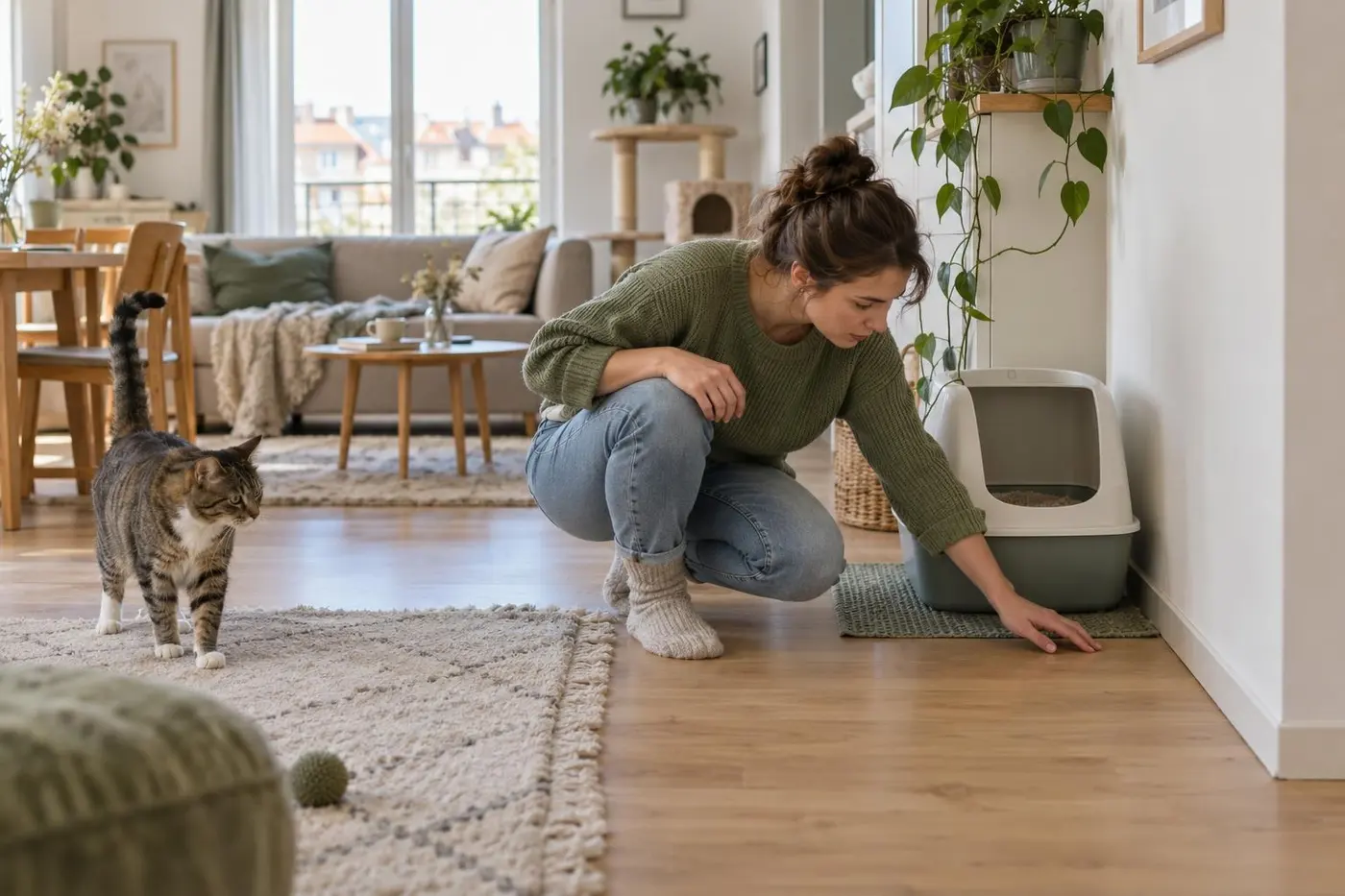
A search for “cat smell in apartment” usually starts after someone has already opened a window, topped up the litter and plugged in an air freshener. The room seems better for half an hour. Then you come back from the corridor and the smell is waiting. That return is a clue. You replaced the air, not the source. In Prague flats, I usually find one of five culprits: the litter tray, urine outside the box, soft furnishings, old food or a dirty filter. Each needs its own cleaning method.
First, work out where the smell actually comes from
Start without spraying anything. Empty the litter waste, open opposite windows for ten minutes, then check the room in small zones. Smell around the tray, the mat, skirting boards, the lower edge of the door and the sides of the sofa. Look behind plant pots, beneath the bed and inside the pet carrier too. A cat may choose a quiet corner that a mop never reaches.
A useful rule is to search low and check soft materials first. Odour lingers in grout, unfinished wood and fabric much longer than it does on glazed tile. If you notice the smell mainly after coming home, or when the weather turns damp, an older patch in an absorbent surface is likely. In one panel flat in Prague 11, the floor around the box was spotless. The real source was a swollen MDF skirting board behind it. Every weekend with the windows shut brought the smell back.
A UV torch may reveal an old mark, but it does not prove that every glowing patch is urine. Detergent residue, glue and spilled drinks can fluoresce as well. Mark suspicious spots with paper tape and inspect them closely. Do not soak the whole carpet “just in case”. That can spread the contamination into the underlay and leave you with a much harder drying job.
Litter tray, litter and floor need separate cleaning
Remove clumps and faeces at least once a day, more often in a multi-cat home. That daily scoop does not replace washing the tray. When you change all the litter, wash the empty box with lukewarm water and a product suitable for its material. Rinse it properly and let it dry before refilling. A heavy perfume is not evidence of cleanliness, and many cats dislike it.
Plastic trays become scratched by scoops and claws. Fine residue stays in those grooves, so a supposedly clean box begins to smell as soon as it warms up. If an empty, washed and fully dry tray still has an odour, replace it. With a covered model, take apart the lid, flap and connecting channels. Dried spray often hides there, out of sight from above.
Treat the mat, scoop and floor as separate jobs. Wash a rubber mat on both sides; launder a fabric one according to its label. Clean the scoop and its holder. On tiled floors, use a small brush on the grout beside the wall and beneath the tray. Put everything back only when it is dry. Moisture trapped under a mat can turn musty within a day, creating a smell that is easy to blame on the litter box.
Urine outside the box is not ordinary dirt
For a fresh accident, blot first and do not rub. Press white paper towels or a clean absorbent cloth onto the liquid, changing them until they come away nearly dry. On carpet, apply pressure from above rather than scrubbing sideways. Before using a cleaner, test it in a hidden area and read both the furniture care label and the product directions.
Cat urine needs a cleaner made for pet urine, usually an enzyme-based product. It has to reach as far as the original liquid and stay wet for the stated contact time. This is where people often rush. They mist a sofa, wipe it five minutes later and assume the job is done. Yet urine may have travelled past the cover and into the foam. Flooding the entire cushion is not a safe shortcut either; without controlled extraction, it can take far too long to dry.
Do not mix chlorine bleach with other cleaners, and do not use it as a universal answer to urine. Dangerous fumes are possible, while the sharp chemical smell can merely cover the problem. Skip fragrance sprays and hot steam until you know what the specific material permits. Heat can make some odour problems harder to remove from fibres. One more point matters: if your cat suddenly starts urinating outside the tray, or keeps doing it, speak to a vet. Pain, urinary disease and stress belong on the checklist alongside cleaning.
Fabric, upholstery and scratching posts hold odour
Wash removable covers, throws and pet beds according to their care labels. Take off loose hair first and pretreat only with a method suitable for that textile. Do not put an item in the tumble dryer until you have washed it, air-dried it and checked that the smell has gone. Heat is a poor way to test a doubtful stain.
For a sofa, mattress or carpet, ask three questions: what is the face material, what sits underneath it, and how deeply did the liquid travel? A cover may be washable while its filling is not. Wool carpet cannot be treated like a synthetic runner. A mattress calls for minimal moisture and plenty of airflow. Keep home treatment local; soaking a broad area without a way to extract the liquid can create a damp problem on top of the original odour.
Scratching posts are easy to miss. Sisal, plush fabric and particleboard all retain smells, and some parts cannot be cleaned reliably. Remove and wash detachable cushions, vacuum hair from every platform and inspect the base. If the inner board was soaked and still smells once completely dry, replacing that part is usually more sensible than adding another round of water.
Judge the result only after everything has dried, preferably the next day with the windows closed. Step outside for a few minutes before checking. Your nose adapts to a room quickly, so returning from the stairwell tells you more than smelling a wet sofa for ten minutes. If you are preparing a rental for handover, leave at least one spare day for this dry check.
Food, fur and ventilation are quieter sources
Wet food turns unpleasant quickly in a warm kitchen. Remove leftovers rather than leaving them all afternoon, wash bowls daily and lift the silicone mat to clean underneath. A small smear trapped beneath a bowl can produce a stubborn fishy note. Check opened tins in the fridge and the bin where empty pouches collect as well.
Fur is rarely the source of a sharp urine smell, but it holds skin oils, dust and food particles. Move the sofa and vacuum beneath it, clean the edge along the skirting board and wash the cat bed. In Prague homes with radiators, clumps often gather below the heater; once warm, they become noticeably stale. Clean the vacuum head afterwards and empty the bag or canister.
Then follow the airflow. A loaded air-purifier filter, a bathroom vent grille or a greasy cooker-hood filter may keep returning captured odours to the room. Clean or replace filters according to the manufacturer's instructions, not guesswork. Never spray products into a shared ventilation shaft. If the smell is entering through a grille from another flat or a service riser, record when and where it appears and contact the building manager. Scrubbing your own floor will not fix it.
When deep cleaning is the sensible next step
Professional cleaning makes sense when the smell returns after drying, has reached several layers, or cannot be located. Common cases include urine in the joint between floorboards, carpet underlay, sofa foam or an unfinished furniture edge. Wool, viscose, velvet, timber and upholstery without a clear care label deserve particular caution. A professional can test a small area and use controlled extraction. Sometimes the honest answer is that a soaked component must be replaced.
In your enquiry, include the number of rooms, the approximate affected area, surface types and the age of the accident if known. Add photographs, list products already used and say whether the cat will remain at home during cleaning. “The smell returns after rain near the left corner of the sofa” is far more useful than “the flat smells”. It helps the cleaner estimate both method and scope.
If ordinary cleaning has not removed a cat smell in your apartment, or you need the place ready for a tenancy handover, send a no-obligation enquiry through the Čistýkout contact form. Čistýkout is a Prague-based option for assessing whether a targeted treatment is enough or several surfaces need deep cleaning.