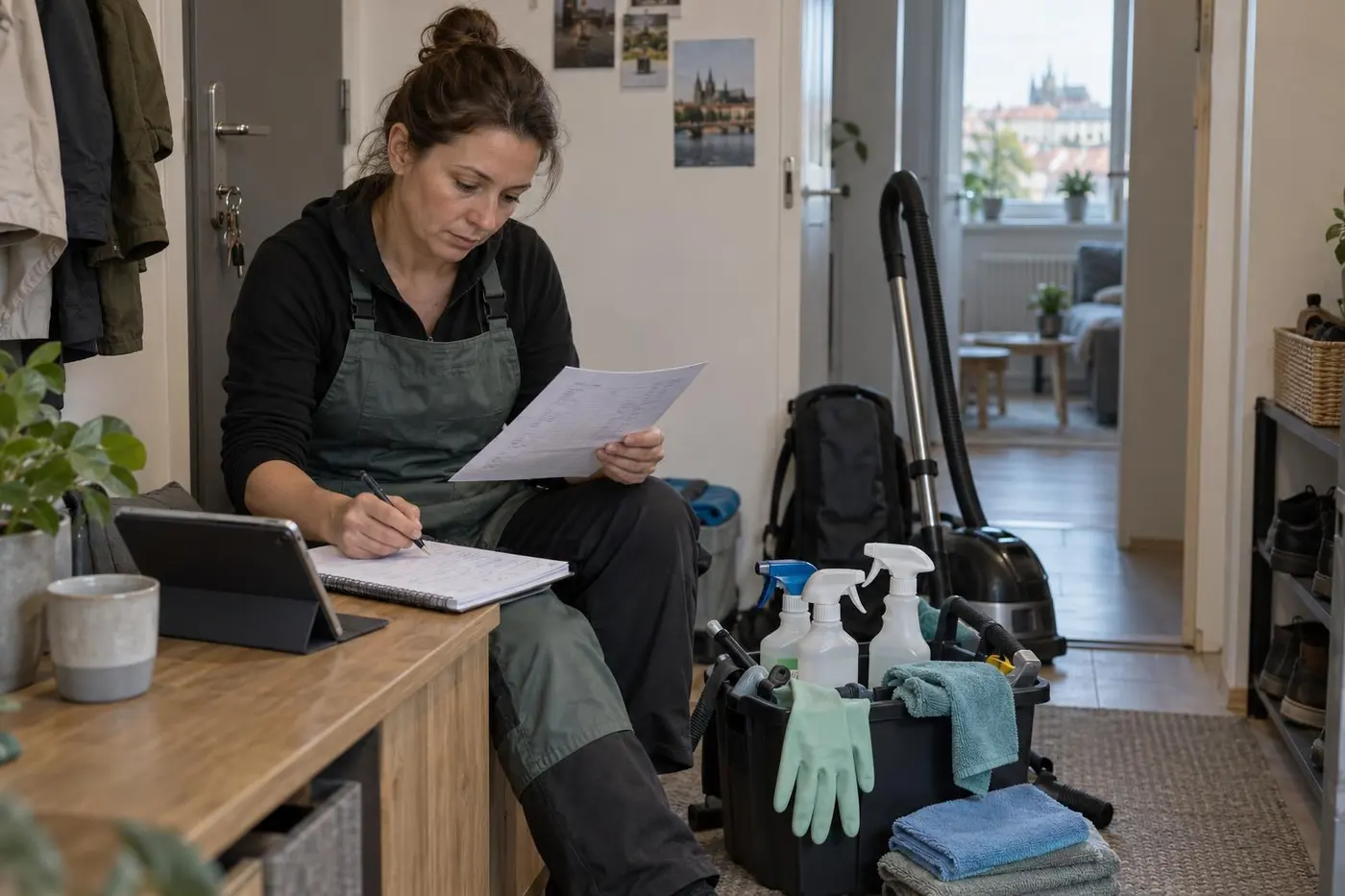
A full diary does not automatically mean a healthy business. Cleaning client profitability only becomes visible when each recurring account carries its real time and costs: travel, preparation, supplies, messages and the small unpaid jobs that collect around a visit. Those overlooked minutes can turn an impressive monthly invoice into one of the weakest accounts on your list.
Turnover will not show which client is taking your profit
Recurring work feels safe. The client pays on time, you know the flat, and you do not have to sell the booking again every week. Yet a large invoice is not the same as strong revenue per labor hour cleaning.
Take two fictional Prague jobs. A flat in Dejvice pays CZK 1,600 and takes three hours on site. A studio in Karlín pays only CZK 1,050 and takes two hours. Dejvice looks better until you count a forty-minute trip, paid parking, mop laundry and the wait for somebody to hand over the keys. The Karlín studio may leave more for every hour you actually gave the job, especially if it sits next to another booking.
Use the same method for every account. Counting travel for one client and ignoring it for another produces a tidy spreadsheet with no business value. Do not judge an account on one awkward day either. A tram closure, a sick team member or soup spilled across a fridge shelf is not a normal visit. Review at least three cleans. For monthly clients, looking back over a quarter is fairer.
I would start at the bottom rather than admiring the biggest invoices. Rank accounts by the amount left per real working hour, then inspect the weakest three.
Record the real time from departure to finished paperwork
A timer started at the client's door misses part of the work. Before arrival, you refill bottles, load the vacuum, check the route and travel. Afterwards, cloths need sorting, an invoice needs sending and somebody replies to a message asking whether the oven could be included next time.
Record five blocks for each visit:
- preparing and packing equipment;
- travel to the job and the next client;
- time on site for every person working;
- cleaning, washing and restocking your own kit;
- messages, invoicing and any complaint handling.
Ten minutes feels harmless. On a weekly account it becomes more than eight hours a year. The same applies to access. If you wait fifteen minutes for office reception to open every Friday, that is not bad luck. It is part of the job and either the process or the price needs to deal with it.
Mark extra tasks separately. Wiping one unexpected mark from a door is normal goodwill. Emptying the dishwasher, changing bed linen and cleaning a second bathroom every week means the scope has quietly grown. A basic code works: P for paid, F for a one-off favour and R for a repeated task outside the agreement. After a month, the notes tell you far more than the feeling that this home has somehow started taking longer.
Calculate the hourly return and the job contribution
You do not need accounting software for a useful review. For every visit, start with the price received and remove direct costs: products and consumables, transport, parking, payment fees and paid help. Solo cleaners should not pretend their own working time is free. The point is to see what the visit leaves for all of those hours.
The quick calculation is:
Job contribution = price − supplies − travel − fees − paid help
Return per working hour = job contribution ÷ all hours connected with the visit
Suppose the client pays CZK 1,500. Products and bags cost CZK 70; travel and parking cost CZK 110. You spend two hours and forty-five minutes on site, fifty-five minutes travelling and another twenty minutes preparing and doing admin. That is four hours in total. The job leaves CZK 1,320, or CZK 330 per working hour.
Now imagine two people complete the home in two hours. The record does not show two labor hours. It shows four, plus any paid preparation or travel. Missing that distinction is a common reason a cleaning job cost calculation looks healthier than the work feels.
Convert the visit to the real frequency. A weekly account averages 4.33 visits per month, not exactly four. The difference between a booking that leaves CZK 300 and one that leaves CZK 650 per visit is more than CZK 18,000 across a year. Small gaps become worth fixing.
This contribution is not final company profit. Insurance, bookkeeping, your phone, vacuum replacement, sick days and holidays still need paying. It is nevertheless a strong way to compare accounts because the same direct-cost rules apply to all of them. If you want a full cleaning job profit margin, add a consistent share of overhead rather than inventing a different allowance for each client.
Fix the operating problem before changing the price
A weak number does not always mean a bad client. Sometimes the route is the problem. Driving from Modřany to Holešovice and back to Prague 4 makes an expensive day even when each booking seems acceptable on its own. Moving one visit can improve the result without asking anybody for more money.
Missing tools have the same effect. If you regularly search for a step stool, carry water across the entire property or return to the car for a pole, repair the setup first. Agree on a place to keep basic equipment, prepare a kit for that office and use a short checklist. Saving fifteen minutes at every visit is measurable.
Then check the scope. A Vinohrady household may have started with “bathroom, kitchen, floors and dusting”. Six months later, laundry folding, the children's room and the coffee machine have joined the visit. Nobody planned to demand free work. The boundary moved in small, friendly steps. Bring back the written checklist and confirm what the price includes.
Measure another two or three visits after any operational change. Their average tells you whether the problem was fixed or the account is genuinely underpriced.
When to raise the price, reduce the scope or let the client go
Every account needs a floor. This is not a number copied from a Facebook group or the cheapest competitor nearby. It is the minimum return per real working hour that covers your pay, contributes to overhead and still makes the slot worth keeping.
If the average stays below that floor, choose one of four routes:
- Repair the operation. Change the route, key access, equipment or order of work.
- Reduce the scope. Keep the hygiene essentials and rotate lower-priority jobs between visits.
- Reprice. Base the new figure on measured time and the scope the client actually expects.
- End the arrangement. Do this when a realistic price and a smaller brief are both rejected.
A price conversation does not need an apology. Try: “The last three visits took an average of forty-five minutes longer once the regularly requested extras were included. From November, I propose CZK 1,850 per visit. If you would rather stay at CZK 1,550, we can keep the bathroom, kitchen, dusting and floors, with laundry and the oven booked separately.” The client receives evidence and a choice instead of a vague reference to rising costs.
Letting an account go is not failure. A recurring cleaning client owns a repeating space in your schedule. If you subsidise that space indefinitely, it blocks a client who could pay a sustainable price. Give reasonable notice, complete what has been agreed and leave professionally. No blame. No farewell clean packed with free extras.
A quarterly spreadsheet is enough
Use one row per client. Record the visit price, frequency, person-hours on site, other time, supplies, travel, paid help, complaints and hourly return. Add the last review date and one next action.
Once a quarter, sort the table from weakest to strongest. Give every account in the bottom fifth a specific decision: move Tuesday's route, store a mop on site, send an updated scope, change the price or release the slot. Put the next review in the calendar immediately. Otherwise a price accepted “for now” in January will still be there next Christmas.
The purpose is not to remove every slightly weaker client. A nearby, reliable booking may fill an awkward gap and carry value that its invoice does not show. Name that value instead of leaving it vague. You can then keep the account deliberately rather than through habit or fear of an empty diary.
If you are looking for a cleaner rather than auditing your own client list, ČistýKout's no-obligation contact form is a simple way to describe a Prague home or workplace and the service you need. A clear scope at the start saves time for both sides.