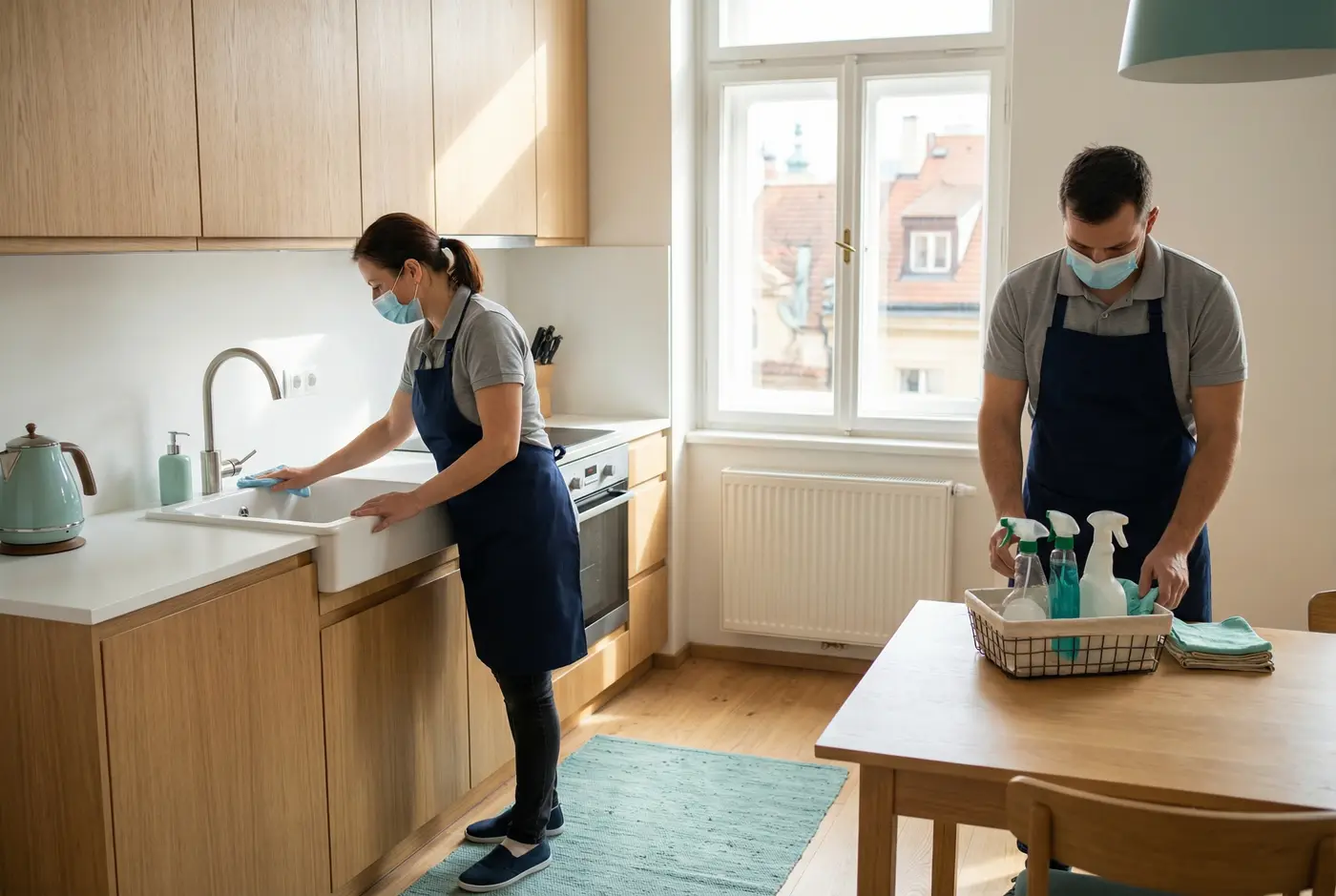
Cleaning service pricing is not just a number you throw out on the phone. For small cleaning providers in the Czech Republic, it is often the moment when confidence either holds or collapses. You call a prospect, remember some suspiciously cheap rate you saw in a local Facebook group, and then quote a price that barely covers fuel, products, laundry, and your own back. That is how good cleaners end up trapped in cheap work. Looking professional does not start with an expensive logo either. It starts when you know exactly what you offer, what it costs, and why.
Why so many cleaners charge too little
You see it all over the Czech market. Someone starts after maternity leave. Someone else learned discipline in hotel housekeeping. Another person begins with a few flats for friends and friends of friends. They know how to work hard. Then pricing comes up and the room goes quiet.
A very real example: Petra from Kladno wanted to build a regular home cleaning service. A friend warned her that somebody online was offering 220 CZK an hour, so she should be careful. Petra opened at 230 CZK. Two weeks later she realised the math was ugly. Travel time, products, washing cloths, messages, scheduling, and last minute changes had eaten most of the margin. She was exhausted and still felt she had to sound grateful. That story is ordinary. Almost boringly ordinary.
Small cleaning businesses often undercharge because they are afraid the client will leave for a cheaper option. The problem is that cheap rarely feels trustworthy on its own. When somebody hires regular cleaning in Prague, Brno, or Plzeň, they are not only paying for wiped counters. They are letting you into their home. They want to know you will show up on time, communicate like a normal person, and not make them explain the whole routine again next week.
What should be hidden inside your cleaning price
Travel time
Cleaning price is not just the time with a cloth in your hand. If you travel across Prague from Černý Most to Modřany, that time does not magically disappear. For small providers, transport is one of those quiet margin killers that people notice too late.
Products and equipment
Some cleaners use whatever the client has at home. Others bring their own kit. Either way, there is a cost. Microfibre cloths wear out. Vacuums do not last forever. Decent limescale remover, degreaser, gloves, and paper supplies all add up. If you work with products you trust, and you should, the result is better but the price has to reflect it.
Physical effort
A post tenancy deep clean, a bathroom with years of mineral build up, a greasy kitchen after a long rental, stairs in a building with no lift. None of that is the same job as a light maintenance clean in a tidy new flat. If you price both almost the same, your body will object long before your spreadsheet does.
Irregular workflow
A small cleaning business rarely has perfect weekly consistency. One week you are full. The next week people cancel because children are sick, they leave for a cottage, or they decide to move the appointment. Your rate needs a realistic buffer for that. Not an inflated one. Just an honest one.
Client communication and admin
Calls, messages, route planning, reminders, keys, invoices, parking, and those long conversations where you explain the difference between a standard clean and a deep clean. That is work too. Invisible work, but still work.

How to set a price that feels fair to the client and to you
Hourly or fixed price
At the start, hourly pricing is usually safer because you are still learning how long different jobs actually take. In smaller Czech towns, regular cleaning by an individual cleaner often sits somewhere around 250 to 330 CZK an hour. In larger cities and especially Prague, 350 to 450 CZK an hour is common, sometimes more when your own equipment, reliability, and better scheduling are part of the service. Deep cleans, post renovation jobs, and neglected spaces should be higher.
A fixed price feels cleaner to the client. A two bedroom flat in Vysočany costs 1,700 CZK for a regular visit, full stop. No stopwatch anxiety. Still, fixed pricing only works when your estimates are based on experience instead of hope. Hope is expensive.
When to raise prices
Raise prices when your calendar is filling up, your costs are climbing, travel is longer, or the scope has quietly expanded. This happens all the time. A client asks for standard cleaning and then adds ironing, oven cleaning, inner window glass, and the balcony once a month. That is not the same job anymore. Charging more is not rude. Staying silent for six months and building resentment is worse.
When to leave a buffer
Leave room in the quote for first visits, larger homes, move out work, and any situation where the client says the flat is 'basically fine' but also admits they have not kept up for weeks. Most cleaners know that sentence. It usually means you should expect more work than the photos suggest.
How location and job type change the price
A practical price list needs only a few rules. One band for regular cleaning. A higher rate or surcharge for deep cleaning. Clear extras for oven cleaning, fridge cleaning, windows, post renovation dust, or longer travel. Add a minimum order if you go outside your main area. None of this is aggressive. It is clear. And clarity is a huge part of looking professional.
- Set a minimum rate for regular work and do not break it just because the client sounds nice.
- Keep time and price buffer for the first visit because the real flat is often worse than the phone description.
- Spell out what is included and what counts as an extra service.
- If travel matters, price it openly instead of pretending it does not exist.
How to present yourself so clients understand your value
A lot of small cleaning providers do genuinely solid work and still look uncertain online. No photos. Two vague sentences saying they offer household cleaning. No service area. No explanation of whether products are included, whether they handle offices, or whether weekend slots exist. Then they wonder why clients compare only the price.
Describe services clearly
Clients should not have to decode what 'complete cleaning' means. Say it plainly: kitchen surfaces, bathroom, toilet, vacuuming, mopping, dusting, rubbish out. If you do not iron, say that. If you clean short term rentals or offices, say that too.
Use real photos
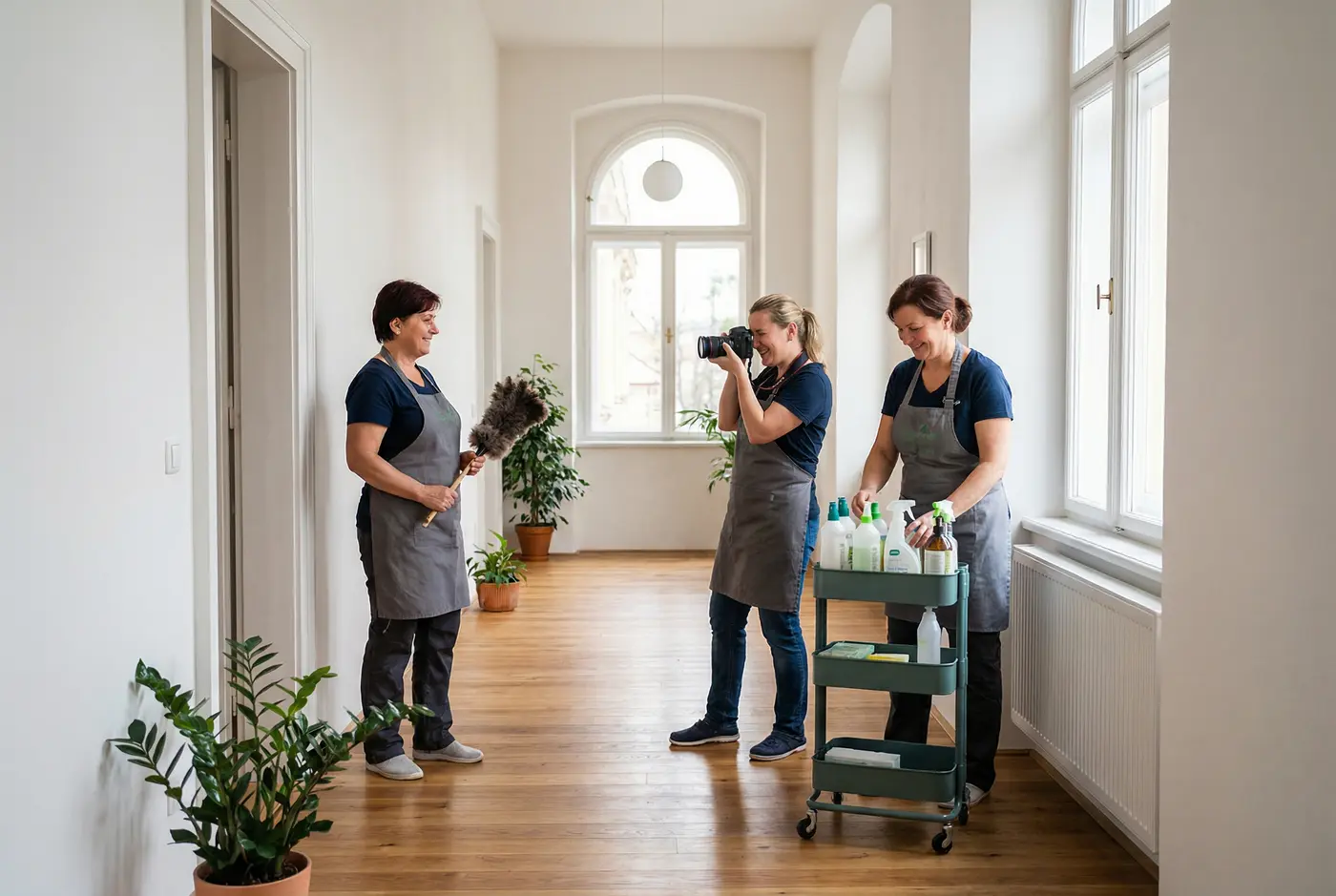
You do not need polished agency branding. A few honest, clean photos help a lot though. Your equipment. A neat supply shelf. A properly cleaned bathroom. Your car with supplies. Maybe a respectful work photo that feels real instead of stock. Those details lower anxiety for new clients.
Show a clear price list and what is included
Clients accept higher pricing much more easily when they understand what they are paying for. A short, readable price guide works better than 'price on request'. That phrase looks flexible, but in practice it often invites suspicion or pushes the whole conversation toward discount hunting.
State your service area
If you only work in Prague 4 and Prague 10, say it. If you cover Brno city and only go further for larger jobs, say that too. It saves time on both sides.
What the client is really buying
When somebody books regular cleaning, they are not really buying shiny taps. They are buying relief. They are buying the feeling that Friday afternoon will not disappear into vacuuming and scrubbing. They are buying confidence that someone capable will arrive, understand the routine, and treat the home with discretion. Business clients buy predictability too. They want a kitchen or office that does not feel embarrassing in the morning.
Honestly, this is where many small providers undersell themselves. They talk about hours and square metres, but they never say the word value out loud. Value explains price far better than a defensive line about more expensive products. Products matter, sure. Reliability matters more.
How to get your first good clients and first reviews
Your first clients shape more than cash flow. They shape your standards. The goal is not to take everything at any price. It is smarter to find a handful of clients who want regular help, communicate fairly, and notice quality. Slower at the start, maybe. Healthier in the long run.
Asking for a review works best when you keep it simple and ask at the right moment. Something like: 'If you were happy with today, I would really appreciate two or three lines for my profile. It helps new clients know what to expect.' No awkward performance. No begging. Just ask while the result is still visible and fresh.
And one more thing. Do not build your first review base around clients who chose you only because you were the cheapest. They are rarely the people who value the work properly. Better to ask the young couple in a new Olomouc flat who are overwhelmed with work and a toddler, or the older client who wants weekly help and cares more about reliability than saving 100 CZK.
What to avoid if you do not want to stay the cheap option forever
- Do not stay vague. If the client cannot tell what you do, they compare price and nothing else.
- Do not hide every detail behind 'message me'. It slows everything down.
- Drop the apologetic tone. You are offering a service, not posting a plea.
- Do not take every booking just to fill the calendar. The wrong client can destroy both margin and energy.
- Do not wait to improve your presentation until the business is bigger. You need it most now.
Small cleaning businesses do not become the cheap option because they clean badly. They become the cheap option when clients have to guess who they are, what exactly they offer, and why they charge what they charge. That guesswork is expensive.
Conclusion: professionalism starts with how you show up
If you want your cleaning service pricing to make sense for both you and your clients, you need two things at once: sound pricing and a professional presentation. You do not have to look like a big agency. You do need to be clear, reliable, and specific. Show the real services, say where you work, use honest photos, and explain what the price includes.
A practical next step is to build an online profile on Cistý kout. Not an empty profile with only a name, but one with real services, photos, your address or service area, and a short human description of how you work. Once your first clients are happy, actively encourage them to add references and reviews. For small cleaning providers in the Czech market, that is often the point where pricing stops feeling like an apology and starts looking like professional value.