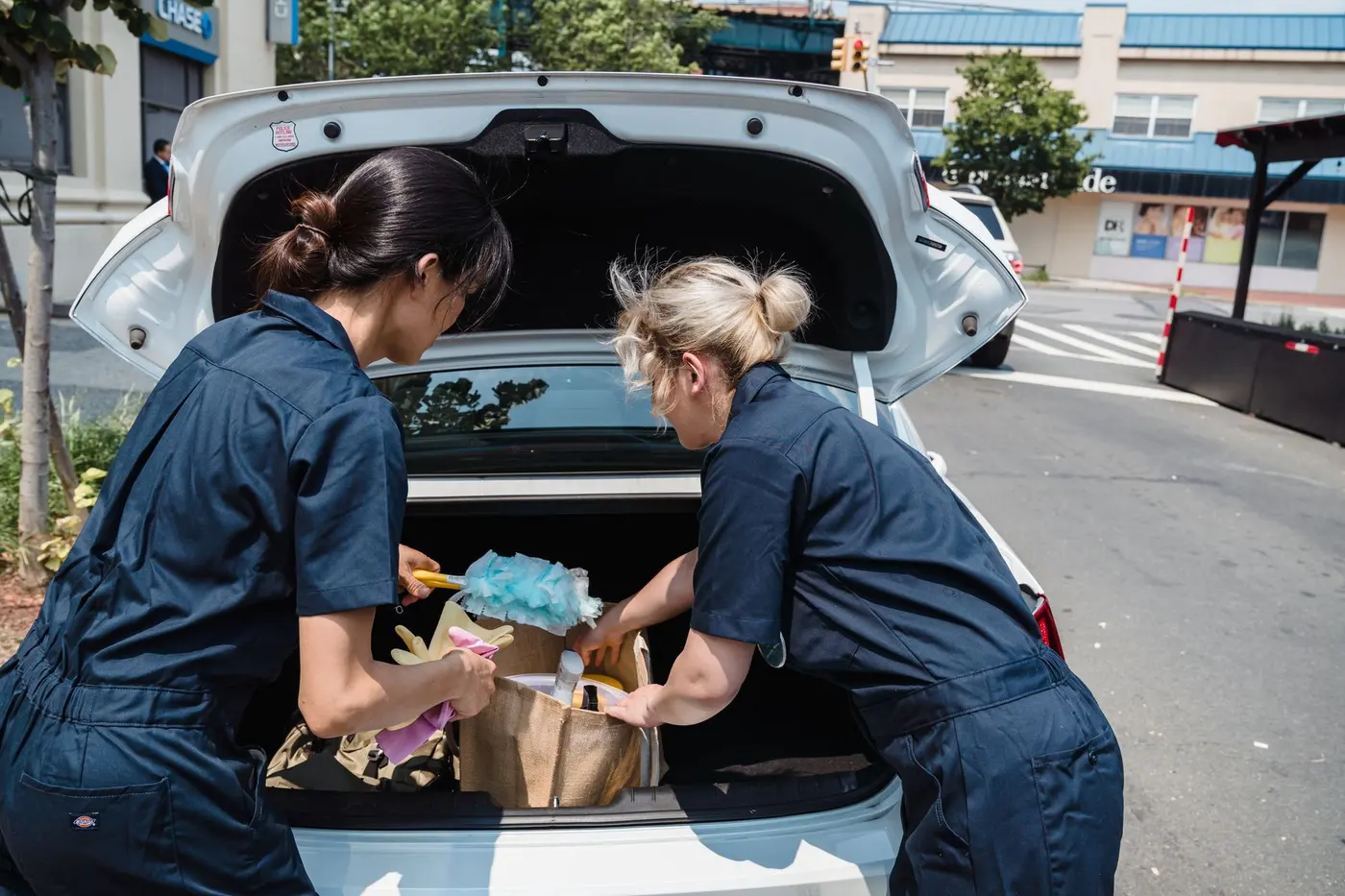
A full diary does not guarantee a good living. Clean in Zličín in the morning, Žižkov after lunch and Modřany late afternoon, and you may invoice seven hours while giving ten hours of your day away. Transfers, delayed trams, parking and carrying supplies eat the difference. Sensible cleaning route planning starts with one blunt question: what do I earn for the whole block, from leaving home to getting back?
Calculate your real hourly rate, including travel
For every booking, record the time you cannot sell as well as the time spent cleaning. Count the trip to the first client, travel between homes, parking, unloading, handover and the journey home. This is not bookkeeping for its own sake. It explains why a busy day can still pay badly.
Take two three-hour cleans billed at CZK 400 an hour. Revenue is CZK 2,400. The homes are 55 minutes apart, the morning journey takes 35 minutes, and getting home takes another 40. Add two ten-minute handovers. Your working block is eight hours and ten minutes, not six hours. The real hourly return before other costs is roughly CZK 294.
The calculation is simple:
(revenue - direct costs) ÷ all time tied to the jobs
Direct costs include fares or fuel, parking and supplies. Count stranded gaps too. An hour between clients is not leisure if you cannot go home or fit in another paid job.
Two short bookings on opposite sides of Prague are often the worst pairing. A three-hour clean in Dejvice and two hours in Háje look respectable on separate invoices. Together, they break the day. Crossing the city can take more than an hour, and a twenty-minute delay at the second key handover makes the gap useless.
Divide your map into service zones
Three practical layers work better than municipal boundaries. Your core zone contains places you can reach reliably and where you already have several clients. The edge zone is worthwhile only on certain days or for longer bookings. Everything else sits outside your normal range and needs special conditions, a different day, or a polite no.
A cleaner based in Prague 10 might put Vršovice, Strašnice, part of Vinohrady and Hostivař in the core zone. Dejvice is not far by kilometres, yet it may be effectively out of range during Tuesday traffic. Drivers must consider parking; public-transport users need to count changes and service intervals. The same logic applies outside Prague. Ten kilometres along a clear regional road may be quicker than four through central Brno.
Set a maximum door-to-door time between clients. I find 25 to 30 minutes a sensible starting point. It is not a universal rule. Someone carrying a heavy wet vacuum needs a tighter area than a cleaner using the client's equipment. What matters is writing the limit down instead of quietly stretching it whenever the phone rings.
Mark the zones on an ordinary map. Add practical obstacles to each address: resident parking, a fifth floor without a lift, a ten-minute walk from the metro, or a reception desk that releases keys only after nine. These details decide whether two jobs genuinely fit together.
Give each day one part of the city
Do not move recurring clients around the week as isolated appointments. Give them an area day first. Monday might be Prague 6, Tuesday Vinohrady and Žižkov, Thursday Prague 4. Only then choose exact times and frequencies.
A cleaner I know had a fortnightly Friday client in Karlín and two other households in Nusle. She accepted an apparently free Friday morning in Prosek for CZK 1,200. In practice, it added almost two hours of travel and blocked her from finding another Karlín client. She moved Prosek to Wednesday, when she already worked in Letňany. Same booking. Very different margin.
Leave 20 to 30 minutes beyond the expected journey between ordinary homes. That buffer absorbs a late tram, missing keys or a bathroom that runs ten minutes over. Without it, one small delay turns the rest of the day into apology messages.
Do not show a new enquiry every empty slot in the diary. Offer two times that support your route: “I work in your area on Tuesdays. I can come at 9:00 or 13:30.” The client still gets a choice, while you avoid creating a lonely Thursday trip. Use the same rule for rescheduling: find the next suitable area day, not merely the next open hour.
Set a minimum visit value without surprise fees
A short clean can require almost as much travel as a long one. A three-hour minimum or a minimum visit price therefore makes sense. Within the core zone, a minimum duration is usually easiest to understand. Clients know what they are buying and do not discover a transport charge after agreeing to the appointment.
A travel fee is fair when a booking creates an exceptional cost: a longer drive, paid parking or a town outside the normal area. State it before confirmation. For example: “I visit Říčany on Thursdays. For another day, the travel charge is CZK 250.” That is a clear condition, not a hidden extra.
Exceptions can work for a recurring client who fills a weak part of the day, or when you clean two flats in one building. One trip supports two paid jobs. A one-off two-hour clean outside town needs a higher minimum, a route-friendly date, or a courteous refusal.
Judge a job by profit, not revenue
Revenue of CZK 1,600 looks better than CZK 1,200. But the first job may involve 70 minutes of travel, CZK 120 parking, your own chemicals and half an hour of messages. The second may be in the next entrance after a recurring client. A profitable cleaning schedule depends on what remains after time and costs, not on the largest invoice.
For a quick decision, check:
- booking price,
- cleaning time,
- travel, waiting and parking,
- supplies and transport,
- administration before and after the visit.
A short fixed-time job outside your route is a warning sign. So is uncertain parking or an appointment that creates a ninety-minute hole in the middle of the day. Offer your area day, a minimum duration, or a price that covers the real commitment.
Sometimes the right answer is no. Keep it factual: “I do not currently have another booking near you, so I could not offer a reasonable price. I can recommend a colleague who works locally.” A useful referral builds a better reputation than arriving late and exhausted after crossing Prague twice.
Start with a spreadsheet; add software when needed
A spreadsheet is enough at first. Record the address or district, frequency, usual day, duration, price, travel from the previous job, plus notes about parking or keys. Add the real hourly return. After two weeks, you will see which clients hold the schedule together and which create expensive holes.
Review the next fortnight every Friday. Look for journeys beyond your limit, isolated addresses and gaps you cannot sell. First, offer recurring clients a stable route-friendly time. Then place new enquiries into the clusters that remain.
Software becomes useful when you assign work to several people, reschedule frequently, or can no longer see who has the keys and equipment. Until then, a colour-coded calendar and honest travel minutes are often clearer. Cleaning business route optimization is not primarily a technology problem. It is a rules problem.
Try it for one week. Total all paid hours and all travel. Then move one appointment so it follows another in the same district. Saving even 45 minutes a week adds up to dozens of hours a year - time you can sell, rest, or simply avoid spending on a tram.
If you are looking for a Prague-based cleaning option rather than building the route yourself, send ČistýKout a no-obligation enquiry through the contact form.