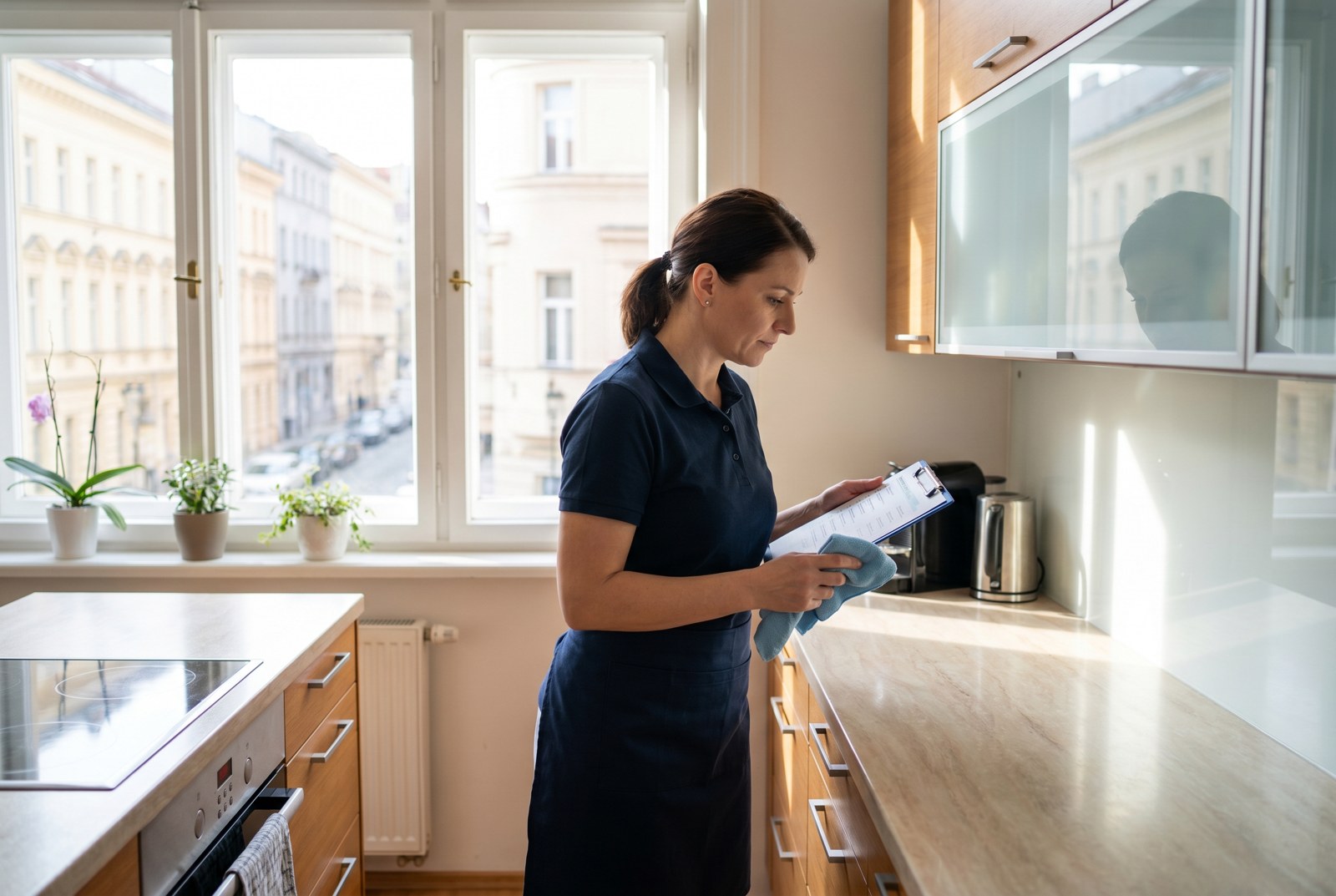
Cleaning service complaints rarely start with a dramatic failure. Most of the time, the trigger is something small that stayed visible after you closed the door behind you. A water mark on the tap. Crumbs along the skirting board. A streak on the mirror. One hair behind the bathroom bin. To the cleaner, that can look minor. To the client, it becomes the final memory of the whole visit. Anyone who has done apartment cleaning around Prague for a while has seen this pattern more than once.
That is why a short exit routine matters. Not a big training manual, not another spreadsheet nobody opens, just a post-cleaning checklist that catches the obvious misses before the client catches them first. For sole traders, that routine often means fewer evening messages, fewer refunds, and fewer awkward return visits. For small teams, it is also the only reliable way to keep the same standard across different people.
Why complaints often come from a small detail, not a major mistake
When a client says they were unhappy, they usually do not mean you failed to do most of the job. More often, the problem is a mismatch between the agreed scope and the client's picture of what "finished" should look like. You may be thinking about surfaces, bathroom fixtures, floors, and a tidy reset. The client is looking for a flat with no visible streaks, no dust line in the corner, and no fingerprint on the light switch.
That is not unfair. It is how people judge service quality. They do it through visible signals. In smaller Prague flats, especially in neighbourhoods like Karlin, Vinohrady, or Letna, those signals stand out fast. A studio is quicker to clean than a large apartment in Dejvice, but it also leaves nowhere for a missed detail to hide. If the counter shines and the corner by the radiator still looks dusty, the client does not think about the ninety-nine things that were done right. They think cleaning quality control probably never happened.
The repeat offenders are predictable:
- taps and dark fittings that show dried water marks immediately
- corners under beds, side tables, and sofas
- switches, handles, fridge doors, and cupboard fronts
- crumbs near plinths, under the dining table, and along the kitchen edge
- hair in the bathroom around the washing machine, shower, or bin
I keep coming back to one simple truth here. Clients rarely remember the hard part of your effort. They remember what they saw last. That is why closing the job properly is not an extra courtesy. It is part of the service itself.
The pre-departure checklist that saves stress and money
A useful post-cleaning checklist has to work on a real day, not in a workshop. If it is too long or too clever, nobody will follow it on the fourth booking of the day. A solo cleaner can carry it as habit. A team needs one shared version on a phone note or internal checklist so the standard does not quietly change depending on who is tired, rushed, or new.
Critical points by cleaning type
On a regular maintenance job, the client is usually looking for consistency rather than miracles. They want the home to feel reset and properly finished. Before packing up, I would check:
- kitchen worktops and the lower edge of the counter
- sink and tap against the light
- the bathroom mirror
- the outside of the toilet, flush button, and tiles around the base
- the walking path from the entrance into the main room, where marks show first
- bins and the floor around them
Deep cleaning is different. So is a first visit. The price is higher, the expectations are sharper, and clients pay more attention to corners, glass, and anything that looks rushed. The same goes for end-of-tenancy work, post-builder dust, or flats that were left in a rough state.
In those jobs, I like a doorway pause in every room. It sounds basic, but it works. Step into the doorway, stop for a second, and let your eyes scan the room as a client would. That distance shows things you miss up close: a crooked bath mat, a cloth left on the radiator, streaks on a glossy cabinet, or a faint mark on the mirror.
A fast room-by-room visual routine
My sequence is plain: high, eye level, low, then one step back to the door.
- High - shelves, appliance tops, shower frames, upper cupboard edges.
- Eye level - mirrors, glass, taps, doors, handles, switches.
- Low - skirting boards, corners, around the toilet, under the table, under the sink.
- Step back - overall look, smell, footprints, and whether the room feels finished.
That is cleaning quality control in its most practical form. Nothing glamorous, which is exactly why it survives daily work.
What to check before packing your own gear
A surprising number of cleaning service complaints begin after the cleaning itself was fine. The vacuum knocks the frame. A bottle drips near the entrance. A damp mop leaves a line in the hallway. A cloth gets left on the window ledge. Suddenly the client remembers the exit, not the clean.
Before leaving, make sure:
- no cloths, bottles, or tools are left behind
- there is no wet mark near the entrance or hallway
- windows and lights are left as agreed
- chairs, bins, and moved items are back in place
- you can summarize the completed scope in one sentence
If your business also offers regular home cleaning, keeping the same closing routine every time helps clients connect your service with consistency, not just effort.
When and how to use cleaning photo documentation without losing trust
Cleaning photo documentation can be genuinely helpful, but only when it is handled with tact. If someone starts taking photos in a private home without explanation, the atmosphere changes immediately. Used properly, though, a few clear before and after shots can save you from a pointless dispute.
I would seriously consider photos when:
- the client is away and will review the result later
- it is a first job after a bad experience with another provider
- the flat was heavily soiled or neglected
- the booking involves deep cleaning or post-renovation cleaning
- several cleaners worked on the job and you need a clean handover record
The best approach is to say it in a normal way: "I'll take a quick photo of the kitchen and bathroom for internal quality tracking, so we have a record of the final condition." No legal tone. No drama. Most clients accept that when the reason sounds operational rather than defensive.
Boundaries matter. Do not photograph documents, family photos, laptop screens, medication, or anything unrelated to the cleaning result. The frame should be about the cleaned area, not the client's private life. In a small apartment that takes some discipline, but it is worth it.
Storage matters too. If a sole trader keeps job photos mixed in the same gallery as family weekends and supermarket receipts, those images become useless when a complaint comes in three weeks later. A simple naming pattern is enough: date, address or internal code, room, before or after. Cleaning photo documentation should feel like process hygiene, not evidence you are preparing against the client.
How to close the job professionally without making it awkward
This is where the emotional tone of the whole service often gets decided. You can do solid work and still weaken the result by ending with a vague "okay, we're done" and walking out. It makes a paid service sound unfinished.
The handover does not need to be long. One calm minute is usually enough.
Say clearly what was completed. For example: "The kitchen and bathroom are done, floors were vacuumed and mopped, surfaces were wiped, and rubbish was taken out. We only cleaned the oven exterior today, as agreed." That last part matters. It reminds the client of the agreed scope without sounding defensive.
Then invite a small correction while you are still there. I would not ask, "Was everything okay?" It sounds hesitant and often gets a vague answer. Better: "If you want, we can do a quick walk-through now and fix any small detail straight away." That gives the client a safe opening to mention something on the spot, not later in an annoyed message.
I also would not leave without some form of confirmation. It does not need to be formal. A verbal okay, a short text, or a quick message after departure is enough if the client was not home. Say what was done, when you finished, and attach two or three images if that fits the arrangement. Client satisfaction in cleaning often improves simply because the service feels properly closed.
What to do if a complaint still comes in
Even a strong routine will not remove every complaint. Real homes are messy, expectations vary, and some misses are simply human. The important part is how you respond first.
Start by separating a clear complaint from a vague one. A valid complaint is specific: streaks on the mirror, grease on the hob edge, dust on the skirting board. A vague complaint sounds more like "I expected better." Fine. Then your job is to ask for the exact area and keep the tone steady.
The worst first move is a defensive explanation. Parking in Zizkov was bad. There was too much to do. Someone on the team was ill. The apartment was in a terrible state when you arrived. Maybe all of that is true. It still does not help in the first reply.
A better response is short and practical: thank them for the message, ask for a photo or exact location, and offer a correction if the miss is real. Something like: "Thanks for letting me know. Please send a photo or the exact spot so I can check it. If we missed something, we'll come back and fix it." That sounds human. It also sounds professional.
When is a quick correction worth it? Almost always, if the issue is small, clear, and the client is otherwise reasonable. One extra trip across Prague usually costs less than a bad review or a lost recurring booking. The line is somewhere else: when the complaint expands into extra unpaid work, arrives long after the visit, or tries to redefine the original scope.
If I had to reduce the whole article to four final checks before leaving a flat, it would be these:
- finish the small visible details, not just the big surfaces
- leave no trace of your own tools or last-minute mess
- close the scope clearly with the client
- know when photos help, and when privacy matters more
If you want a Prague-based cleaning option that takes this kind of process seriously from the first message to the final handover, you can contact the Cistykout team here.