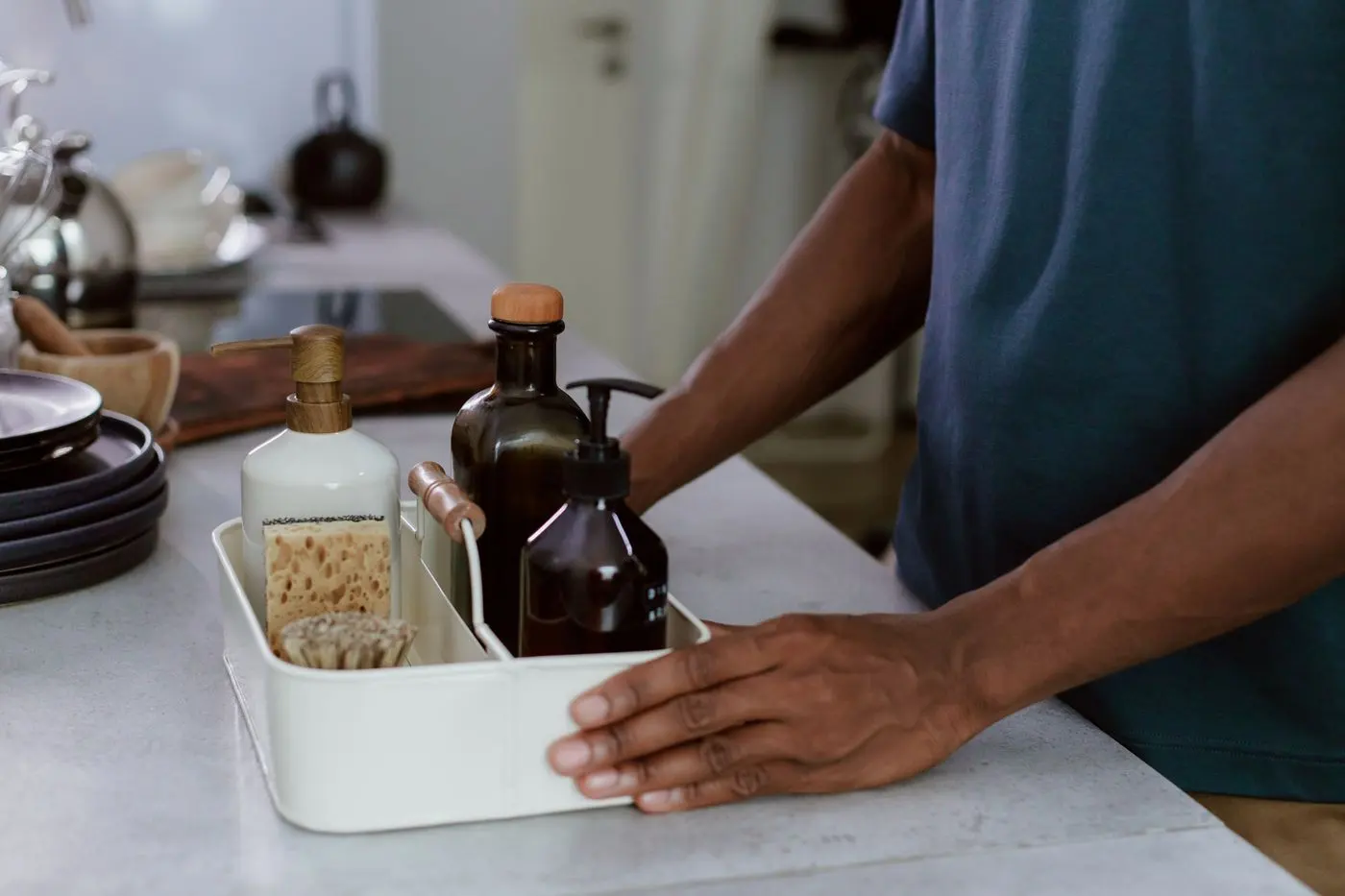
Cleaning supply organization tends to fail for a very ordinary reason: the spray is in the utility cupboard, the cloth is drying on the balcony, and the crumbs stay under the table because nobody wants to hunt for the right tool. In a 55-square-metre Prague flat, the distance sounds trivial. At seven in the evening, with dinner on the hob and a child asking for help, four metres and two cupboard doors are enough. A small cleaning station puts the basics where the mess happens. It is a practical version of “clean as you go”, without turning your fridge into a weekly timetable.
Why a few metres decide whether you clean now
People rarely leave spilled coffee because they do not know how to wipe it up. The delay begins with a search. Where is the clean cloth? Did somebody leave the spray by the bath again? Once the bucket has to come out from behind the vacuum, the job starts to feel like Saturday work. By Saturday, one mark has become three dried ones.
I use “maintenance” for the little jobs that stop dirt getting established: fresh grease off the hob, water off shower glass, grit caught at the door. It isn't a miniature deep clean. Our guide to what regular cleaning includes draws the line in more detail. Some of these jobs take 30 seconds, some take five minutes. The useful bit is timing. Wet coffee comes off; old coffee needs persuasion.
A couple in Žižkov showed me their cleaning cupboard once. Nine products, beautifully lined up. The kitchen, where they cooked every night, had no clean cloth. We moved four useful things under the sink and left the impressive collection alone. A week later, those four had done all the work. A station is a working minimum, not a second chemist's shop.
Do not build one for a job that happens twice a year. Window cleaner does not belong in every room, and one decent vacuum should remain shared. Separate kits make sense in the kitchen and bathroom, and often by the entrance. In a studio flat, the entrance and living area can share one closed box.
A kitchen station for grease, crumbs and spills
The kitchen kit fits in a low washable caddy. Keep two colour-coded cloths, washing-up liquid, a small brush for the fiddly area around the tap, and a hand brush with a dustpan. One cloth is for food-preparation surfaces; the other is for cabinet fronts or the floor. The colour distinction matters when you are moving quickly.
An all-purpose spray is optional. Warm water and a drop of washing-up liquid deal with most fresh cooking grease in my kitchen. But check the worktop first. Stone, lacquered wood and stainless steel have different care rules, and I've seen an over-strong degreaser leave a pale, dull patch. The bottle did its job; unfortunately, it also did a job on the finish.
Keep the caddy away from flour, children's snacks and pet food. A locked compartment under the sink can work. With a toddler or a cat that treats cupboard doors as a puzzle, I'd choose a high cabinet instead. Chemicals stay in their original bottles. Cloths go back only after they've dried.
My after-dinner version is hardly a routine. Food goes away first. While the hob cools, I clear the obvious crumbs; then I wipe the splashes. Egg and tomato sauce are both far less stubborn now than they'll be on Sunday. A boiled-over pan still has to wait until the surface is safe to touch, of course.
A bathroom station for limescale and mould prevention
Drying does most of the useful work in a bathroom. Hang a squeegee inside the shower. Keep one microfibre cloth for taps nearby, plus a product suitable for the actual surface in a closed cabinet. Vinegar is not the answer to everything. Acids may damage natural stone, some grout and sensitive metal finishes.
After a shower, pull the squeegee down the glass and wipe the tap and the corner where water pools. It takes about two minutes. Prague's water can leave visible mineral deposits, so removing droplets before they evaporate reduces what you will have to scrub later.
Then ventilate. Open a window wide for a short time, or run a working extractor in a windowless bathroom. Leaving the door ajar after showering can also help when the layout and household safety allow it. Never squash a wet cloth into a closed caddy. Hang it to dry, or the “cleaning” station will soon smell stale.
Do not keep chlorine cleaner loose beside an acidic descaler, and never mix them. The combination can release dangerous gas. Most routine jobs need one correctly chosen product anyway. Mould that keeps returning is no longer a five-minute task; check airflow, seals and the possibility of a building defect.
An entrance and living room without tools everywhere
In a dry Prague July, shoes bring dust home from the tram. November adds wet leaves; winter brings road salt. A useful entrance kit is modest: a hand brush, an absorbent cloth and a lint roller if a dog or cat lives with you. The roller also works on a fabric bench or a coat before you go out.
Cleaning stations at home do not need to be visible. A narrow washable box in a shoe cabinet, or an opaque caddy on a high shelf, keeps a small flat calm. Only dry tools go inside. A damp rag beside shoes is a reliable way to create a bad smell.
The living room usually does not need its own chemical kit. A duster or dry microfibre cloth in the cabinet where you use it is enough. Share the vacuum, mop and bucket between rooms; duplicates take space and defeat the whole system. A handheld vacuum earns its place only if you use it nearly every day, perhaps for pet hair on the sofa.
When you come in, hang the coat, leave shoes on the mat and sweep visible grit. Stop there. You are not vacuuming the whole flat. You have caught the dirt at the door before socks carry it into the bedroom.
Safety for children, pets and sensitive surfaces
Convenience never outranks safety. In a home with children, a person with memory problems, or an animal that opens cupboards, store chemicals high up or behind a reliable lock. Match the child lock to the cabinet and check that it cannot be pulled off easily. The hand brush may stay close; the cleaner may not.
Decanting products into attractive anonymous bottles creates needless risk. If you need to store cleaning supplies near the job, keep the original packaging with its directions, warnings and information needed after an accident. Never use a drinks bottle. Do not pre-dilute a chemical unless its manufacturer explicitly allows it.
Separate incompatible products and check caps for leaks. Keep chlorine cleaners away from acids, including some limescale and toilet products. Do not store chemicals beside heat or in direct sunlight. A bulging or leaking bottle, or one with an unreadable label, should go through the municipality's hazardous-waste route.
Colour-coded cloths protect both surfaces and hygiene. Assign one to the kitchen counter, one to the bathroom, and another to the floor. Test a new product in a hidden spot first. With marble, wood, brass and screens, one minute spent reading the care instructions is worth more than a bottle that says “universal”.
A seven-day test: keep, add or remove
For the first week, buy nothing. Put the minimum in place and make a pencil mark each time something gets used. Mine would be on a scrap of old envelope taped inside the door; this doesn't need an app. Seven days later the pattern is usually blunt. An untouched brush goes back to storage. Three searches for a dry cloth means the station needs another cloth.
Keep one central stock for sealed refills and the odd deep-cleaning tool. That is where the window kit can live for eleven months of the year. Three big bottles of the same cleaner aren't a system; they're three big bottles taking up room. Only refill a smaller working bottle when the maker permits it and the label remains unmistakable. Often, the small original pack is the safer answer.
At night, pick the mess you'll be annoyed to meet in the morning. For me, that's grit in the hall. Somebody else will choose the greasy hob or wet shower glass. Set five minutes if a limit helps, and actually stop when the timer rings. The rest can wait.
After seven days, keep the stations that earned their cupboard space. Good cleaning supply organization may look rather boring. Fine. If you catch the spill now and keep Saturday morning free, the system is doing exactly what you hired it to do.
If the backlog is already larger, or you would rather begin with a professionally cleaned flat, send a no-obligation request through the ČistýKout contact form. ČistýKout is a Prague-based option for matching the cleaning to your home and the time you would rather keep for yourself.