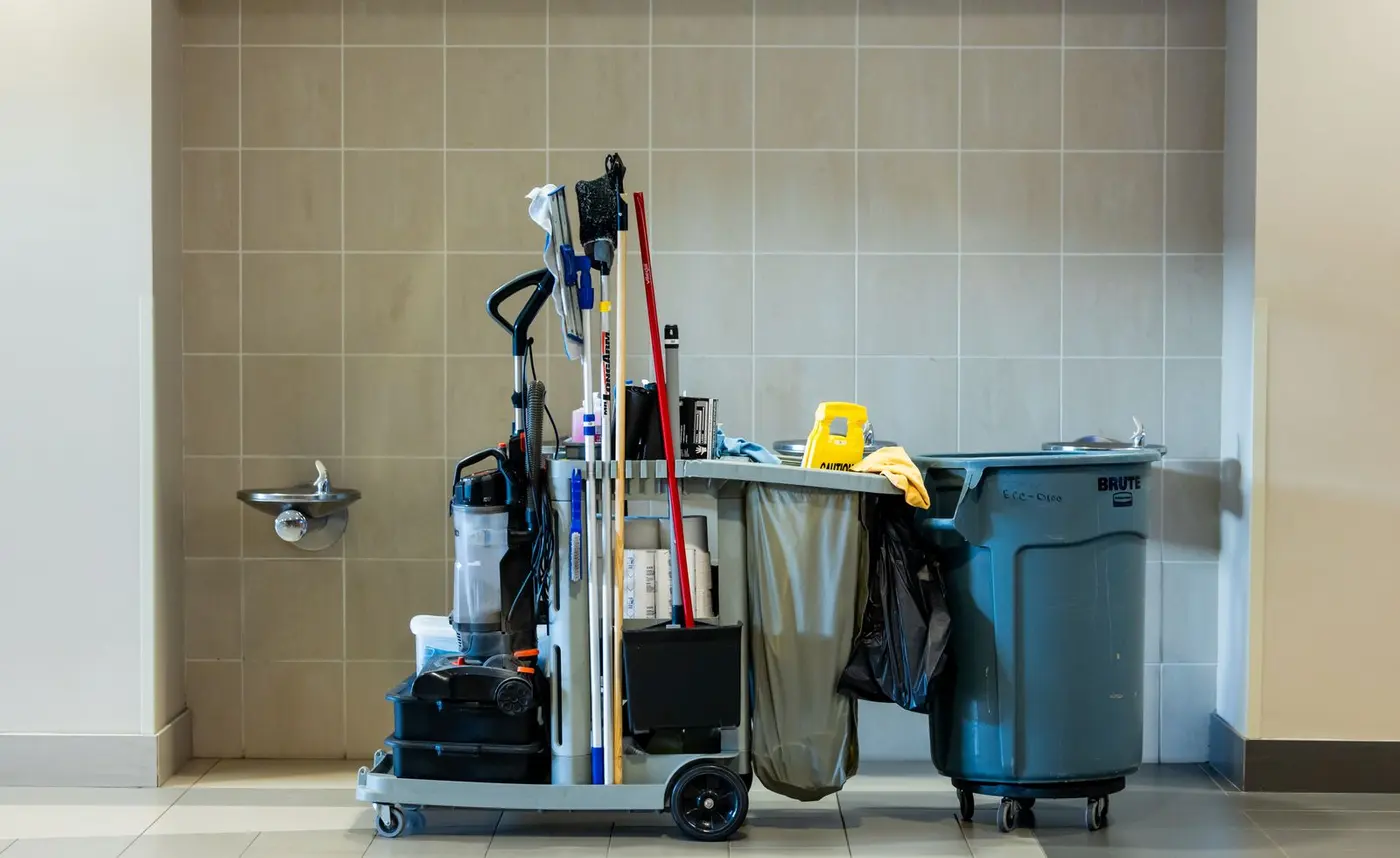
Your first set of commercial cleaning equipment should be chosen during the site walk-through, not while browsing a supplier’s catalogue. Picture a real job: a 180 m² office in Prague’s Smíchov district, carpet in the work areas, vinyl in the kitchenette, two toilets, glass doors, and service twice a week. This contract does not require a storeroom full of machines. It requires a reliable way to vacuum, mop, clean the washrooms, wipe touchpoints, remove waste, and leave every surface undamaged.
Plan the kit around the premises and scope
During the walk-through, record what needs cleaning, how often, and in what condition. “Office, 180 square metres” is not enough. Note the floor types and approximate areas, the number of bins and washrooms, the amount of glass, and access to water, sockets, lifts, and waste containers. A bin store across a courtyard and behind two locked doors can quietly add ten minutes to every visit.
Ask what the client already supplies. Some offices provide bin liners, hygiene refills, or even a vacuum. Others call a narrow shelf with no sink a cleaner’s cupboard. Put responsibilities in the quotation: who buys consumables, where supplies can be stored, and whether you must carry everything in and out. If you travel by tram or use a small car, transport is part of the cost, not an afterthought.
Separate routine service from periodic work. Vacuuming carpet twice a week belongs in the regular scope. Hot-water extraction twice a year is a different service, price, and equipment decision. The same applies to high windows, machine scrubbing, and floor-finish restoration. An occasional task should not force a major purchase before your first invoice has been paid.
If the contract is also your first step into self-employment, the guide on how to start a cleaning business step by step covers the wider setup around the job.
A basic kit must complete the whole routine service
For this office, I would want one compact set that covers every promised task. No returning the next day because the right brush was left at home. A sensible commercial cleaning starter kit includes:
- a dependable vacuum suitable for the carpet, plus a spare bag and filter;
- a flat mop, several clean pads, a bucket, and a wet-floor sign;
- a brush and dustpan, or a light floor set for local debris;
- colour-coded microfibre cloths, a glass squeegee, and a small detail brush;
- gloves, spare bin liners, and a closed box for transporting chemicals;
- a few products selected for the surfaces on this particular job.
Colour coding is not training-room decoration. Keep one colour for toilets, another for the kitchenette, and a third for desks, handles, and doors. A cloth travelling from a toilet to the microwave is not a minor saving; it is a hygiene failure and a fast way to lose trust. Apply the same separation to brushes and mop pads.
A realistic cleaning business equipment list also includes the boring backups: shoe covers for crossing a finished area, spare gloves in the right size, a working spray trigger, absorbent cloths for a spill, and a crate that will not leak in the car. An expensive machine rarely creates the strongest professional impression. Having a spare vacuum bag when the first one tears often does.
Buy a machine only when you know the paid-use count
Buying the wrong mop is annoying. Buying a machine whose payback depends on contracts you have not won is expensive. I use one simple test:
Uses to break even = total acquisition cost / saving per paid use.
The acquisition cost is more than the sticker price. Add the first accessories, consumable parts, likely servicing, and transport. To calculate the saving per use, multiply the minutes saved by your true hourly cost, then subtract consumables plus the time needed to set up and clean the machine.
A worked example, without optimistic maths
Suppose a compact floor machine and its accessories cost CZK 28,000. On a larger unit it saves 50 minutes. Your real hourly cost includes your pay, statutory costs, travel, and overhead; here it is CZK 420. The gross time saving is roughly CZK 350. Subtract CZK 70 for consumables, preparation, and cleaning the machine, leaving CZK 280 per use.
28,000 / 280 = 100 paid uses.
At one use a week, payback takes almost two years, before allowing for a breakdown or a lost contract. At four paid uses a week, it is closer to six months. That is why the same machine can be a sound purchase for one small firm and dead weight for another. Do not count “saved” time unless the new process genuinely reduces paid labour or creates capacity you can sell.
That saved time only helps when it is reflected in the quote. The follow-up guide on how to set cleaning service prices explains the choice between an hourly rate, a fixed fee, and pricing by area.
Renting or hiring a specialist may cost less than ownership
An extractor, rotary floor machine, or powerful wet-and-dry vacuum can be rented for occasional periodic work. Renting shows whether a machine suits your contracts, vehicle, storage, and physical handling. Do not make the client’s floor your first rushed practice run. Ask for operating instructions and test the process in an inconspicuous area.
Compare the full cost: rental, chemicals, deposit, travel to the hire shop, collection, cleaning, and returning the machine on time. A three-hour task can consume half a day once logistics are included. Even so, a one-off cost of perhaps CZK 1,500 or 2,500 may be healthier than tying up tens of thousands in equipment used twice a year. Treat those figures as an illustration and check current local prices before quoting.
For a risky surface, bring in a specialist. Natural stone, damaged PVC, old timber, or carpet with an uncertain fibre composition is a poor place to experiment. A specialist may charge more than machine hire, but you are also buying experience and, ideally, suitable liability cover. One damaged floor can wipe out the margin from many small office cleans.
Chemicals need a dosing system, not ten similar bottles
Beginner kits often contain a bottle for every imaginable purpose yet lack the correctly diluted neutral cleaner for the actual floor. A small office usually needs only a few compatible products: a neutral cleaner for washable surfaces and flooring, an appropriate washroom product, glass cleaner, and disinfectant if the agreed scope calls for it. Materials, manufacturer instructions, and the required result should make the decision.
Label each working bottle with the product name, dilution, and preparation date. A measuring cup or dosing cap costs little and prevents two common problems. A weak solution fails to clean; an overly strong one leaves residue, wastes money, and can damage the surface. Never mix unidentified chemicals or decant them into drinks bottles.
Keep safety information for the professional cleaning supplies you use, and transport liquids upright in a closed crate. A readable label, repeatable dose, and orderly box say more about professional practice than a boot full of half-empty spray bottles.
Adjust the kit after the first three visits
The first visit runs slowly because you are learning the keys, light switches, waste route, and best sequence. By the third clean, you have useful evidence. Record arrival and departure times, time by zone, what was consumed, what was missing, and what travelled with you without ever leaving the box.
Find one bottleneck. Did vacuuming around crowded desks take most of the visit? Did you redo glass doors because of streaks? Did the mop pads become saturated so quickly that the floor needed a second pass? Buy the next tool against a specific problem and an expected saving. A professional-looking box is not a business case.
I once saw a small operator arrive with a trolley full of chemicals and only two genuinely clean cloths. She did not need a steam machine. She needed more colour-coded textiles and a clearer laundry routine. It cost a fraction of a machine and shortened the next visit more than any flashy purchase would have done.
Your first commercial cleaning job should fund the next stage of the business, not a cupboard of idle machines. Buy the basics for the agreed routine service, rent specialist equipment first, and invest in ownership when paid-use data supports it.
If you would rather commission dependable office or small-premises cleaning in Prague, send ČistýKout a no-obligation enquiry through the contact form. The service and equipment can be matched to the actual premises instead of a generic package.