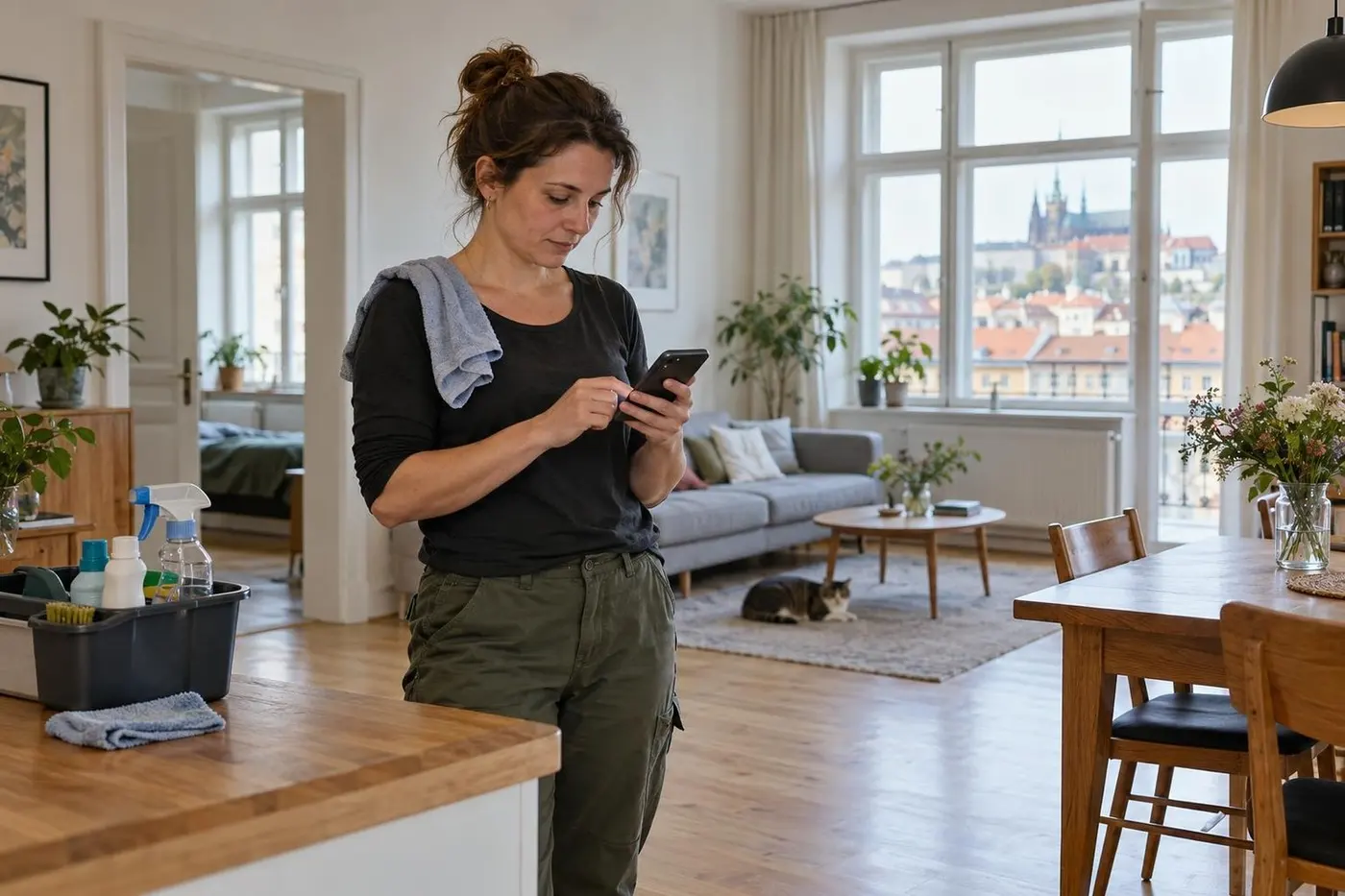
For EET 2.0 for cleaning services, the lazy rule of thumb - cash is recorded, bank transfers are not - is wrong. The new Czech system looks closely at where and how the client pays. A transfer made from the client's sofa after an invoice arrives may sit outside EET, while a transfer made on a phone beside the freshly cleaned kitchen can be a contact payment. In practice, I would start with one normal working day and map it payment by payment. Buying a new till comes later, if it is needed at all.
What is settled on 1 November 2026, and what still needs checking
Act No. 180/2026 Coll. was published on 7 October and takes effect on 1 January 2027. The Financial Administration keeps the official full text in its EET 2.0 document library. The Act defines a contact payment. For cashless payments, circumstances matter more than the method's label. Cash is stricter: it is recorded even without personal contact if it is qualifying business income and no exemption applies.
The official timetable marks 1 November as complete: EET functions are in MOJE daně and certificates can be generated. Free MOJE eet is scheduled for 1 December. Normal operation starts on 1 January. The Czech Financial Administration describes January as a project trial month, but the Act still takes effect that day.
Keep an eye on new worked examples and the version of MOJE eet released in December. Ignore advice written for the old EET. For vouchers, unusual deposits or intermediaries, use the official EET contact form instead of guessing.
Does EET 2.0 apply to your cleaning business?
Main or secondary self-employment does not answer the question. Neither does working alone or running a company. The Financial Administration's guide applies three tests: statutory form, business income and no exemption.
Regular paid cleaning is normally business income, whether the client is a Prague 4 family or a Karlín office. An invoice paid later without personal contact is remote. The same transfer made in front of you after the job is different.
Small size creates no general exemption. EET OFF is available to qualifying individuals in the first flat-tax band whose previous self-employment income did not exceed CZK 1 million and who register for a CZK 1,400 monthly surcharge. Ask an accountant to check your position.
Cash, card, QR and transfer: the payment setting decides
One Monday, a Vinohrady client pays CZK 1,200 in cash. In Holešovice, another scans a QR code from the cleaner's phone in the hallway. A third pays an emailed invoice at home that evening. Same service, different EET result.
Four ordinary payment situations
- Cash after the clean: record it, even if the client leaves it in an envelope, provided it is qualifying business income.
- Card or QR on site: record it. It happened during personal contact.
- Invoice paid later from home or work: current guidance treats this as remote and outside EET.
- Payment link after the visit: check the actual moment. Paying later without you present is remote; paying in front of you is contact.
A QR code is not automatically inside or outside EET. Scanning it from your phone in the hallway differs from scanning it from an invoice two hours later. Transfers and card gateways need the same factual check.
A short decision map
- Cash or another physical instrument? Record it if it is qualifying income without an exemption.
- Cashless during personal contact, at your premises or in your business vehicle? Record it.
- Remote from home or work with no personal contact? Usually outside EET.
- EET OFF, voucher, security deposit or intermediary? Check current guidance.
Deposit and balance
The word "deposit" decides nothing. CZK 500 sent from home before the appointment is remote; the same amount paid during an in-person survey is contact. Assess the balance separately.
For vouchers, prepaid packages and complex deposits, consult the official data-message examples. For a simple deposit, make sure the software does not count the same money twice.
Preparing in DIS+ without buying an expensive till
First, can you sign in to DIS+? The official setup guide lists Czech digital identity, eID, a data-box login and credentials from the Financial Administration. Activation can take 48 hours, or up to five working days for a taxpayer not yet in its records.
Inside DIS+, register for EET and create at least one recording unit. A solo cleaner without fixed premises may use the taxpayer herself, linked to her registered address. A company might also have premises, a website or vehicles. Each unit receives an identification number.
Next, generate the free till certificate through DIS+. It signs data messages and ties them to the taxpayer. Store it safely, set permissions for staff or the accountant, and never share the file or password in ordinary chat.
An expensive till is not compulsory. A phone, tablet, laptop or compatible till can work. The free MOJE eet application targets businesses with low transaction volume and no more than two recording units. Test it first if you take only a few daily payments. Several teams and an accounting integration may justify an updated commercial system.
After an internet failure, send the transaction without undue delay and no later than 48 hours. EET does not require a printed receipt, although other Czech laws may require a customer document.
What to change in the order, invoice and handover
Put the service, price, deposit, balance and payment method in the order, then repeat the same service name on the invoice and job list. EET does not receive a list of cleaned items, but your records must connect payment and job. Under Section 8, refund or correct an already recorded sale with a negative amount. Agree who checks payments, rejected messages and corrections. Tell the accountant whether a transfer happened in front of you or later against an invoice.
A November checklist for self-employed cleaners
- Review 30 days of payments: cash, cards, QR, on-site and remote transfers, deposits and balances.
- Add where the client paid and whether you were in contact. A bank statement will not show this.
- Check EET OFF eligibility with your accountant.
- Sign in to DIS+, activate EET 2.0 and check your identification data.
- Create the right recording units for solo work, premises, a website or vehicles.
- Generate the certificate and install it securely in the chosen solution.
- From 1 December, test MOJE eet with cash, QR, deposit, balance and correction scenarios.
- Write a short procedure for an outage and a mistaken payment. The 48-hour limit is the outer deadline, not the normal workflow.
- Book an accounting check for early January. The legal duty starts on 1 January.
The most useful change may be very small: after every job, note "paid on site" or "paid later against invoice". That fact will often matter more than the logo of the payment app.
If you are reading from the client's side and need a Prague-based cleaning option, you can send a no-obligation cleaning request through ČistýKout. Posting the request is free, and you can compare replies without committing to a provider.
Updated on 1 November 2026. This is a practical overview, not individual tax advice. Check borderline cases with your accountant or the Czech Financial Administration.