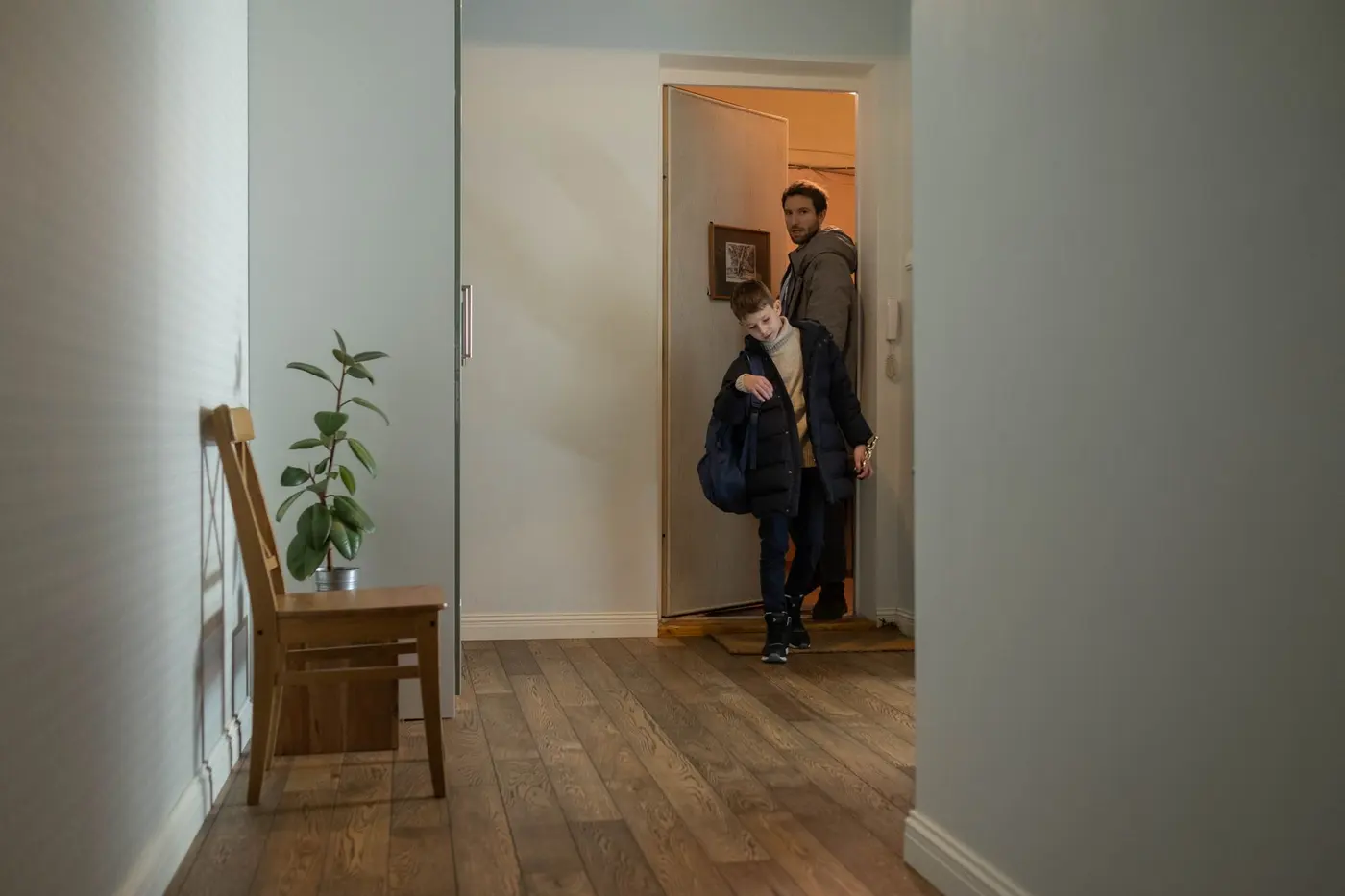
September puts entryway organization through a fairly unforgiving test. A child comes in with grit on both shoes, a damp sweatshirt, a backpack and a PE kit that should not stay zipped overnight. Then another child follows. No cabinet can fix that daily collision on its own. The useful part is the short route between the door and each item's place, especially on a Monday at 7:25 when nobody has time to think.
Why September clutter starts in the entryway
School brings a predictable load home five days a week. Outdoor shoes, indoor school shoes, coats and sports bags all arrive at roughly the same time. A Prague flat may have a hall of three or four square metres, even when the home itself has enough room for a family. Four people meeting by the front door can fill it in seconds.
People often blame the room. Sometimes they are right; a narrow panelák corridor will never hold a deep wardrobe. More often, nobody has decided where today's shoes belong, where wet clothes wait or where a form needing a signature should go. Everything lands on the bench. By Wednesday the bench is buried.
Dirt travels from there. Sand catches on socks. School-bag wheels cross the tiles. Mop a muddy patch before removing the grit and the floor gets a thin grey wash that reaches the kitchen. A sensible entryway cleaning routine starts with the route taken by shoes and bags, not with a bucket.
I once watched a Žižkov family search for keys in a hallway fitted with an expensive built-in cupboard. The storage was not bad. The children simply could not reach it, while opening two large doors during the morning rush was irritating. They moved two hooks lower and put a shallow dish beside the entrance. Most of the hunt disappeared. No extra storage was added.
Divide a small hallway into four working zones
Watch two ordinary arrivals before buying anything. Notice where shoes come off and where the backpack drops. The real movement through the room is a better plan than a showroom photograph.
Start with the shoes worn this week. In September, that might mean trainers and rain boots for one child, nothing more. An open shelf down by the floor is usually used more faithfully than a handsome cabinet with stiff doors. That is the awkward truth about small hallway shoe storage: counting pairs helps more than counting shelves. The party shoes can sleep elsewhere.
Next comes the wet patch. I would rather see two muddy shoes sitting openly in a rimmed tray than find them hidden, still damp, in a cupboard three days later. The tray should survive a trip to the shower for rinsing. Pull out soaked insoles, loosen the laces and leave a little air around everything.
Coats and bags take the wall. For workable school bag organization, I fit two hooks for each child: one takes the backpack, the other catches whichever coat or sports bag came home that day. Let the child choose the height by pretending to hang the bag. If an adult has to lift it into place, the hook has already failed. Full school bags are heavy, so use a fixing made for the wall rather than trusting the small screw supplied in a multipack.
Near the door, reserve a hand-sized patch for keys and access chips. School papers can stand in a narrow file with two plain labels, “sign” and “take”. I have tried the big-basket approach. It feels wonderfully forgiving for about four days, after which somebody has to excavate a permission slip from beneath batteries, receipts and a lone glove.
Stop sand and rainwater at the door
Use a coarse mat for stones and mud, then an absorbent mat for fine grit and water. If the shared corridor cannot take an outside mat, put a longer runner inside. A shoe needs two or three steps across it. Most tiny decorative mats barely touch the sole.
Vacuum both sides of the mat and check underneath for trapped moisture. Tiles are forgiving. Timber and parquet, common just beyond the hall in renovated Prague flats, are not. I learned to distrust the folded towel beneath wet boots. It soaks through, stays hidden and keeps the floor damp; a waterproof tray shows you exactly when it needs emptying.
Direct radiator heat once left a pair of our trainers with a lifting sole, so wet shoes now dry at room temperature. A wad of ordinary paper inside absorbs the first lot of water; when it feels damp, I swap it. Mud on leather comes off with a soft, barely damp cloth before the product recommended for that particular shoe.
Sand and water make horrible grey paste. I pick up the grit while it is dry, usually with the little vacuum kept near the door. Only the marks left behind get a damp microfibre pad, squeezed almost dry. That pad goes to the sink afterwards, not on a tour of the kitchen. I also measure detergent from the label now; a stronger splash made our tiles slightly sticky and they looked dusty again the next morning.
A five-minute evening reset the family can keep
Five minutes is a ceiling. If the job regularly takes fifteen, the arrangement asks too much and will be ignored by Thursday. Set a timer and split the work.
Clear the walking path first. Shoes return to the shelf or tray; coats and bags go on their hooks. Take the towel out of the swimming bag. Put the lunch bottle by the sink. Signed forms go straight into the correct backpack, while keys return to the dish. Use the last half-minute on the sand by the door.
A young pupil can manage shoes, coat and lunch box. An older child can check the timetable, pack sports clothes and vacuum the mat. Adults handle signatures, very wet items and cleaning products. That is enough. A long chore chart pinned to the wall usually creates one more thing to maintain.
After dinner works best in my home. At bedtime, nobody wants to walk back to the front door. Another family may prefer the moment they arrive. The exact time does not matter, but attach it to something that already happens daily.
Once a week I take ten extra minutes. The shoe rack gets vacuumed, the tray goes under the shower, and I wipe the skirting board and the grubby patch around the light switch. Then I look in the paper holder, because that is where next Tuesday's forgotten form will be. It is hardly a grand cleaning day. Good.
Change the system before scheduling another big clean
Do not tidy a familiar pile without asking why it chose that spot. Bags directly below the rail? A child probably cannot reach the hook, or the hook bends under the weight. Shoes wedged against a cupboard door? The shelf asks for an extra step at precisely the moment nobody will take one. If school letters spread over the cabinet every week, place the file there. Oddly enough, the pile has told you where the missing storage belongs.
Prague gave us sandals on one Tuesday and proper boot weather by Thursday. Both pairs earned their spot that week. The unworn shoes did not: we cleaned them, waited until they were dry, and moved them out of the hall. I found one pair with a split sole in the process. It went straight into a bag for the repair shop, because another six months in a box was not going to help.
Our coat rail gets a matching edit. Each person leaves out the jacket being worn and, if the forecast is grim, a rain layer. The winter coats can wait behind closed doors. Put them out too soon and the children cannot even see their own hooks.
There is still a place for professional cleaning. Once the family has moved its belongings, a cleaner can concentrate on the work that tends to be postponed: the correct treatment for the floor, marks on doors, skirting boards, handles, switches, an empty shoe cabinet and the dust above tall storage. Do not “clean for the cleaner”. Just clear personal items and mention any delicate finish or mark that needs attention.
My version of stop dirt at the door is not particularly glamorous. I keep fewer shoes out, put the children's hooks where their hands actually reach, tolerate one visibly wet tray, and spend five minutes resetting the space. Try your version for a school week. The bit that fails on Wednesday is the bit to alter.
If the hall needs a proper reset, or you would like it covered during regular home cleaning, Čistýkout works with households in Prague. The contact form accepts a no-obligation request; a short description of the floor and the family's daily traffic is useful.