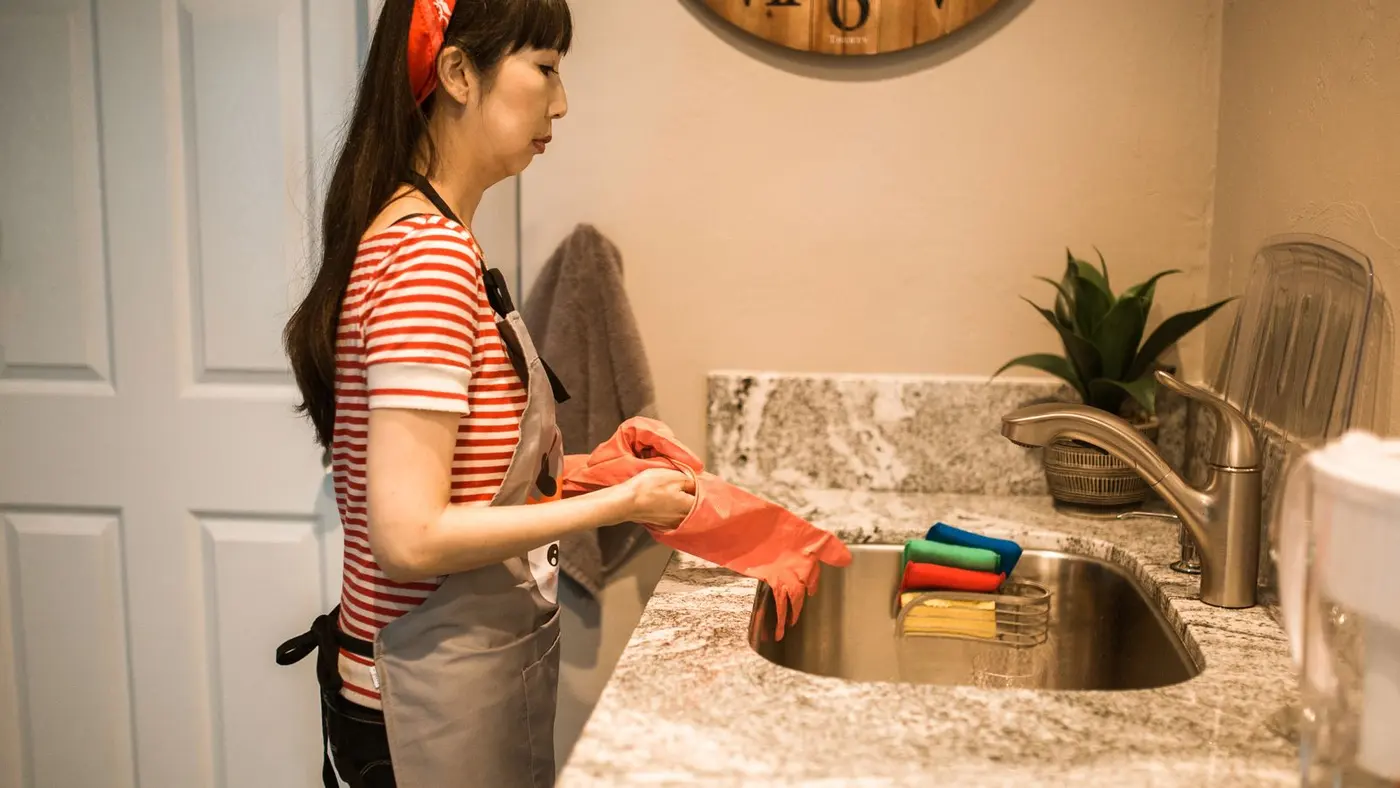
A client stops you halfway through the kitchen: "While you're here, could you quickly wipe out the oven?" That is how most extra cleaning requests begin. Not with a big argument about the agreement, but with a job that sounds like five minutes. A workable rule is this: treat it as a small courtesy only if the whole interruption takes no more than five minutes including setup and putting supplies away, carries no safety risk, does not happen repeatedly, and will not compromise the agreed clean or the next booking. Anything else needs a task swap, a paid add-on, or another appointment.
Five minutes is not a customer entitlement or a standing discount. It is an internal decision limit. A solo cleaner can make the call herself. In a small team, everyone needs to know what a cleaner may approve on site and when the owner must step in. Without that rule, each team member gives a different answer and a favour quietly becomes part of the cleaning service scope.
Sort requests into a courtesy, a scope change, or risky work
No cleaner wants to search through terms and conditions in the middle of a job. Put the request into one of three buckets instead.
A small courtesy is short, safe, and genuinely one-off. You might wipe two fresh drips from the fridge door, take a light rubbish bag out as you leave, or clean one empty shelf while the cloth is already in your hand. It stops being small if the bathroom is left unfinished, the final check is rushed, or departure slips.
A scope change is work that the customer did not book. Cleaning inside the oven or fridge, washing extra windows, ironing, or adding a room all belong here. The first glance may suggest ten minutes. It is still extra work. Agree on a task swap, a price, or a future date before starting.
Risky work never counts as a courtesy. That includes biological waste, a large patch of mould, blood, discarded needles, climbing on an unstable stool, moving heavy furniture, and using an unlabelled cleaning product. If a customer pulls an unlabelled bottle from under the sink and says it works on stone, do not experiment. Check the surface, product, equipment, and safe method first. Some requests should simply be declined.
Repetition changes the category too. Watering two plants once may be a favour. Doing it every visit makes it part of the service and the time belongs in the checklist. In my experience, repeated tiny tasks eat more margin than dramatic requests because nobody records them.
The five-minute rule also needs money and schedule limits
A stopwatch is not enough. A five-minute action may require a different product, clean gloves, a stepladder, or a trip back to the car. Count the entire cycle: collect the equipment, prepare the area, complete the task, put everything back, and inspect the result. A "quick" microwave wipe can become fifteen minutes once dried food is involved.
For a solo operator, I would use four conditions together:
- no more than five minutes from leaving the original task to returning to it;
- no unpriced materials or extra cost;
- no safety or hygiene concern;
- at least ten minutes of buffer before the planned departure.
Small teams need an approval limit as well. A cleaner might approve a one-time courtesy that uses no extra materials, while the business owner confirms all paid cleaning add-on services. This is not about distrusting the cleaner. It keeps her out of a price negotiation while she is wearing wet gloves and the customer is waiting for an instant yes.
Picture an ordinary Tuesday in Prague. The Vinohrady booking ends at 11:30 and the next flat starts at noon in Žižkov. At 11:18, the customer asks for four balcony windows. The glass itself may look like ten minutes, but plant pots need moving and the squeegee needs rinsing afterwards. There is no buffer. Saying "not today" protects the promise already made to the next customer.
Give the cleaner one sentence she can use without a confrontation
The worst answer is a hesitant "probably", followed by a check of time and price. The customer has already heard yes. Every qualification after that sounds like backtracking.
A team member can say:
> "I understand that you'd like the oven added today. It isn't in the agreed scope, so I'll send the request for approval of the time and price now. We'll let you know whether it fits today or needs another appointment."
A solo cleaner can use a shorter version:
> "I'll check the time left. We can either swap the oven for one of today's tasks, or I can confirm the add-on price and longer visit before I begin."
Both scripts acknowledge the request without promising the work. They also give the customer a next step. There is no reason to say "my boss won't let me" or blame a colleague. That weakens the team and makes a normal business rule sound personal. The customer is not difficult for asking. Trouble starts when the change goes ahead without agreement.
If the work cannot fit today, a plain reason is enough: "I would have to leave the agreed bathroom unfinished and arrive late for my next booking. I can note this for next time and have the price confirmed." Specific beats defensive.
The owner chooses between a task swap and a paid add-on
There should be three possible outcomes, not a blunt yes or no.
Swap work within the booked time
The customer wants the oven, but the visit cannot run longer. Offer a swap. Perhaps doors and skirting boards come off today's list, freeing that time for the oven. Say the trade out loud and record it. Otherwise the customer sees untouched doors that evening and assumes the service was incomplete.
Approve paid extra work
When the schedule has room, confirm the scope, estimated duration, and price first. For example: "Based on its condition, the oven should take 30 to 45 minutes and cost an additional 350 to 500 Kč. Can we extend the visit?" Do not promise one price before checking the burnt-on grease, racks, and surfaces. A surprise charge can turn good work into an avoidable dispute.
Move it to another appointment
Today's route has no slack, or the right product is not in the kit. Record the request and offer a date. Ten minutes between Holešovice and Dejvice can easily become half an hour in Prague traffic. One spontaneous extra then damages two bookings.
The order never changes: customer approval first, work second. Even a casual "do it and add something to the bill" is worth confirming in a short message. That leaves the price and expectation in writing.
Record every request before it becomes the new normal
Memory is not a system, even with only six recurring homes. The client record should show the date, exact request, approver, actual time, price, and outcome. One line can do the job: "20 Oct - customer requested oven interior; swapped for doors and skirting; 32 minutes; no surcharge; offer as add-on next visit."
After the second repeat, update the cleaning service scope. Add the task to the recurring checklist and recalculate the price, or label it clearly as an advance-booked extra. The second occurrence is a useful trigger because it separates an odd day from a new habit.
Every team member must see the note. A customer should not hear "that's only a tiny job" on Monday and "we don't do that" from somebody else on Thursday. Inconsistent answers invite negotiation and punish the colleague who follows the rule.
A simple change record needs six fields:
- date and address;
- original booked scope;
- customer's new request;
- decision: courtesy, swap, add-on, later date, or decline;
- approved time and price;
- note for the next visit.
An add-on price list for cleaning services shortens the discussion on site
A cleaning add-on services list does not need three pages. Start with what customers request most often: oven interiors, fridges, cupboard interiors, extra windows, ironing, or changing several beds. For each item, state what is included, typical time, a price range, and any conditions.
"Oven from 350 Kč" on its own can create trouble. A regularly maintained oven and one with years of burnt grease are different jobs. A clearer entry would be: "Oven interior including racks, usually 30 to 60 minutes, approximately 350 to 700 Kč depending on condition; book in advance." The customer can see why the price varies and the cleaner does not invent a number at the door.
Once a month, review all the courtesies you recorded. Add up the minutes and look for repeats. Twenty five-minute favours equal more than two unbilled hours. Microwave interiors, taking recycling to a distant bin, or watering plants may deserve a defined place on the menu. You may also decide that a few courtesies remain free. Fine. The point is to make that a business choice, not a reflex under pressure.
The final protocol comes down to five questions. Is it in the booking? Is it safe? Does the full interruption fit within five minutes? Can you still finish properly and reach the next client on time? Is it genuinely one-off? One "no" means pause, offer a swap, price, or future date, and record the change.
Looking for a Prague cleaning service with a clear scope and straightforward communication, and a practical way to find cleaning-business clients? Send Čistýkout a no-obligation cleaning request and describe what you want the visit to include.