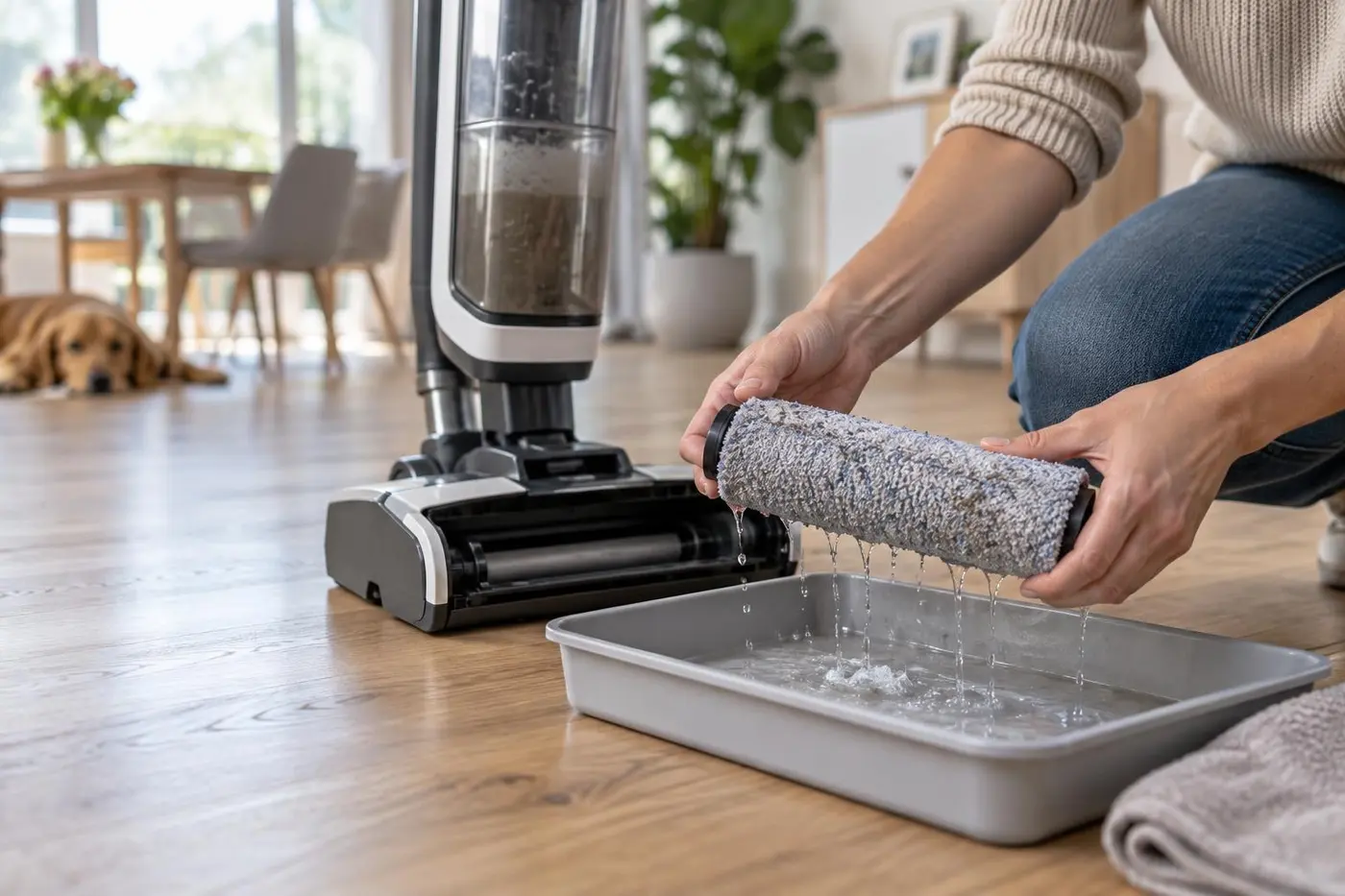
A sour, damp-cloth smell two days after mopping does not automatically mean the machine is faulty. In most cases, the missing step was a few minutes of manual care. Floor washer cleaning does not end when the self-clean button stops flashing. The programme rinses the areas reached by its water circuit; it cannot empty the dirty tank for you, pull hair from the roller ends or leave every wet part open to dry.
What a self-cleaning cycle actually does
Most vacuum mops run their self-clean cycle in the dock. The machine spins the roller, feeds in clean water and moves the resulting waste into the dirty-water tank. Some models flush part of the internal channel as well. Newer machines may add heated water or warm-air drying. That is genuinely useful. It just has limits.
A rinse is not the same as washing a part by hand, and neither guarantees that the part is dry. The roller surface can look clean while a loop of hair remains wound around one end and grey residue sits beneath the scraper. Meanwhile, the recovery tank holds water mixed with floor dust, kitchen grease, crumbs and whatever else the head picked up. I would not leave that mixture sealed overnight in an ordinary bucket. A plastic appliance tank is no different.
Manufacturer instructions make the boundary fairly clear. Kärcher tells FC 7 owners to wash the rollers after every use and gives the waste-water tank its own cleaning procedure. The Roborock Flexi manual covers the roller slot and dirty-water pipe as separate maintenance points. Treat self-cleaning as the start of maintenance, then follow the exact instructions for your model.
Five places that keep dirty water and debris
Start with the dirty-water tank. Pouring out the brown water does not remove the greasy film on its walls. Foam, lint and fine sludge collect beneath the lid. If the lid contains a float or debris separator, clean those pieces in the way the manufacturer allows.
Next is the roller. The broad face may look fine, so check both ends and the axle. That is where long hair and pet fur wrap tightly. The third spot is the scraper or roller cover. Its narrow edge gathers a grey paste that a brief water jet may not shift.
The filter and the space beneath it make the fourth area. Wet debris restricts airflow and can smell surprisingly quickly. Only rinse a filter if the manual calls it washable; paper and other non-washable filters need a different approach. Finally, inspect the accessible suction channel and the dock tray. A little cat litter, one strand of hair and a teaspoon of water are enough to create a damp pocket inside a closed machine.
I saw this in a Vinohrady flat where the floor looked good after every clean but the utility cupboard smelled stale. The owner ran self-cleaning religiously. He also left the recovery tank closed inside the machine, and the tray stayed wet beneath the roller. The smell disappeared after the tray was washed and the parts spent two days drying separately. No stronger chemical was needed. Neither was a new roller.
A five-minute routine after every use
Dock the machine and run its cycle in the order given in the manual. Some floor washers need enough fresh water in the clean tank; others ask you to empty solid debris first. A video for a different brand is not a safe substitute for the instructions that came with yours.
Once the programme finishes:
- Switch the appliance off and release only the user-removable parts shown in the manual.
- Empty the dirty water immediately, even after a short job.
- Rinse the tank, lid and washable separator with lukewarm water. Use the supplied soft brush for residue.
- Remove the roller. Pull hair and solid dirt from the ends, then rinse it if the manufacturer permits this.
- Wipe the scraper, accessible channel opening and dock tray. Keep water away from the motor housing and charging contacts.
- Leave the tank, lid, filter and roller open and separate. Reassemble the machine only when every part is dry.
For anyone searching how to clean a vacuum mop without dismantling the whole head, this is the practical minimum. You are not servicing the appliance after every pass. You are removing wet organic dirt before sealing it in plastic.
My low-tech check is to smell the clean roller before putting it back. If it is still damp and slightly musty, it stays out. Drying can be slow in a windowless Prague bathroom during a wet autumn week. Choose a ventilated place away from a hot radiator and direct sun; forced heat can affect glue, foam or the roller's shape.
The weekly check: roller, filter and edges
Once a week, or after an unusually messy job, spend another two minutes on the edges. Run a gloved finger around the inside rim of the cover. A slippery film means the quick rinse is not reaching everything. Hold a washable filter up to the light. If it remains clogged after the approved cleaning method, or the material has started breaking down, check the replacement interval in the manual.
The roller should be evenly clean, free of hard deposits and stable on its axle. Look at the rubber scraper too. A bent, greasy or clogged edge often explains streaks on matt tiles or vinyl. The motor may be working perfectly; the head is simply putting part of yesterday's dirt back onto the floor.
Restricted airflow can show up as a new noise, weaker water pickup or a wetter trail behind the machine. Check the filter, accessible channel and tank seating first. Do not poke a screwdriver or wire into narrow pipework. Manufacturers usually supply a brush or identify the safe access point. Anything behind a screwed cover belongs with a technician.
Why any old floor cleaner can cause trouble
Dish soap creates a remarkable amount of foam from a tiny dose. Inside a floor washer, that foam can confuse the level sensor, travel into an air path and leave sticky residue in the roller or pipe. Strong fragrance does not solve a hygiene problem either. After a few days, perfume mixed with stale water can smell worse than the original mess.
Use only a solution approved for the appliance and measure it as directed. Tineco, for example, specifies a compatible solution while its Floor One maintenance instructions still tell owners to clean and fully dry the dirty-water tank, filter, brush roller and roller cover after use. Compatible detergent never replaces rinsing.
Do not combine leftovers from different products. Vinegar, chlorine cleaners, disinfectants, essential oils and ordinary floor concentrates have not necessarily been tested with the pump, seals and plastics in your model. Keep them out of both tanks unless the manufacturer explicitly says otherwise. When changing between approved solutions, rinse the tank thoroughly with clean water first.
When a smell needs maintenance and when it needs service
A roller stored wet in a closed machine will often recover after a careful hand wash, complete drying and cleaning around the axle. Sludge under the tank lid is another common culprit. Clean every user-accessible part and leave the pieces apart for a day or two. If the smell goes, you have probably found the source.
Book service when the odour comes from the machine body after the removable parts are clean, inaccessible water remains inside, or the self-clean cycle no longer drains properly. Stop using the appliance if it leaks, knocks, overheats, smells burnt or repeats an error message. Switch it off, disconnect it from charging and contact an authorised repairer.
Warranty and electrical safety set a sensible boundary. Do not open the motor housing or back-flush internal pipes unless your manual explicitly shows that procedure. Home wet dry vacuum maintenance covers the tanks, roller, cover, accessible filter, scraper, dock and visible channel entrance. Screws, wiring and pumps are service territory.
The best defence against a smelly floor washer is wonderfully ordinary: empty dirty water now, never seal away damp parts, and inspect the edges that automatic rinsing misses once a week. Self-cleaning cuts the work. It does not remove the last few minutes.
If you would rather spend your time on something other than a full home clean, ČistýKout is a Prague-based cleaning option. Send a no-obligation enquiry through the ČistýKout contact form.