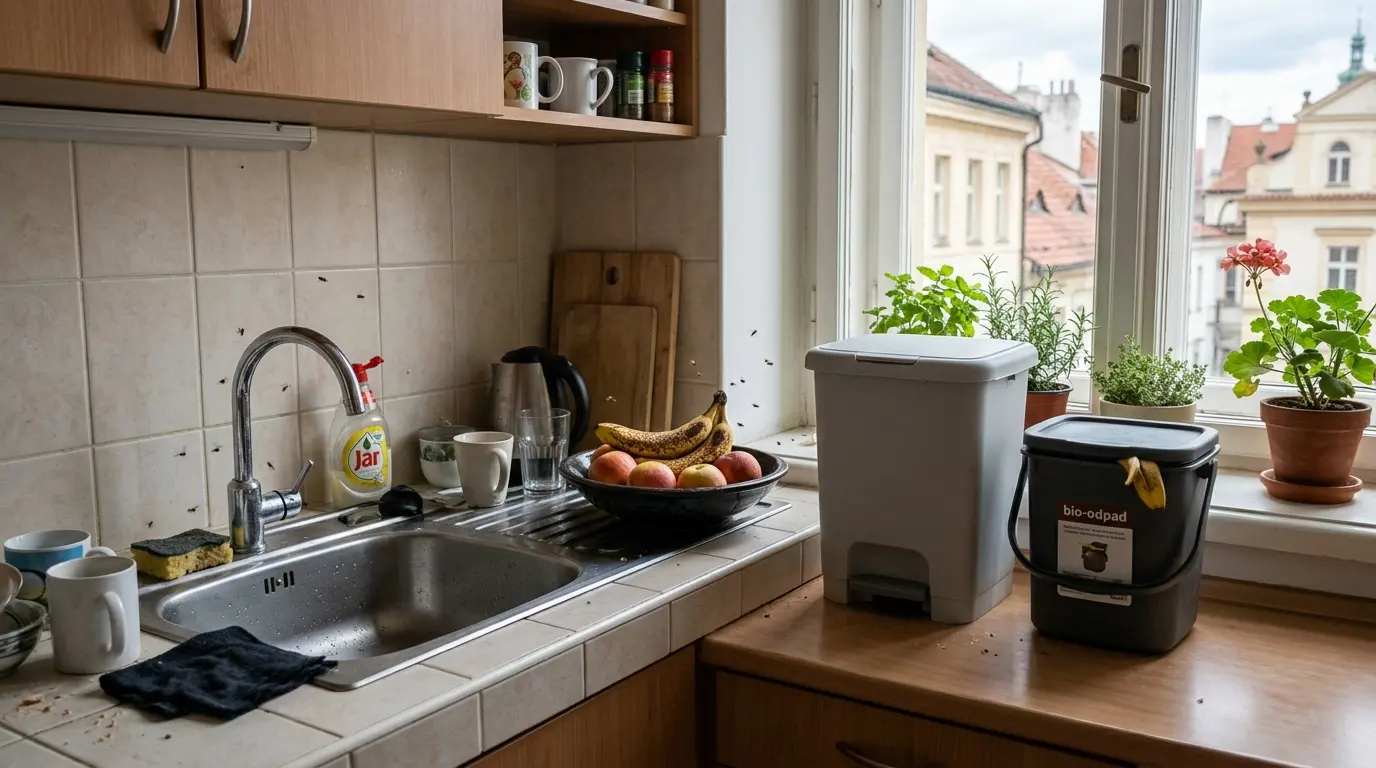
When you come back from a weekend away and find fruit flies in kitchen corners, the first instinct is usually a trap. Vinegar, a jar, a bit of dish soap, maybe one of those ready-made lures from the drugstore. Fine. Traps catch adult flies. They do not clean the sticky ring under the bin lid, the film inside the kitchen drain, or the one soft peach sitting behind the coffee machine. In Prague flats, especially in June and July, three closed days can be enough. A small bio-waste bag stays under the sink, the room warms up, and by Sunday evening the kitchen feels as if the problem arrived from nowhere.
First, separate fruit flies, drain flies, and plant gnats
Fruit flies are the small tan flies that gather around fruit, wine, beer, juice, tomato scraps, melon rind, and anything sweet that has started to ferment. If you open the bin and a small cloud rises from the lid, the source is probably the kitchen bin or food scraps. If they hover over a fruit bowl, start there. The fruit does not always look rotten. One split plum, a bruised banana, or juice at the bottom of the bowl can be enough.
Drain flies behave differently. They are often darker, slower, and a little fuzzy, almost like tiny moths. You see them near the sink, shower, floor drain, utility room, or a drain that has not been flushed properly for a while. In the kitchen this gets confusing because every tiny fly gets called a fruit fly. But if the activity is strongest around the sink in the morning, around the dish rack, or on the wall above the tap, a vinegar trap will not do much on its own.
Then there are fungus gnats from houseplants. They stay around damp soil, not fruit. In a small apartment, though, they can drift across the whole kitchen. Someone waters the basil heavily before leaving for the weekend, the soil stays wet, and by Monday the little flies seem to be everywhere.
The irritating part is that there may be more than one source. A food-waste bag starts the problem, the sink keeps it going, and a wet sponge gives the flies another damp place to sit. When is it no longer just a messy countertop? When the flies come back after the bin is emptied, when they sit on the drain, when they appear from under appliances, or when you also see them in the bathroom. At that point you need to inspect the kitchen like a small map, not buy another trap and hope.
What to check as soon as you get home
Start with the bin. Not just the bag. The whole bin. Take the liner out and check the bottom, the inner walls, the lid, the hinges, and the pedal area. Food-waste containers often hide the problem in the edge of the lid or the little groove where juice from cucumber, melon, or salad scraps has run down. It may not look dramatic. It feels sticky. For fruit flies, that is enough.
Next, check fruit, vegetables, bottles, and cans. A forgotten onion in the lower pantry basket, a soft potato in a paper bag, an unfinished can of radler by the sink, a wine bottle waiting for the glass container. These can cause more trouble after a weekend than a visible fruit bowl. Many people in Czech flats are good about recycling, but the empty packaging waits in a bag by the door or under the counter. If there is one sweet drop left inside, flies find it.
At the sink, look at the strainer, draining board, sponge, cloth, bottle brush, and the area behind the tap. A sponge left wet for three days is not just unpleasant. It is a damp little buffet. A cloth hanging over the sink edge, with water and crumbs underneath it, works the same way. Lift the dish rack rather than wiping only the top. Under the plastic tray there is often a thin slick film. It does not look shocking, but it keeps the kitchen attractive to small flies.
Then go low. The floor by the cabinets, the space under the bin, the plinth under lower cabinets, the gap behind the fridge, the corner by the dishwasher. This is where normal cleaning misses things: dried juice, a piece of fruit dropped by a child, a wet paper towel, crumbs stuck to the skirting board. I once saw a fruit fly source in a Vinohrady flat behind a freestanding microwave. It was not a horror scene, just a small piece of mandarin that had slipped there before the owners left. The traps on the counter were catching flies. The source sat thirty centimetres away.
Clean the kitchen so the flies have nowhere to continue
The order matters. Remove the food source first, then think about traps. If you begin with a trap, you feel as if you are doing something, but the source keeps working. Throw out suspect fruit, empty food waste, close bottles, rinse cans, and take recycling out. If you use a small compost container in the kitchen, do not just empty it. Wash it with hot water and dish soap, clean the lid and lower edge, then let it dry properly.
Wash the bin itself. Bottom, sides, both sides of the lid, the liner holder, and the floor underneath. If it smells, use a normal degreasing cleaner and hot water. On plastic bins, avoid unnecessarily harsh chemicals that leave their own sharp smell behind. On stainless steel bins, wipe the lower outer edge too. Juice from a weak bin bag often runs down there and dries into a sticky line.
Do not wipe the counter only where you can see it. Move items away. Lift the fruit bowl, coffee machine, storage jars, and knife block. Clean underneath. Wipe the front edge of the counter, the side of the cabinet near the bin, and the handles. If a sweet film remains, flies will keep landing and you will think the treatment failed.
Under appliances, take your time. Do not drag a heavy fridge across a delicate floor. But move a freestanding bin, small shelf, pull-out waste unit, or countertop microwave if you safely can. Vacuum dry crumbs first, then mop or wipe. Around the dishwasher and sink cabinet, check for leaks. Moisture alone does not attract fruit flies as strongly as sweet residue, but moisture plus dirt creates a place where the problem continues.
Traps make sense after this. They can reduce the adult flies that are already moving around the room. A jar with apple cider vinegar and a drop of dish soap, or a shop-bought trap, is not wrong. Just do not expect it to fix a dirty drain, sticky bin lid, or juice under the cabinet plinth.
Drains and the sink: when the problem sits below the surface
The kitchen drain is tricky because it can look clean until you shine a light into it or remove the strainer. Grease, crumbs, coffee grounds, and organic film stick to the walls of the pipe. With drain flies, that film is often where the next generation develops. If flies still appear near the sink after the bin is clean, take the drain seriously.
There are a few things you can usually handle at home. Remove and scrub the strainer. Clean the plug if you use one. Brush the accessible part of the drain. Flush with hot water. If the smell or flies continue, use an enzymatic drain cleaner exactly as directed. Be careful with strong chemical cleaners, especially in older apartment plumbing. Do not mix products. Pouring everything from under the sink into one drain is not thorough cleaning; it is a good way to irritate your eyes or damage the trap.
The sink trap is a separate issue. If you know how to remove, clean, and refit it properly, fine. If not, leave it to someone who has done it before. A badly fitted trap under the kitchen sink can cause a bigger problem than the flies.
How do you know the source is not really the kitchen? The flies gather near the bathroom drain, shower, washing machine, utility sink, or a rarely used drain. In a small flat they may still end up in the kitchen because that is where the light and food are. If activity is strongest by the shower or washing machine, clean those drains as well. Sometimes the source is a damp cloth behind the washer, a saucer under a plant pot, or the bathroom bin.
When to book a one-off kitchen clean
A one-off kitchen clean makes sense when several things are happening at once: a longer vacation, a smell, sticky surfaces, food waste, a dirty sink, the fridge, the floor under the counter, and a bin that needs more than a fresh liner. This is not a moral failure. In summer, a few closed days and one badly timed fruit scrap can be enough.
Booking help also makes sense when you do not have the time to inspect the kitchen properly. A trap takes ten minutes. Taking apart the draining board, washing the bin, cleaning under the cabinet edge, checking the fridge, wiping plinths, and dealing with the sink can eat half a day. That feels especially unreasonable when you come home on Sunday night and need to function on Monday morning.
When you send a request, avoid a vague line like “I need the kitchen cleaned.” Be specific: “After vacation we have fruit flies in the kitchen. Please clean the bin including the lid, the floor under the bin, the sink, draining board, counter, area around appliances, and the floor under the lower cabinets. The source may be food waste or the drain.” The cleaner then knows this is not just a surface wipe. It is a source hunt.
Čistýkout is a Prague-based option for requesting a one-off kitchen clean through the contact form. You will get a better match if you mention where the flies are most active, whether there is a smell, and what you have already tried. Leave the traps on the counter if you want. Just do not ask them to do the detective work. That part still belongs to a person, hot water, a cloth, and some patience.