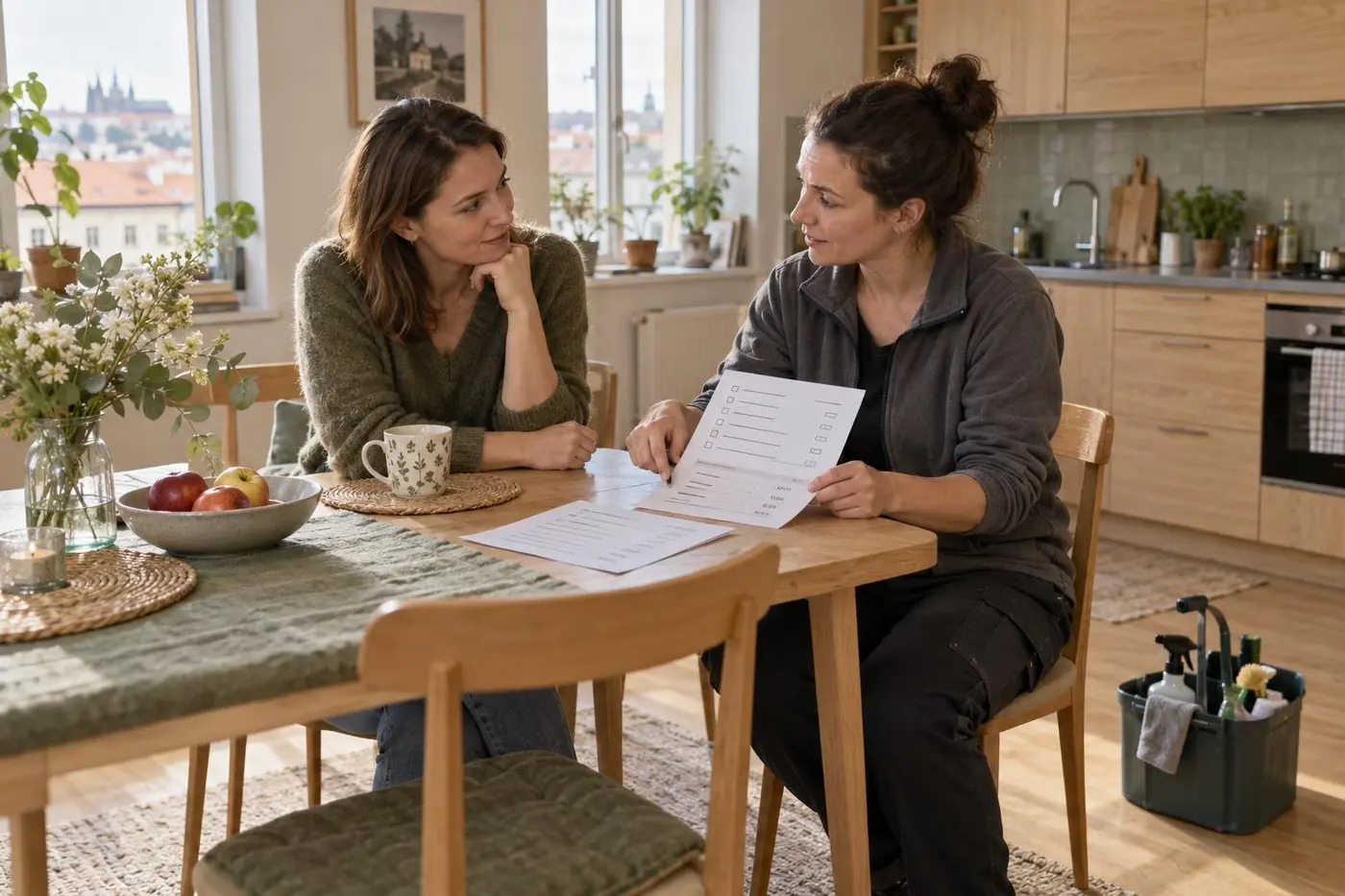
An hourly rate for house cleaning can be perfectly fair. So can a flat price. Trouble usually starts because the client and cleaner have pictured different outcomes, not because one pricing model is dishonest. One person expects the whole flat to be finished; the other has agreed to three hours of ordinary work. Before the first visit, confirm more than the number. Agree on the scope, the add-ons and what happens if the work takes longer than expected.
What are you actually buying: time or a result?
With hourly billing, you buy labour time. If the agreed rate is CZK 400 per hour and the cleaner stays for three hours, the basic charge is CZK 1,200. That calculation does not promise two bathrooms, a kitchen and every floor. The task list has to fit inside the booked time.
A flat price reverses the arrangement. You buy an agreed result, such as a routine clean of a one-bedroom flat covering the bathroom, kitchen surfaces, vacuuming and mopping. As long as the home matches the information supplied for the quote, the provider carries the risk of how long the work takes.
This is why the lowest hourly figure does not always produce the lowest bill. One cleaner may work alone while another sends a two-person team. One brings suitable products and follows a settled routine; another spends part of the visit finding equipment. Comparing CZK 350 per hour with a flat quote of CZK 1,600, without an estimated duration or matching scope, is like comparing a taxi's per-kilometre rate with the price of the entire journey.
Condition matters as much as size. A regularly maintained 55 m² flat in Vinohrady is not the same job as a flat of the same size after a move in Žižkov. Grease above the cupboards, limescale in the shower or hair from two dogs changes both the time and the products needed. A serious quote asks about those details.
When an hourly rate is fairer
Hourly billing works well when nobody can estimate the job responsibly yet. A first visit after a long gap is one example. A short pre-guest tidy-up is another. You can say: "We have three hours. Please start with the bathroom and kitchen, then do the floors. Anything left can wait until next time."
That protects both sides. The cleaner is not promising an unseen result, and the client controls the upper limit. Without a time cap, however, an hourly rate is only an open-ended multiplication. Ask whether the figure is per cleaner or per team, whether there is a minimum visit and how partial hours are rounded.
Priority order matters. "Clean the whole flat" is not a useful brief. Split the work into:
- must be finished today,
- do this if time remains,
- leave this for another visit.
I once saw a first clean in a two-bedroom Nusle flat go wrong in a very ordinary way. The client expected the bathroom, kitchen, floors and two shirts to be ironed. The cleaner began with the oven because she understood it as part of the kitchen. Two hours later the oven looked excellent, but the living room was untouched. Nobody had cheated. They simply had not agreed on priorities.
Hourly charging also suits a household that wants to change the mix from week to week. You might add ironing once and request extra bathroom time on the next visit. After a few appointments, the normal workload becomes clearer. Before the first booking, this guide to how long apartment cleaning realistically takes can help you set the time cap. You can then keep the hourly arrangement or ask for a stable flat price.
When a flat cleaning price makes sense
Flat rate house cleaning is easier when the same scope repeats and the home's condition remains broadly stable. With a weekly visit, the routine soon becomes predictable: one bathroom, kitchen surfaces, reachable dusting, vacuuming and mopping. The client knows the result; the provider knows the real workload.
It can also work for a one-off clean after a viewing or a detailed set of photographs. For a deep clean, one tidy photo taken from the living-room doorway is not enough. The quote needs to account for the oven, shower screen, grout, windows, cupboard tops and any heavy deposits. Photos are not an inspection of the client. They prevent a price negotiation on the doorstep.
A fixed amount needs a fixed description. The written quote should name:
- the rooms and surfaces included,
- the tasks included in the price,
- the exclusions,
- whether travel and supplies are covered,
- the circumstances in which the price may change.
"Flat cleaning for CZK 1,800" is still only an estimate if the scope is missing. "CZK 1,800 for the listed routine clean of a one-bedroom flat, excluding windows, oven interior and ironing" is something both sides can check. If the actual condition is far heavier than the photos suggested, a revised charge may be reasonable. It should be approved before extra work begins, not revealed on the invoice.
Common add-ons: windows, ironing, ovens and heavy soil
Routine cleaning usually means maintenance work on accessible surfaces. Windows, the inside of an oven, ironing, blind washing and old grease deposits take different amounts of time and may require different equipment. Charging separately is not unfair. Leaving cleaning service add-on fees vague is.
Confirm the charging unit for every extra. Windows may be priced per opening section, by the hour or as one defined set. Ironing often makes more sense by time because ten T-shirts and ten dress shirts are not equal jobs. An oven can carry a flat charge when photos show its condition. Heavy build-up may need a price range or an in-person look.
Ask literal questions. Does window cleaning include the frame, sill, both faces of the glass and blinds? Is a French door counted as one window? Does the oven price cover racks and trays? Who supplies the product suitable for the surface? A short message before the booking beats an argument afterwards.
An add-on is justified when the work was outside the agreed scope or its condition could not reasonably be seen in the supplied information. Wiping ordinary kitchen worktops should not suddenly appear as an extra if the quote promised a standard kitchen clean. The written description matters more than the package name.
How to compare two quotes without picking a false bargain
Send both providers the same brief. Include the layout and approximate floor area, bathroom count, floor types, frequency, current condition and extra tasks. Share the same photographs. If you want a practical template, see how to write a useful home-cleaning enquiry. Only then do the totals become comparable.
Imagine quote A at CZK 380 per hour, with a three-hour minimum, CZK 250 travel and supplies included. Quote B is CZK 1,550 flat for the same task list including travel. A looks cheaper at first, yet its minimum visit is already CZK 1,390. Another half hour removes the gap. That does not make B the automatic winner. It means you are comparing the likely cost of the same outcome rather than two isolated numbers.
House cleaner pricing also covers things that are harder to see: references, insurance, a substitute when someone is ill, reliable scheduling and a remedy if work falls short. An independent cleaner may offer valuable personal continuity. A managed service may offer easier replacement and a clearer complaints process. Neither feature guarantees good cleaning, but both have value.
Check travel, supplies, minimum billable time, weekend charges, cancellation terms and payment method. A surprisingly low quote is not necessarily a trick. It may simply exclude something you assumed was standard. One extra question is cheaper than a dispute.
Five sentences to confirm before the first visit
You do not need a three-page contract for an ordinary home clean. A written message confirming these five points is often enough:
- "The rate is CZK 400 per hour for one cleaner, with a three-hour minimum," or "The flat price for the agreed scope is CZK 1,600."
- "Please start with the bathroom and kitchen, then the floors; do not go beyond three hours without asking me."
- "Windows, ironing, the oven interior and heavy deposits are outside the base scope; we will approve each add-on price first."
- "Travel and ordinary supplies are included," or name exactly what the household will provide.
- "We will check the result after the visit; I will report any problem within the agreed period so we can arrange a remedy."
The fair answer to how much to pay a cleaner is not automatically hourly or flat. A fair price is predictable, tied to a clear scope and agreed before the work starts. If you want a Prague-based option, send a no-obligation enquiry through the ČistýKout contact form. Add a few photos and say what matters most on the first visit; that gives the quote a much better chance of matching the real job.