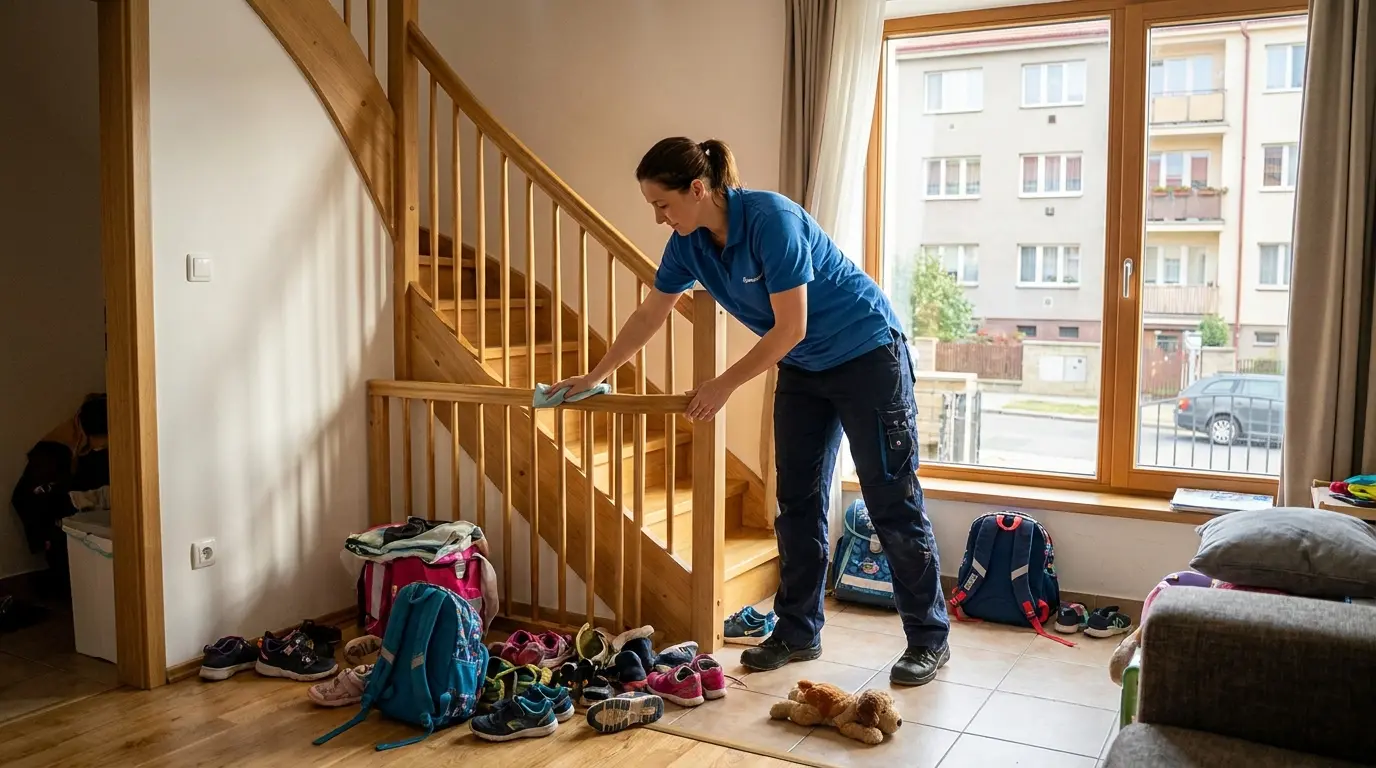
When clients ask about house cleaning, they often start with the same assumption: if the floor area looks similar, the quote should look similar too. I get why. On paper, a 140-square-meter family house and a large four-room apartment can sound almost identical. In real work, they rarely are. The gap usually has nothing to do with vague pricing tricks. It comes from logistics: stairs, extra bathrooms, entry zones, terrace doors, utility rooms, bigger window surfaces, and all the small transitions that eat time all day long.
Why a house is not cleaned the same way as an apartment
An apartment is usually compact. Even when it is large, the cleaner tends to work on one level, move through shorter distances, and repeat the same few surfaces across the home. A house changes the rhythm. The issue is not only square meters. It is how many separate zones the cleaner has to switch between, how often equipment moves up and down, and how many details sit outside the main living rooms.
I see this all the time around Prague. A bigger apartment in Vinohrady or Karlín may have an open living room, two bedrooms, one bathroom, and a long hallway, but the work stays concentrated. A family house on the edge of Prague, in places like Jesenice or Průhonice, often has a similar room count plus stairs, a wider entry hall, a second bathroom, a guest toilet, terrace access, a utility area, and more glass. Similar layout labels, different workload.
More zones mean more small tasks. A cleaner finishes one type of work, carries supplies elsewhere, changes cloths, switches products, and starts again in a new micro-environment. Those minutes are easy to miss if you only compare homes by size. They are very real on site.
Stairs are one of the biggest differences. People sometimes treat them as an afterthought, as if they are just a few extra steps between rooms. They are not. Stairs collect dust in corners, crumbs on edges, marks on skirting, fingerprints on rails, and pet hair where airflow pushes it. Vacuuming them properly takes time. Mopping them safely takes more time. Doing both while carrying gear between floors changes the pace of the whole visit.
Surface variety matters too. Apartments often repeat the same flooring and a simpler mix of materials. Houses are more mixed. Tile at the entrance, timber upstairs, stone or composite window sills, large glass doors to the terrace, chrome in multiple bathrooms, maybe a laundry room with different storage and utility fittings. None of those tasks is dramatic on its own. Put them together and the home cleaning scope becomes wider and slower.
Then there are the in-between spaces. Landings. Entrance transitions. Storage under the stairs. Pantry corners. The area around the back door. They are rarely the reason someone books a cleaner, but they are exactly the places that separate apartment cleaning vs house cleaning in real labor terms.
Which parts of a house extend the job the most
The biggest time drain is usually not the living room. Large living spaces can actually be straightforward if they are maintained well. The real slowdown usually comes from bathrooms, separate toilets, entrance zones, utility rooms, large windows, and staircases.
Extra bathrooms are the obvious one, but people still underestimate them. One apartment bathroom and two house bathrooms plus a guest WC do not add a few symbolic minutes. They add another set of taps, mirrors, tile splash marks, toilets, shower glass, drains, bins, and limescale risk. Bathroom work is detail-heavy. It is one of the most labor-intensive zones per square meter in any home.
That becomes even clearer in households with kids, a dog, or hard water. If you are comparing house cleaning price quotes, this is often where the spread starts to make sense. A smaller house with two active bathrooms can be slower than a larger apartment with one easy bathroom and fewer wet zones.
The entry area is another underestimated factor. In many apartments, the hall is small and isolated. In houses, the entrance often opens into a larger circulation zone with shoe storage, coats, a bench, maybe a laundry section nearby, and direct traffic from outside. On rainy days or through winter in Prague, this zone takes a beating. Dirt comes in, settles fast, and needs more than a quick pass.
Utility rooms are a quiet budget driver. They rarely look important in a floor plan, but they are time-consuming in practice. Dust around the washer and dryer, detergent drips, fluff in corners, marks on cabinet doors, messy floor edges around baskets or recycling bins. If the room is included every visit, it should be priced in every visit.
Terraces and large glass doors create another common misunderstanding. A client says "regular cleaning" and assumes the visible interior side of terrace glass is part of that idea. The provider may be thinking of standard interior maintenance without detailed window work. Neither side is trying to be difficult. The definition is simply not shared.
French windows and sliding doors take longer than people expect because the job is not just the glass. It is the frames, tracks, lower rails, fingerprints at child height, splash marks near the handle, and dust gathering in corners. Add parapets, rails, or a staircase next to the glazing and the question of how long does house cleaning take stops being theoretical very quickly.
How this affects price and cleaning time
The cleanest way to compare quotes is not by area alone, but by labor density. Two homes with the same square meters can differ by an hour or more if one of them has more wet zones, more vertical movement, and more detail work.
I usually tell clients to think in three layers: layout, wet zones, and detail load. Layout means how fragmented the home is and how much movement happens between rooms or floors. Wet zones mean bathrooms, toilets, kitchens, and utility spaces. Detail load means stairs, skirting, large mirrors, terrace doors, interior glass, window sills, and the spots where outside dirt shows up first.
This is why one-off cleaning often reveals the biggest difference between apartments and houses. A first visit or occasional reset has to deal with buildup: limescale, grease, dusty corners on stairs, marks on glass, and neglected entrance zones. If that scope is not described properly, the cheapest quote is often just the least informed one.
Regular service works differently. Once the cleaner knows the route, the surfaces, and the priorities of the household, the visit becomes more stable. The time estimate improves. So does the consistency. In many cases, a house that looked expensive on a one-off basis becomes much more manageable in a regular schedule.
As for pricing structure, fixed pricing makes sense when the scope is clearly described. Hourly pricing makes more sense when the scope is uncertain, after renovation, after a long gap, or when the client is unsure whether the visit includes windows, appliance interiors, basement stairs, or utility-room detail work. Both models can be fair. Problems start when the scope stays fuzzy.
This is why apartment cleaning vs house cleaning comparisons can go wrong if you only look at the final number. A quote that is 800 or 1,200 CZK higher may simply include the second bathroom, the staircase, the terrace door tracks, and the utility room. Another provider may be leaving those items out and planning to discuss them later. Same category of service, different scope.
How to prepare your request so quotes are actually comparable
A good cleaning inquiry does not need to be long. It needs to be specific.
Start with the layout and approximate size, but do not stop there. Add the number of floors, bathrooms, separate toilets, and whether the cleaner should include stairs, terrace doors, utility rooms, or a high-traffic entrance zone. That tells more than a bare line saying "family house, 5+kk" ever will.
It also helps to list the friction points in plain language:
- two bathrooms, one with shower glass and visible limescale
- staircase between ground floor and first floor
- large sliding doors to the terrace
- dog bringing dirt into the entrance area
- fingerprints on glass and cabinet fronts
Photos save time. You do not need a full real-estate-style gallery. A few honest phone photos of the bathrooms, kitchen, entrance area, staircase, and larger windows are enough to prevent a lowball estimate or an inflated defensive quote.
The most confusing phrase is still "regular cleaning of the whole house" with no explanation. For one provider, that means vacuuming, mopping, kitchen, and bathrooms. For another, it also includes visible glass, door marks, chair legs, skirting boards, and the terrace threshold. The more precise you are, the easier it is to compare like with like.
If you are evaluating more than one offer, ask each provider to break down what is included in the standard visit and what is charged separately. In larger homes, that is not nitpicking. It is basic quote hygiene.
When a regular plan starts making more sense than one-off visits
For households with children, dogs, two bathrooms, or steady traffic from a garden or terrace, regular service usually starts paying off earlier than people expect. Not because of a fluffy convenience argument. Because dirt is cheaper to manage before it builds up.
The fastest-loading zones are usually the entrance, bathrooms, kitchen worktops, terrace glass, and stairs. In a family house, these are also the places that make the whole home feel messy even when the bedrooms and living room are mostly fine. That is why a regular plan does not have to mean every detail on every visit. A smarter setup is a stable core plus rotating detail work.
In practice, that might mean every visit covers floors, bathrooms, kitchen, and the entrance zone, every second visit adds terrace glass, and once a month includes more detailed stair or sill work. That approach is often better for both sides. The client gets a cleaner baseline. The provider can price the work more fairly because the buildup stays under control.
If you are comparing offers now and wondering why house quotes diverge so much from large apartment quotes, ask for the scope by zone, not just by square meters. That is where the real answer sits. If you want a Prague-based option, ČistýKout can help you work through the details before the quote is set. Send a simple inquiry through the contact form, mention the number of bathrooms, floors, stairs, and larger glass surfaces, and the estimate will be far more realistic from the start.