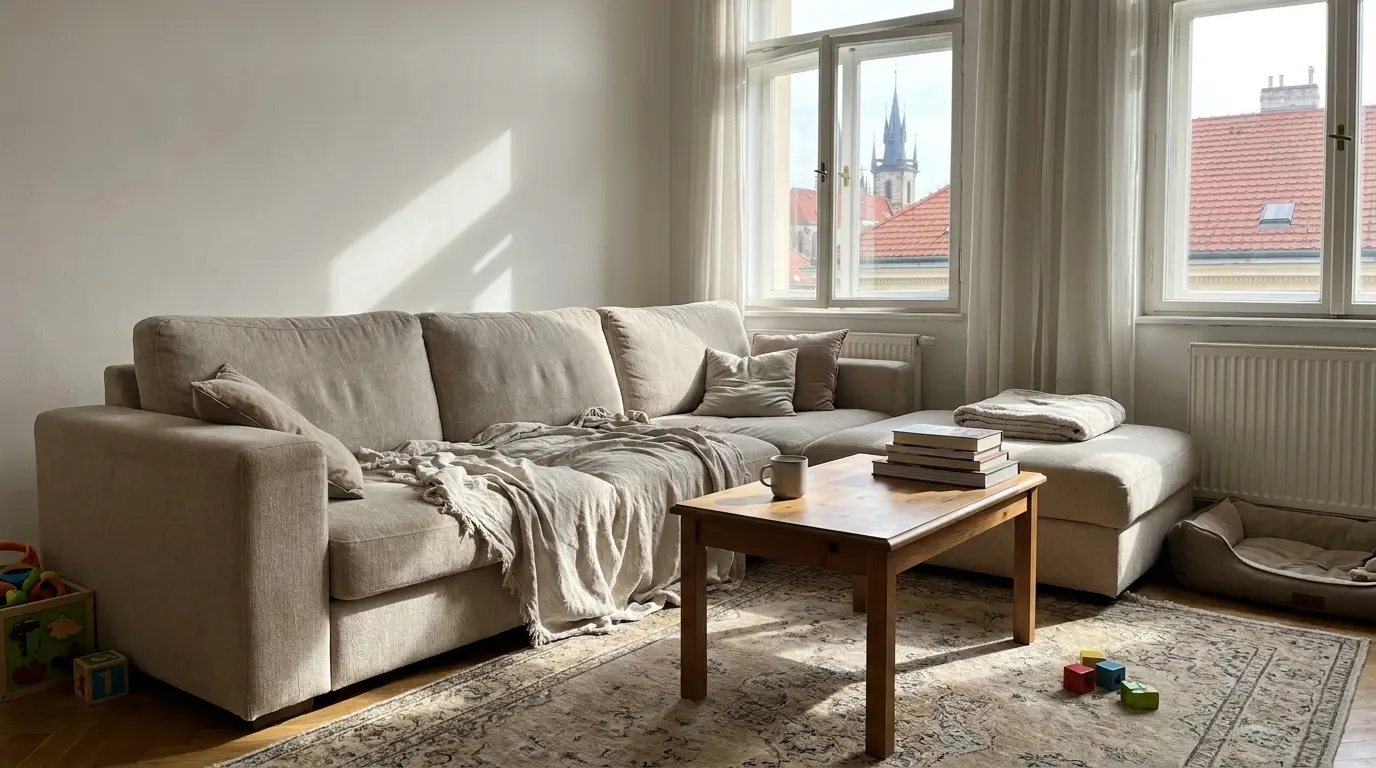
When people ask me how often to deep clean a sofa, I almost never give the same answer twice. A charcoal couch in a quiet flat in Dejvice, used mostly in the evenings, ages very differently from a cream sectional in a family house outside Prague where two kids, a dog, and a bowl of crackers pass over it every day. That is why blanket advice like "once a year" sounds neat but does not help much in real homes.
In real life, the interval depends on traffic. A normally used sofa in a home without pets, small children, or allergy issues often does fine with a proper deep clean every 12 to 18 months. Add a dog, regular eating on the couch, or a bright fabric that shows everything, and the rhythm usually shifts to every 6 to 9 months. If someone in the home has allergies, or the sofa doubles as the family headquarters from morning to night, twice a year is often the smarter call. Not because people are being precious, but because upholstery quietly collects more than most owners notice.
What matters most when deciding how often to clean a sofa
Fabric comes first. Some synthetic upholstery handles daily life well and gives you a bit more room for quick spot treatment. Lighter textured fabrics are less forgiving. Bouclé, soft woven upholstery, pale beige covers, anything with visible texture, all of that tends to hold body oils, dust, and smells faster than people expect. The sofa can still look "fine" from across the room while the seat area is already a shade darker.
Then there is the home itself. Children, pets, allergies, and simple daily use matter more than product marketing. A sofa in a formal living room behaves one way. A sofa in the actual center of family life behaves another way entirely. I have seen plenty of homes where the couch is not just seating. It is a snack station, a homework zone, an occasional bed, a dog perch, and the place where everyone collapses after work. In those homes, upholstery cleaning is not about perfection. It is about managing wear before it turns into a bigger problem.
There is also a difference between a presentable living room and a truly lived-in one. Some sofas are there for visitors and the occasional coffee. Others are used ten times a day by the same people in the same corners. That matters. The usual darker patches on the favorite seat are not random. They are the record of real use: skin oils, fabric friction, dust, hair, and whatever came in from outside on clothes.
Allergy load is another big factor. Even when the surface does not look dirty, upholstery traps dust, fine particles, pet hair, and pollen in the filling. In Prague flats near busy roads, it also catches city dust that drifts in through open windows. Upholstery acts like a soft filter. The trouble is that hardly anyone treats it that way.
What routine makes sense between deep cleaning appointments
A sensible routine buys you time between bigger cleans. Weekly vacuuming with an upholstery attachment does more than people think, especially around seams, under armrests, and in the cracks where fine dust settles. In homes with a dog or cat, I would not hesitate to do it twice a week. That is not obsessive. It is just maintenance.
Spot cleaning also matters, but timing matters more. Fresh spills are still on your side. Old stains are not. If coffee, juice, or a greasy mark is dealt with early, there is a decent chance you keep it near the surface. The usual mistake is panic scrubbing. People soak the spot, rub hard, and end up pushing moisture deeper into the filling. A clean cloth, gentle pressure, and some restraint usually get you further than aggressive rubbing and half a bottle of cleaner.
Rotating loose cushions helps too. Sofas do not wear evenly. One corner becomes dad's seat, another belongs to the kids, and the middle gets every visitor. Swapping cushions around, using a throw in the heaviest traffic zone, and airing the room properly can stretch the interval before the next professional sofa deep cleaning appointment.
Odors and grease build slowly. That is what catches people out. A sofa rarely smells bad all at once. It gets there in layers, from cooking, outdoor clothes, sweat, pet fur, and the general humidity of a busy home. The owner stops noticing it first. Guests usually do not.
When home cleaning is enough, and when it is not
Home cleaning is enough for light surface issues. Dust, a fresh spill, a mild mark, the kind of refresh that makes the sofa feel looked after. If the upholstery still smells neutral, the fabric dries evenly, and there are no old mystery stains or heavy darkened seating zones, a careful home clean may be perfectly reasonable.
The limit is depth. This is where a lot of people blur the line between a sofa that looks better and a sofa that is actually cleaner. Surface improvement is not the same as pulling dirt out of the filling. That difference becomes obvious with old stains, pet smells, greasy head marks, or upholstery that has taken months of daily pressure in the same places.
Over-wetting is the big risk. Some sofas have thick filling and dry slowly, especially in smaller flats where airflow is limited. If too much moisture gets inside, you can end up with musty smells, water marks, or a sofa that stays out of use far longer than expected. In a compact Prague apartment, losing the couch for half a day or more is not a minor detail.
Honestly, I think the line is usually crossed the moment someone starts testing one internet hack after another and still does not trust the result. If you are on your third method for how to clean a couch, the cheap option may already be getting expensive.
Signs your sofa needs professional cleaning
The clearest sign is odor. Not the artificial fragrance from a spray cleaner, but the smell that is still there the next morning. Pet odor, stale moisture, old smoke, body oils, that kind of buildup often survives home treatment because the problem is not just on the surface. Professional sofa cleaning has an advantage here because extraction matters as much as the cleaning solution.
Visual signs are next. Seat areas that are darker than the rest of the fabric. Armrests with a dull greasy cast. Upholstery that still looks tired after vacuuming. This shows up fast on light sofas, but darker fabrics hide it for longer, which is sometimes worse because owners wait too long.
Then there is the allergy angle. People often tell me they vacuum regularly, and I believe them. The issue is that the surface and the inner filling are two different worlds. If dust still lifts when someone sits down, or pet hair keeps appearing from seams no matter how often the sofa is vacuumed, home care has probably reached its limit.
A very typical example: a family in western Prague had a pale corner sofa, two children, and a French bulldog. From a distance, it looked manageable. Up close, the most used seat was visibly darker, the sofa carried that damp dog-after-rain smell, and one child kept getting stuffy in the evening. They had already tried cleaning it themselves. The fabric stayed damp until the next day and the result was only partial. After a proper professional sofa cleaning visit, the room did not look transformed for Instagram. It simply felt normal again. That is usually the real win.
How much time and effort home cleaning really takes
People often compare the price of a cleaning product with the price of a service and stop there. That is too narrow. Real home cleaning also includes moving furniture, vacuuming first, testing chemicals on a hidden patch, working section by section, managing drying time, and keeping everyone off the wet seat. In a small apartment, that disruption is real.
There is mental effort too. What cleaner is safe on this fabric. How much moisture is too much. What if the manufacturer recommends dry cleaning only. What if the stain fades but leaves a ring. Home upholstery cleaning is not paid for only in money. It costs time, uncertainty, and the risk of ending with a halfway result.
From an economic point of view, regular maintenance often wins over rescue mode. If the sofa was expensive, used daily, and exposed to children, pets, or allergy load, scheduled professional sofa cleaning usually makes more sense than repeated trial and error. Home care is still useful. It just has limits, and most people are happier once they stop pretending otherwise.
How to book sofa cleaning so the result matches expectations
A good booking starts before anyone arrives. Send clear photos in daylight and describe the upholstery if you can. Light or dark fabric, standard woven cover, velvet feel, microfiber, removable covers, old stain, recent stain, pet odor, previous DIY cleaning attempt, those details matter more than most customers think.
Mention smells, pets, and allergies directly. That is not oversharing. It helps set the right method and the right expectation. A sofa with everyday dust is one thing. A sofa where a dog sleeps every afternoon, or where an old spill was half-cleaned at home, is another.
It also often makes sense to combine items into one visit. Sofa, mattress, rug, upholstered dining chairs, even a fabric headboard if the household needs it. One disruption instead of three, and usually a better use of the cleaner's visit.
If you want a calm second opinion before trying more DIY fixes, ČistýKout is a practical Prague-based option to start with. A short description, a few photos, and an honest note about stains, odor, or pets are usually enough to judge whether a home refresh still makes sense or whether it is time for proper professional sofa cleaning. The simplest route is to send a contact request and have the condition assessed before the couch gets worse.