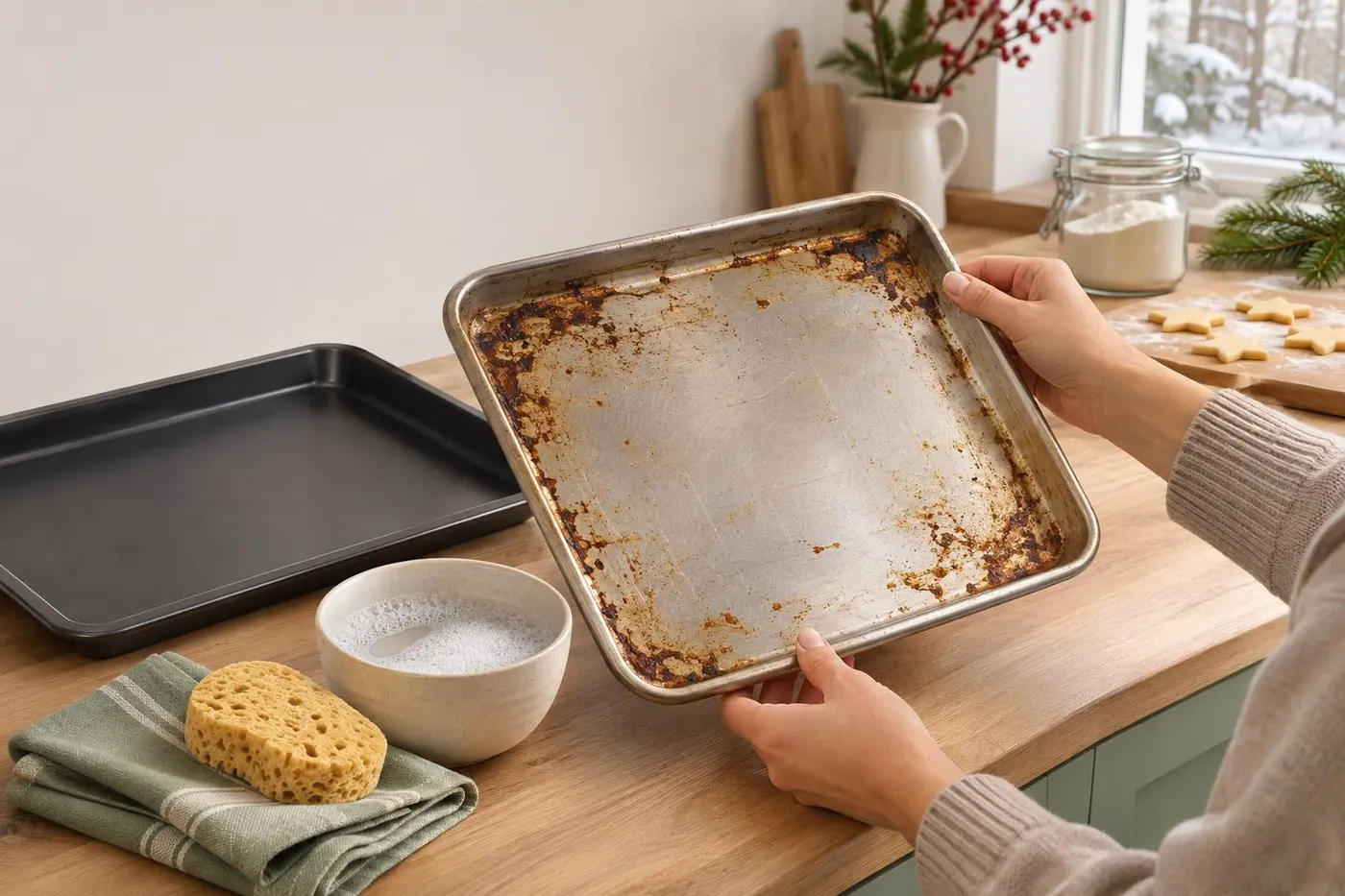
If you are wondering how to clean a burnt baking sheet, do not start with vinegar, baking soda, or the roughest scrubber in the cupboard. Start with the material. A black patch on stainless steel is one job; the same-looking patch on bare aluminium or a nonstick coating is quite another. I have seen old trays survive years of Christmas biscuits, then get ruined in ten minutes by a viral cleaning trick.
Identify the material and condition before you start
Remove crumbs and blot loose grease with a paper towel. Give the tray a quick gentle wash so you can see the surface, then examine it in daylight. A magnet may offer a clue with some steels, but it is not a dependable material test. Weight, finish, exposed edges, and existing damage tell you more.
Enamel is smooth, glossy, and usually a consistent dark colour. A chip exposes the metal underneath. Stainless steel is silver, relatively heavy, and has no differently coloured layer beneath an ordinary scratch. Bare aluminium is light and pale grey; it often develops a dull patina. Nonstick bakeware has a dark, even coating over a metal base. On an older pan, the distinction may only be obvious around the rim or inside a deep scratch.
Do not assume every black tray is enamel. In one Žižkov flat, an old baking tray looked like heavy enamel until the grease came off. Tiny grey flakes showed around two corners. That was not stubborn dirt. The coating itself was lifting, and more scrubbing would only have spread the damage.
Look for scratches, blisters, peeling, chipped enamel, rust under rolled edges, and warping. If the original maker's instructions are still available, follow those ahead of a general internet recipe. Le Creuset tells users to stop using cookware when enamel has chipped and exposed the metal. By contrast, scuffs and stable discolouration on uncoated aluminium may only be cosmetic.
A flaking nonstick coating, a sharp enamel chip, or a tray that twists badly when hot is not a restoration project. Replace it. That may feel wasteful, especially with a pan that has been in the family kitchen for years, but appearance and structural damage are different things.
Remove the greasy film before tackling carbonised food
A sticky film and a hard carbon layer need different work. A greasy baking sheet feels slick or tacky, and some of the residue transfers to a towel. Carbonised food is dry, dark, and firmly bonded to the pan. Most neglected trays have both. If you attack the black spots first, the sponge simply carries grease across the rest of the surface.
Blot loose fat rather than smearing it around. Add warm, not boiling, water and a small amount of hand dishwashing liquid. Let the solution work for ten to fifteen minutes, subject to the maker's instructions. An overnight soak is not automatically better. Water can sit inside a rolled rim, and prolonged soaking may be a poor choice for aluminium or damaged coatings.
Use the soft side of a sponge, a microfibre cloth, or a nylon brush on the softened film. Only then can you see what has genuinely burnt onto the metal. Nordic Ware recommends warm soapy water, a non-metal brush, and a short soak for its uncoated aluminium sheets. It also advises against dishwasher cleaning because alkaline detergent and heat can discolour aluminium.
Clean the corners, underside, and folded rim too. Grease left there reheats in the oven, smokes, and leaves a stale smell. I keep a soft kitchen-only brush for narrow seams; a knife tip is a bad substitute. If rusty water runs from a rolled edge or the seam is opening, retire the tray.
Durable metal and nonstick coatings need different methods
The least aggressive method that works is usually the right one. Start with warm water and dish soap. Add contact time. Increase mechanical force only after that, and choose the tool for the surface rather than the drama of the stain.
Enamel
Use a soft sponge or nylon brush after a short soak. Work in small areas without heavy pressure. Steel wool and gritty cleaning paste can scratch the glossy layer. Enamel makers generally recommend warm soapy water, non-abrasive tools, thorough rinsing, and immediate drying. A chipped food-contact surface is different: stop cleaning and replace the piece.
Stainless steel
Uncoated stainless steel tolerates more, but it is not indestructible. Begin with a nylon brush. For a stubborn mark, use a mild product specifically labelled for stainless cookware, follow the grain, and test a small area first. Skip chlorine bleach and oven cleaner. Tefal warns that chlorine products can cause pitting corrosion in stainless steel.
Bare aluminium
Aluminium reacts with acids and strongly alkaline products. Vinegar, lemon juice, and dishwasher detergent may dull, darken, or pit it. A brighter patch is therefore not proof of a cleaner pan; sometimes the metal itself has changed. For ordinary deposits, use warm soapy water and a non-metal tool. Keep contact short, rinse, and inspect. A stable patina is often a better outcome than chasing the original shine.
Nonstick coating
To clean a nonstick baking pan, leave out wire wool, scrapers, gritty paste, and metal utensils. Use warm water, dishwashing liquid, a soft sponge, and patience. Tefal recommends a non-abrasive sponge and a brief soak for coated surfaces. If the deposit will not release without force, replacement may be the sensible answer. No homemade paste can repair peeling or deep scratches.
Homemade mixtures are not universal recipes
Baking soda and vinegar make satisfying foam on video. Much of that spectacle is the two substances neutralising each other. Either ingredient may have a place on a compatible surface, but combining them does not create a universally stronger cleaner.
Think of baking soda as mildly alkaline and gently abrasive. Do not turn it into a scrubbing paste for a nonstick coating unless the manufacturer permits that use. Acids can react with bare aluminium. Heavy-duty degreasers may be strongly alkaline and can damage aluminium or decorative finishes. Read the label for compatible materials, dilution, and contact time.
Do not layer products. Rinse one away, inspect the tray, and only then consider another compatible method. Never mix chlorine bleach with acids, ammonia, or another cleaner. If you do not know the ingredients, do not combine the products. Ventilate the kitchen, wear suitable gloves, and use oven cleaner on a baking sheet only when its maker explicitly allows it.
There is another trap: visual improvement. Acid can leave aluminium looking pale because it has altered the surface. Abrasive paste may lighten a nonstick pan because part of the coating has gone. Holiday baking tray cleaning is not a contest to restore showroom colour. You need a sound, degreased food-contact surface with no loose residue and no cleaner left behind.
Rinse, dry, and inspect the tray before baking
Rinse the tray several times with clean warm water. Run clean fingers over it. The surface should not feel slippery from detergent, release powder, or smell of cleaner. Dry the top and underside, then stand the tray on its edge so water can drain from folds. Press a dry cloth against the rim seam.
Now inspect it once more. The finish should be continuous, with no flakes. The tray should sit flat and should not rock under light pressure. Stable patina on bare aluminium is not the same as peeling coating. Rust emerging from a seam, a sharp enamel chip, and serious deformation are reasons to stop using it.
Clean baking trays in November, not on the afternoon when four batches of dough are waiting. An old safe sheet does not have to look new. It does need to be clean, structurally sound, and suitable for food contact. If the trays are only one part of a greasy oven, extractor hood, and kitchen that need attention before Advent, ČistýKout offers a no-obligation cleaning request. It is a practical Prague-based option, with requests also available elsewhere in the Czech Republic.