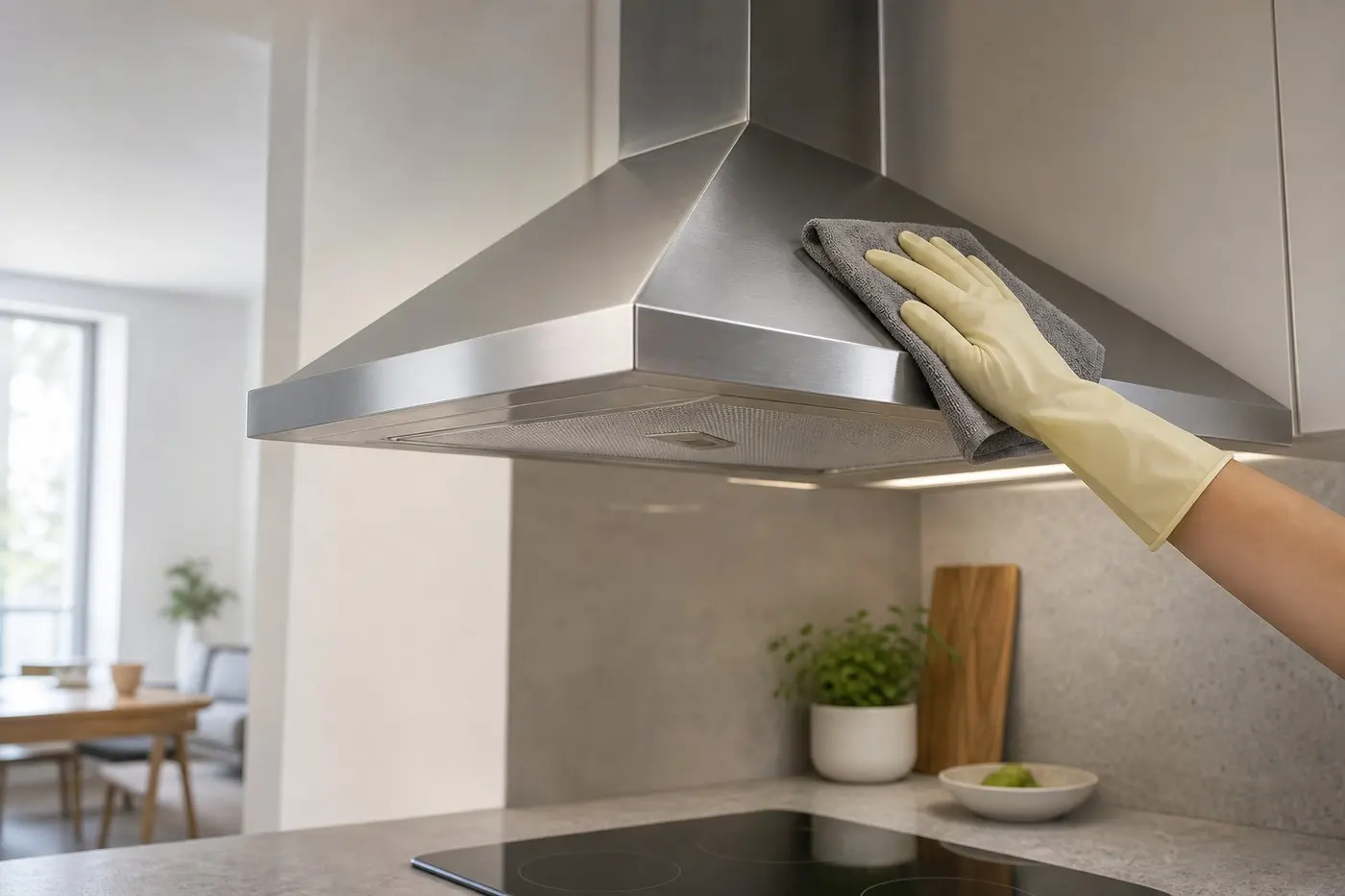
Ask three people how to clean a cooker hood and somebody will suggest oven cleaner. Please don't start there. The mesh filter, charcoal cassette and brushed-steel shell are different materials doing different jobs. I have seen perfectly sound aluminium come out grey after one overenthusiastic clean. A slower start saves that sort of damage.
Check the filter and finish before cleaning
Unplug the hood before touching the filter. For a hard-wired model, isolate its circuit. Controls and lamp fittings sit surprisingly close to the areas people wipe, so I work with a damp cloth and never a dripping one.
Start underneath. A flat panel made from layers of metal mesh is the reusable grease filter. An older hood may have paper or fleece in a frame instead; that insert goes in the bin when loaded. Washing it turns it into a limp, ineffective sheet.
Behind the mesh, a recirculating model normally carries a second filter for smells. Charcoal filters come as discs and rectangular cassettes, often black. A ducted hood sends air outdoors and usually has no need for one. Find the model number before ordering or washing anything. Near-identical cassettes can have quite different instructions.
Now look at the casing in side light. Fine parallel lines mean brushed stainless steel. A continuous coloured skin suggests painted metal; the shiny front may be glass, while silver buttons are often plastic. Try the cleaner behind an edge first. I put it on the cloth, away from switches, rather than spraying the hood.
A decision rule worth remembering
- Put a metal filter in the dishwasher only when its manual says you can.
- Hand-wash it when the manual does not explicitly permit dishwasher cleaning or its painted frame looks delicate.
- Replace ordinary charcoal, paper and fleece filters.
- Regenerate a long-life charcoal filter by its own instructions, not a generic tip.
- Leave grease around wiring or the motor to an appliance technician.
Degrease a metal filter by hand or in the dishwasher
To clean a cooker hood filter by hand, use a wide sink or roasting tray, warm water, washing-up liquid, gloves and a soft brush. Warm is enough; boiling water can distort a plastic latch and is unkind to some painted components.
Lay the filter in the solution for 15 to 30 minutes. If it does not fit, soak one half and turn it around. Brush the mesh gently from both sides. Pressing hard can crush its thin layers, leaving the panel warped and awkward to refit. Rinse until the water runs clear.
For a badly loaded filter, repeat the soak instead of adding oven cleaner or caustic soda. Strong alkalis attack aluminium. Even bicarbonate is not automatically harmless: a weak solution may loosen residue, but I would not leave a thick paste sitting on the frame without the maker's approval.
Where the manual permits machine washing, keep the filter away from the dinner plates and choose a moderate cycle. Do not panic if bare aluminium comes out darker: detergent and heat can alter its colour without stopping it from catching grease. The old shine rarely returns, though. Painted black frames stay in my sink.
After rinsing, prop the panel upright overnight. Wiping the rim is not enough because droplets hide deep in the mesh. I refit it the next morning, once a shake produces no water at all.
A charcoal filter can only be cleaned sometimes
Charcoal causes the most expensive misunderstanding. A standard cassette does not reset in a bowl of soapy water. Once its carbon is loaded with cooking smells and grease, a soak cannot empty the pores; it may only disturb the binder holding the insert together.
Lingering frying smells, poorer airflow or a louder hood can all suggest a loaded filter. Usage matters more than a calendar date. In a home that fries food several times a week, a standard filter may need replacement after three to six months; lighter cooking can stretch that period. Follow the appliance indicator and the maker's stated interval.
Washable and regenerable filters do exist, but their routines differ. One may go through a dishwasher before controlled oven drying; another uses heat alone. Oven temperatures and timings are model-specific. If neither label nor manual says “regenerable” or “long-life”, buy a replacement. Guessing is false economy here.
Clean a stainless steel cooker hood without streaks
Search for how to clean a stainless steel cooker hood and you soon meet vinegar, lemon, bicarbonate and scouring pads. They do not belong in one heroic mixture. For normal kitchen film, warm water, one drop of washing-up liquid and a fresh microfibre cloth are enough.
Remove loose dust first. Dust mixed with grease acts like a fine abrasive. Wipe with the grain, not in circles. The cloth should be damp rather than dripping, especially near lights and controls. Follow with another cloth dampened with clean water, then dry the steel straight away. That last dry pass often fixes streaks better than applying more product.
For one stubborn dot, hold a damp cloth against it for a minute and let it soften. Do not reach for the green side of a sponge, abrasive powder or a melamine pad. Avoid oven cleaner, chlorine products and strong acids. Chlorides can damage stainless steel, while an abrasive leaves scratches that polish cannot simply undo. Vinegar is not my default either; concentration, contact time and adjacent metals all matter.
Use stainless-steel polish sparingly and only after cleaning. A thin film hides fingerprints; too much catches dust. Painted steel and plastic controls need little more than dilute washing-up liquid. Glass cleaner is fine for glass, but spray the cloth at the worktop. A mist aimed at the hood finds button gaps remarkably well.
Find grease around the grille, light and top edge
The front can look clean while the hidden ledges feel like flypaper. Check behind the filter lip, around its latch, on top of the chimney and under the cupboard beside it. Built-in hoods in Prague flats often leave a narrow slot below a shelf. A cloth misses it for months; dust does not.
With the filter removed, use your phone light to inspect the fixed frame, but keep your hands out of the fan area. Wipe accessible metal with a well-wrung cloth. A cotton bud or small soft brush can reach a seam, provided it is only lightly damp and does not push liquid into an opening. Let the lamp cool and disconnect the power before cleaning around it.
Dust the top first, then degrease it. Check the side of the adjoining cupboard too. Airborne oil settles there and binds with dust. If the cupboard is laminated chipboard, keep water away from its exposed edges. Once the board swells, cleaning will not reverse it.
Stop when deposits extend to wiring, fan blades or the enclosed motor housing. A rattling fan, burnt smell, tripped circuit or grease leaking from a joint also calls for a service technician. Screws in a cover are not an invitation to dismantle an electrical appliance. A technician can strip the relevant parts safely and inspect the duct at the same time.
Clean often enough to avoid an hour-long job
Give the cool lower lip a quick wipe after frying. Two minutes now beats half an hour with old brown grease. I check the mesh once a month, or fortnightly in a home that fries several times a week. A kitchen used mostly for soup, pasta and oven food may comfortably go two or three months between filter washes.
Recirculation puts more weight on maintenance because the air comes straight back into the room. Even a strong fan struggles through blocked mesh. Watch the hood rather than worshipping a calendar: oily droplets, a stale frying smell and steam drifting past the canopy all say it is time.
The routine in my own kitchen is unremarkable but it works. I wipe the shell after greasy cooking, wash the filter when it looks loaded and remember the top ledge during a deeper clean. Leaving oil until it becomes brown and tacky makes aggressive products seem attractive. That is usually when surfaces get damaged.
A hood in a long-neglected kitchen can be folded into a professional kitchen clean, especially when its upper edge is unsafe to reach. Contact Čistýkout for a no-obligation enquiry in Prague. Mention the hood model and whether the problem is the accessible casing, filter or grease around the appliance.