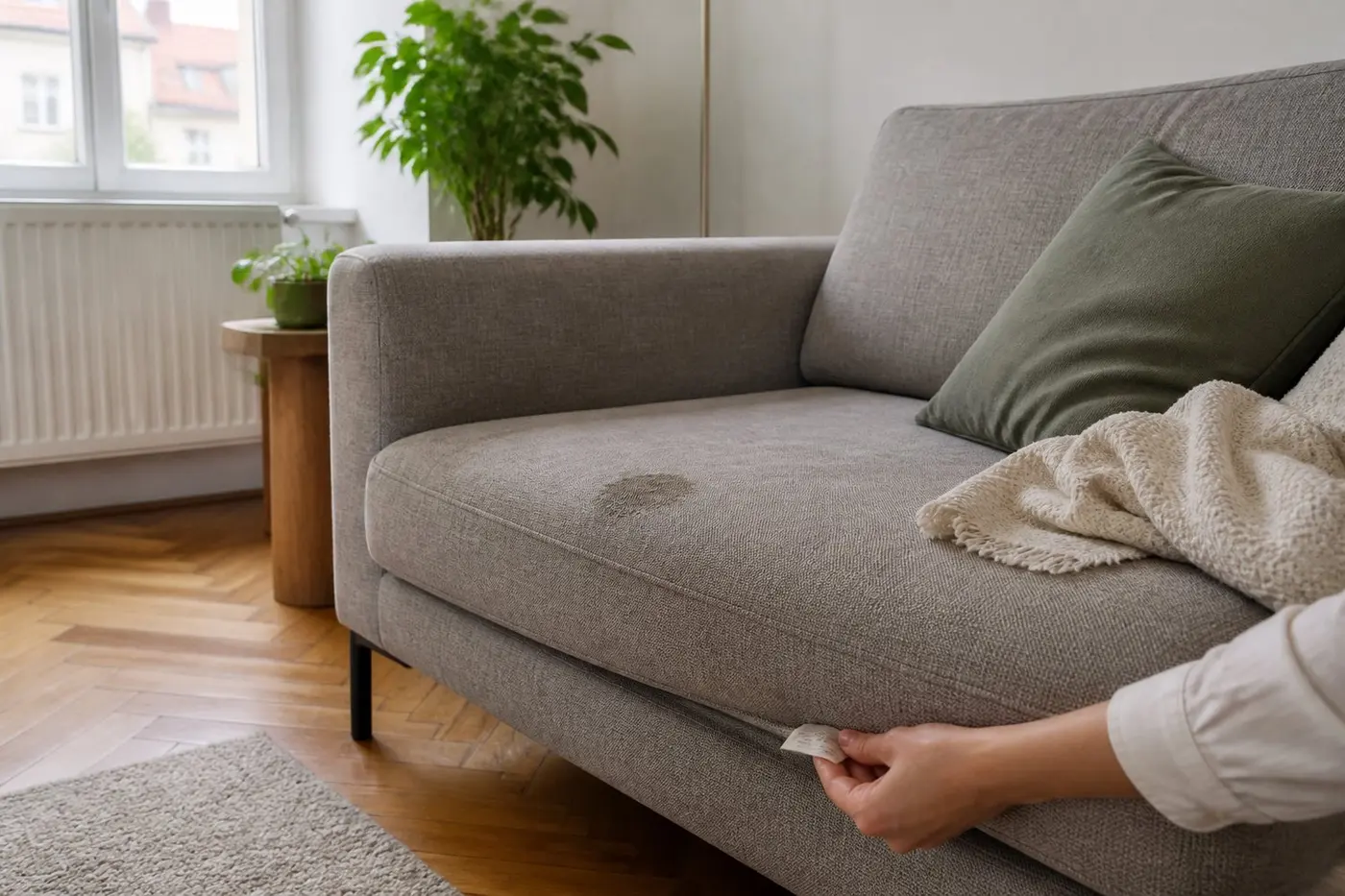
When coffee lands on a pale sofa, the usual reflex is water, dish soap and a sponge. That reflex causes plenty of the rings people later blame on the original spill. If you want to know how to clean a fabric sofa, start with the care label. Its W, S, WS or X code tells you whether the upholstery can take a water-based product, a solvent, either one, or no liquid at all.
Find the label and identify the material first
Look beneath a loose seat cushion, on the underside of the cushion cover, along a rear seam or under the frame. A sectional may have labels on more than one piece. The ottoman and scatter cushions can also carry different instructions. You are looking for the fibre content and, more importantly, the cleaning letter.
Appearance is a poor guide. Two grey woven fabrics can look almost identical while behaving very differently. One may be a durable polyester with a W code. The other may contain viscose, have a sensitive dye or use a backing that distorts when wet. Even “microfibre” is not a cleaning instruction. Finish, backing, adhesive and colour all matter.
I once saw a sofa in a Prague flat where the owner had treated a small apple-juice mark. The juice disappeared, yet a pale oval the size of a dinner plate appeared as the cushion dried. The damp patch had picked up old dust and left it at the outer edge. She had not found a second stain; she had made the familiar ring left by an uneven wet clean.
No fabric couch cleaning label? Dig out the receipt first. The maker or retailer may still have the cleaning code filed against the model; send them the model number, a full photo and a close-up of the weave. Until they confirm a method, stick to dry maintenance. Vacuum with an upholstery attachment and lift off solids gently. Never assume code W when the fabric's cleaning code has not been confirmed.
What upholstery cleaning codes W, S, WS and X mean
The code is a boundary, not a promise of perfect results. It describes what the face fabric may tolerate. It cannot account for faded dye, a fragile backing, soaked filling or whatever someone sprayed on the stain last year.
- W (water): use a water-based product made for upholstery. W does not mean “washable”, and it does not give permission to saturate the cushion or use steam. Follow the product directions and use as little foam or solution as the job needs.
- S (solvent): keep water away. This fabric calls for a water-free upholstery solvent, careful ventilation and strict attention to the safety label. Nail-polish remover and a random bottle of rubbing alcohol are not substitutes. Faced with a whole S-coded seat, I would put the bottle down and call someone who works with upholstery solvents. The margin for a home experiment is too small.
- WS or SW: either a suitable water-based cleaner or an upholstery solvent may be used. You still need a hidden-area test and controlled application. Match the method to both the stain and the product instructions.
- X: use a vacuum or light brushing only, as directed by the manufacturer. Do not add water, solvent or homemade spray. Show a stain to a specialist before doing anything else. The honest answer may still be that removal would damage the cloth. Frustrating, yes, but better than turning one mark into a ruined panel.
A zip is not a washing symbol. Many cushion covers unzip because that makes the furniture easier to manufacture or repair. Machine washing can shrink a cover so badly that it will not fit over the foam again. Only wash it when the care instructions explicitly say you can.
Baking soda, vinegar, dish soap and steam: the home remedies tested
Searches for sofa cleaning bring up familiar kitchen recipes, and this is where many sofa cleaning mistakes begin. They seem harmless because the ingredients live beside the sink. Upholstery does not care where a product came from. It reacts to water, pH, surfactants, heat and friction.
Dry baking soda may absorb a little odour before it is vacuumed away. Fine powder also lodges in a tight weave and inside the filling; once damp, it turns into an alkaline paste. Vinegar can affect sensitive dyes, and it will not remove the source of a smell when urine or milk has reached the foam. Mixing vinegar with baking soda mostly neutralises both. The bubbles look busy. They are not proof that the sofa is getting cleaner.
Dish soap cuts grease on plates but is difficult to rinse out of upholstery. Residue can stiffen the pile and attract fresh soil. On an S or X fabric, the water in the mixture is already a deal-breaker. Steam brings heat plus a heavy moisture load. It can set a protein stain, weaken adhesive, shrink fabric or drive contamination deeper into a cushion.
Run a useful hidden-area test
Choose a genuinely hidden patch near the floor or beneath a cushion. Dab a little of the approved cleaner onto a white cloth, then press it against the patch. No rubbing. If colour comes away, stop. Leave the test overnight before comparing the shade, feel and direction of the pile. It should look boringly unchanged. Even then, stick to the method on the maker's label.
Treat the type of stain without scrubbing or rings
Blot a fresh spill first. Use a white absorbent towel, press from above and keep turning to a dry section. Do not push liquid down into the foam. Lift solids with a spoon or blunt edge. Then work from the outer edge towards the centre so the affected area does not grow.
Pause before opening the cleaning cupboard. Work out what landed on the seat. Then read the code again.
- Grease from pizza, sauce or cosmetics needs a product that can release oil and is approved for the sofa code. Plain water often spreads it.
- Protein stains such as milk, blood, egg and pet accidents do badly with heat. Start cold, using only the method permitted by the label. With urine, the filling and the odour also matter; a clean-looking surface may hide a contaminated cushion.
- Pigment stains from wine, juice, marker or makeup may dye the fibres. Trying five household mixtures in a row makes the reaction harder to predict and leaves a specialist with a much more complicated job.
Unless the product label says otherwise, dose the white cloth rather than spraying the sofa. Press, lift, move to a clean bit of cloth, repeat. I would not scrub it. A brush can roughen the fibres or turn the pile in another direction; the resulting pale patch is damage, not dirt, so another cleaner will not take it away.
Why does a neat circle appear after cleaning? One part of the panel became wetter than the rest and dried at a different speed. With a broad mark, a trained cleaner may work across the complete section from one seam to the next, extracting moisture as they go. That is quite different from soaking one circle with a spray bottle.
Open two windows if the Prague weather allows it, or run a fan across the room. Keep the dog, the children and everyone else off the seat until it feels dry beneath the surface, not merely dry on top. A hot hairdryer looks like a shortcut. In practice it can dry the rim first and leave exactly the outline you were trying to avoid.
When to stop cleaning at home
Stop if colour transfers to the white cloth, the fabric fades, the pile sticks together or the cover starts to ripple. A cushion that still feels cold and wet hours later is another warning. So is a damp-filling smell or a brown edge that returns during drying. More water rarely solves any of these problems.
Professional extraction or low-moisture cleaning makes sense for a large soiled area, an old unidentified stain, urine in the filling, an S or X code, or upholstery without a label. A competent cleaner will assess fibre, colourfastness and construction before choosing a process. “Steam cleaning” is not one universal hot-water setting for every sofa.
When requesting a quote, send a full photo of the sofa, a close-up of the mark and a readable photo of the label. Say what spilled, when it happened, what you have already applied and whether the filling became wet. Mention the vinegar, dish soap or hired extraction machine. That history helps the cleaner avoid a second reaction.
If the code is unclear, or yesterday's small mark now has a ring around it, send a photo with a no-obligation enquiry to Čistýkout. For Prague households, the service helps match the job with a cleaner. Sending the pictures first also saves an awkward visit with the wrong kit in the van.