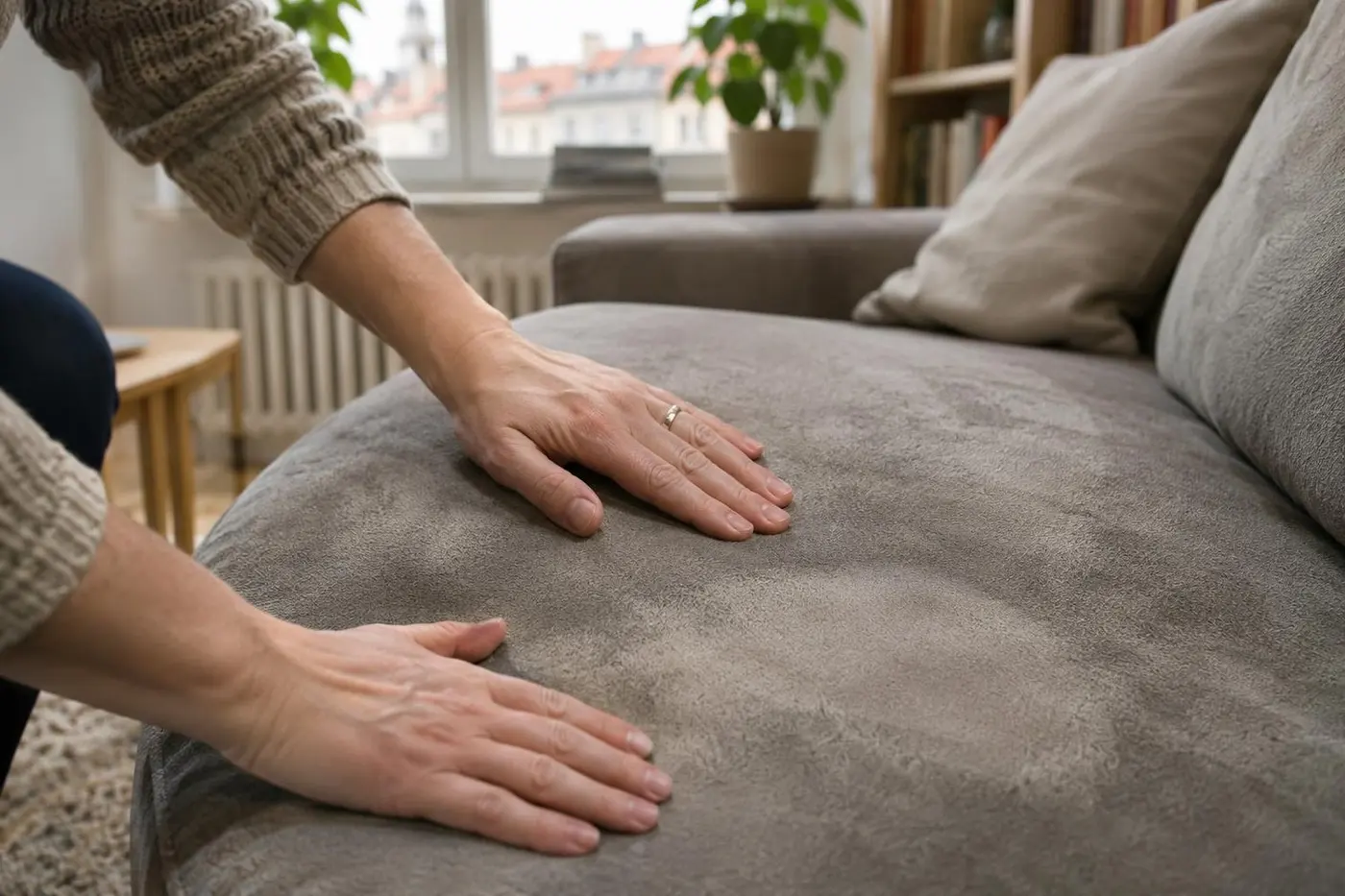
If a home cleaning attempt left your sofa stiff, patchy or ringed with a darker edge, resist the urge to wet it again. That second pass often pushes cleaner and moisture farther into the cushion. The safest answer to how to clean a microfiber couch starts with diagnosis: work out whether you are looking at detergent residue, a drying mark, flattened pile, colour loss or wet foam underneath.
First identify what actually went wrong
Microfiber changes shade when its tiny fibres point in different directions. Run a clean, dry hand across the cushion, then brush the whole panel one way with a soft clothes brush. If the light and dark areas move with the pile, the fabric may only be matted. That is good news. A genuine stain or colour change stays put when the nap is aligned.
A stiff or slightly tacky patch usually suggests cleaner residue. Sometimes a barely damp white cloth produces fresh foam even though you have added no soap. A neat ring is more likely to be a drying mark: dissolved soil, detergent or minerals travelled to the edge of the wet area and settled there. Dye loss looks different. The shade remains changed from every viewing angle, and a white test cloth may pick up colour.
The awkward problem sits below the cover. Press a dry white towel against the seat for several seconds. Check the seams and the underside of a removable cushion too. If the area still feels cold and damp after a day, leaves moisture on the towel, or smells musty when compressed, stop adding liquid. The face fabric can feel nearly dry while the foam is holding far more water than it can release quickly.
I once saw a sofa in a Prague 7 flat that had been cleaned three times over one weekend. Each new round was meant to remove the ring left by the previous one. It did not. By Monday the ring was wider and the foam smelled stale. With microfiber, doing less is often the move that keeps a recoverable mistake from becoming an expensive one.
A dry check before you reach for another product
- Flattened pile: the shade changes when you brush it, while the surface and filling feel dry.
- Cleaner residue: the patch feels crisp, sticky or soapy and may foam during a minimal cloth test.
- Water mark: a defined ring or tide line appears around the area that was wet.
- Colour change: the difference remains after brushing; dye may transfer to a white cloth.
- Wet filling: the seat stays cool, damp or musty below the surface.
Go back to the label and test again out of sight
Look for the care label below a seat cushion, underneath the frame or beside the zip of a removable cover. A microfiber couch cleaning code does not promise that a particular stain will come out. It tells you which family of cleaner the manufacturer permits.
- W allows a water-based upholstery cleaner.
- S calls for a water-free upholstery solvent.
- W/S permits either type, subject to a patch test.
- X means vacuuming and dry brushing only; leave wet treatment to a professional.
No label? Treat the upholstery as unidentified material. Two fabrics can both be sold as microfiber and react very differently because their fibre blend, dye, backing or adhesive is different. Do not copy a method simply because it worked on a relative's similar-looking sofa.
Write down everything already used, including the product name, approximate amount and whether you added tap water, washing-up liquid, vinegar, alcohol or a machine formula. Mixing another cleaner into residue of uncertain composition is a gamble. Products that seem mild on their own can create sticky foam or shift the shade when combined.
Patch-test behind a cushion or close to a hidden seam. Put a very small amount of the code-appropriate cleaner on a white cloth, then press it against the test area ten times. Do not scrub. Check for dye transfer and clumping. Most importantly, wait until the spot is fully dry before judging it. Wet microfiber is darker, so an immediate result tells you very little.
A hard surface often means residue, not ruined fabric
If the patch test shows no colour movement and the code permits the chosen method, you may be able to lift the residue out. Think blot and extract, not rewash. The point is to move contamination into a clean cloth rather than wake up all the old soap and spread it across the cushion.
For a W-coded panel, dampen a white absorbent cloth with distilled water. It should be moist enough to work but nowhere near dripping. Press it onto an area about the size of your palm, then blot immediately with a dry section. If you own a suitable extractor, use suction without spraying more solution. For S-coded fabric, use only a water-free upholstery solvent that the sofa maker accepts. Rubbing alcohol is often mentioned online, but it is not automatically safe for every microfiber blend, dye or backing. With W/S, choose whichever tested option dried without colour or texture change.
Work in small doses. One light application, a few presses, then extraction and a pause. If the white cloth keeps producing heavy foam, or the seat smells of several products at once, stop. More rinsing at home may simply drive the mixture down into the foam.
Once the panel is completely dry, lift the nap gently with a soft clothes brush. Never brush wet fibres aggressively. A dry pile that loosens and feels normal again was probably matted by residue. Shiny, fused or crumbling fibres point to physical or heat damage, which no brush can reverse.
Do not repair a water ring by drawing a larger wet ring
The tempting method is to dampen the border, then dampen a wider border when that dries badly. Soon the cushion has several tide lines. On W or W/S upholstery, you can sometimes even out the moisture across one construction panel, such as a single seat from seam to seam. That does not mean soaking the whole sofa. Do not try it on S or X fabric.
Use a minimal amount of distilled water or an approved water-based upholstery product, distributed evenly through a white cloth. Start at the cleaner edge of the panel and work towards the mark. Extract each small area straight away. You are not trying to flush the cushion; you are trying to prevent sharply different moisture levels from drying at different speeds. This is why DIY microfiber upholstery stain removal becomes risky once the filling has already been wetted.
Leave cushions separated and keep everyone off the sofa. Brief cross-ventilation helps, followed by a fan moving room-temperature air along the surface. Skip the hot hair dryer. Heat can distort synthetic fibres, affect the backing and lock the nap into an uneven direction. The same caution applies to steam cleaning a microfiber couch: steam adds both heat and moisture and is only an option when the manufacturer permits it and extraction is adequate.
If your aim is to clean a microfiber sofa without water marks, even drying matters as much as the liquid you choose. A Prague flat can be slow to dry in November, especially with the windows shut. Sitting on a damp cushion compresses the pile and traps moisture in the area under the greatest pressure.
When to stop and book professional upholstery cleaning
Stop the home repair if colour transfers to the white cloth, the patch darkens after every drying cycle, several cushions are affected or the filling smells musty. Stop as well when the code is X, the label is missing, or you cannot reconstruct the products already used. A professional can choose compatible chemistry and extract more efficiently, but even professional cleaning cannot replace dye that has left the fibre or undo heat-fused pile.
Send the cleaner one photograph of the whole cushion and one close detail. Include the fibre information if available, the cleaning code, every product used, and how long the cushion stayed wet. Mention any odour. "I tried everything" is understandable, but the exact list is much more useful when someone has to decide whether another treatment is safe.
After treatment, keep air moving and do not use the sofa until the seams and lower cushion feel dry, not merely the centre of the surface. Fast, complete drying is part of the job.
If you would rather not risk another ring, send a no-obligation enquiry to Čistýkout with the care code and a few photos. Čistýkout can help you find a Prague-based cleaning option and check whether corrective upholstery cleaning still makes sense before anyone wets the sofa again.