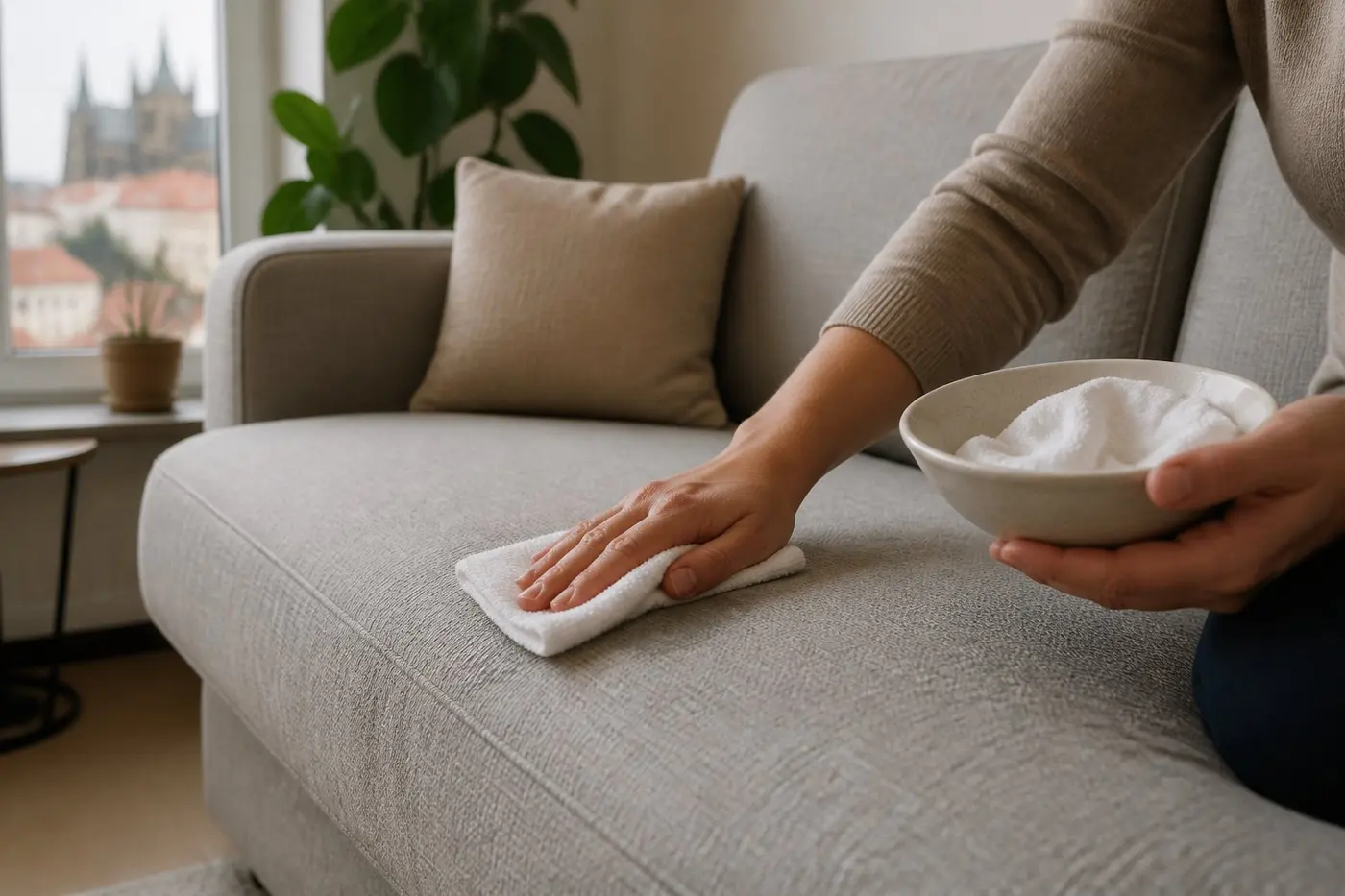
A coffee spill on the sofa invites panic cleaning: sponge, plenty of water, a squeeze of washing-up liquid. That reaction often leaves a larger mark than the original spill. If you want to know how to clean a sofa without a machine, start by identifying the upholstery, use the least moisture that will do the job, and control how the fabric dries. A fresh surface stain is often manageable by hand. Old urine, mould, or wet filling is not.
Check the upholstery and test for colourfastness first
Look beneath a seat cushion, under the frame, or beside the zip on a removable cover. The care label may show an upholstery cleaning code: W permits a water-based product, S calls for a solvent-based cleaner, W/S permits either, and X normally means vacuuming or professional care only. Treat the code as a boundary, not a challenge.
No label? That is common with a second-hand sofa or an older piece that has moved between Prague flats. Dampen a white cotton cloth with your chosen solution and press it against a hidden area near the floor. Do not rub. Wait five to ten minutes, then check the cloth for transferred dye and inspect the upholstery for a change in texture, sheen, or pile. Judge the result only after it has dried completely; wet fabric naturally looks darker.
Avoid home water cleaning on velvet, silk, viscose, some linen blends, and any cover marked X or S unless the maker has approved a specific product. Loose feather filling and a sofa whose inner construction you cannot identify deserve caution too. Water can reach glue, timber, or metal fasteners, and the resulting brown mark may appear hours later.
Remove dust and crumbs before wet cleaning
A sofa should be vacuumed before it is spot cleaned. Remove loose cushions, fit the crevice tool, and slowly cover seams, folds, and the spaces beneath the seats. Fine dust is nearly invisible on grey upholstery. Once wet, however, it becomes dirty slurry. Moisture carries that residue towards the edge of the treated patch, where it dries as a grey ring.
Use a clean upholstery brush attachment on flat woven fabric. For microfibre or a fabric with pile, work out the direction of the nap and brush gently with it. Skip the stiff scrubbing brush. It can flatten fibres and leave a pale circle that no cleaner will remove because it is wear, not dirt.
I once saw this on a beige sofa in a Žižkov flat. A dark ring had appeared after the owner used “only water” on a drop of tea. The real culprit was fine dust in the seam above the spot. Water pulled it down the armrest, turning a tiny mark into a broad tide line. The boring preparation would have saved the sofa a second cleaning.
Work from the edge towards the centre with very little water
Set out two or three white absorbent cloths, a bowl of lukewarm water, and a cleaner allowed by the care code. Do not pour by instinct. With mild washing-up liquid, start with roughly one drop in 250 ml of water. You want a weak solution, not foam. Without an extractor, excess detergent is difficult to rinse out and its sticky residue attracts more dirt.
Blot up anything that can still be lifted with a dry cloth. Next, wet one corner of a clean cloth and wring it thoroughly. It should feel damp, never drip. Work from the outside edge of the stain towards its centre using short presses. Turn to a clean part of the cloth every few touches. Scrubbing spreads the stain sideways and disturbs the fibres.
Match the method to the stain
- Coffee, tea, or a sugary drink: blot first. Use a weak water solution if the care code permits it, then press with a cloth dampened in clean water to remove sugar and cleaner residue.
- Grease: cover a fresh mark with absorbent paper or a light dusting of bicarbonate of soda, allow it to draw up the oil, then vacuum. Add moisture afterwards. If a greasy shadow remains, more washing-up liquid is rarely the answer; use a product approved for that fabric.
- Milk, egg, blood, and other protein stains: use cold to lukewarm water. Hot water sets protein in the fibre. Do not try to bleach blood from coloured upholstery.
- Mud: let it dry fully, loosen it with a soft brush, and vacuum. Rubbing wet soil makes a wide grey-brown border.
Working in small sections does not mean cleaning a sharp little circle in the middle of a cushion. Feather the damp zone outwards or continue to a natural boundary such as a seam. After each section, press firmly with a dry towel. The sofa should not feel wet when you finish. Slightly cool and damp is enough.
Remove odour instead of covering it with perfume
Bicarbonate of soda can help with a mild surface smell if the sofa is completely dry and the maker does not prohibit dry treatment. Apply a thin layer, leave it for several hours, and vacuum meticulously. Test it in a hidden area first. Fine powder can lodge in deep pile and remain visible.
A perfumed spray is camouflage. If milk, beer, or urine has reached the foam, the source remains beneath the cover. A smell that returns in humid weather or when someone sits down is a useful clue: the contamination is deeper than the surface.
Create cross-ventilation in short bursts while the sofa dries, or run a fan so air moves along the upholstery. Do not hold a hot hairdryer close to the fabric, and keep people off the damp seat. In a Prague flat during winter, a cushion may need six to twelve hours. A cold external wall and closed windows can stretch that time considerably. If the filling is still damp or musty the next day, stop adding water.
Why water marks appear and how to even them out
Most water marks on a sofa are not a new stain. They are the boundary between areas that received different amounts of moisture, minerals from hard water, dissolved dust, or detergent carried to the edge as the patch dried. That explains why the ring can look worse the next morning than it did during cleaning.
On W-coded fabric, a small tide mark can sometimes be blended by very lightly dampening the whole visible panel from seam to seam with clean demineralised water. Spray the cloth, not the sofa. Wipe the panel in one direction, then press repeatedly with dry towels. The entire panel needs to dry at a similar rate.
Try that correction once. Stop if the ring expands, dye transfers, the fabric stiffens, or a brown tone rises from the filling. Another round of water will dissolve more material beneath the surface and push the boundary farther out. Given Prague's hard water, demineralised water is cheap insurance for a final blending pass.
When extraction or professional upholstery cleaning is safer
Hand cleaning suits a small, identifiable, mainly superficial stain. Seek help when the affected area covers much of a cushion, has soaked into the filling, or came from a substance you cannot identify. Urine, mould, vomit, musty foam, and repeatedly saturated upholstery are poor candidates for home experiments. With mould, the cause of the moisture and the condition of the filling may matter more than the visible patch.
Be equally cautious with expensive or delicate fabric, a missing care label, unstable dye, and old rings left by earlier attempts. An extractor is not magic. The advantage of a professional process lies in matching the chemistry to the textile, controlling the solution, and removing it thoroughly.
Tell the provider what the fabric is, approximately how old the stain is, what caused it, and every product already applied. Photograph the label and the mark in daylight. Remove throws and loose objects before the visit, but do not wet the stain again.
If the care code is unclear or the ring grew after one careful attempt, send Čistýkout a no-obligation enquiry through the contact form. Čistýkout is a Prague-based option for finding suitable cleaning help. A photo and a short history make it easier to judge whether the sofa needs local treatment, extraction across a whole panel, or replacement of damaged filling.