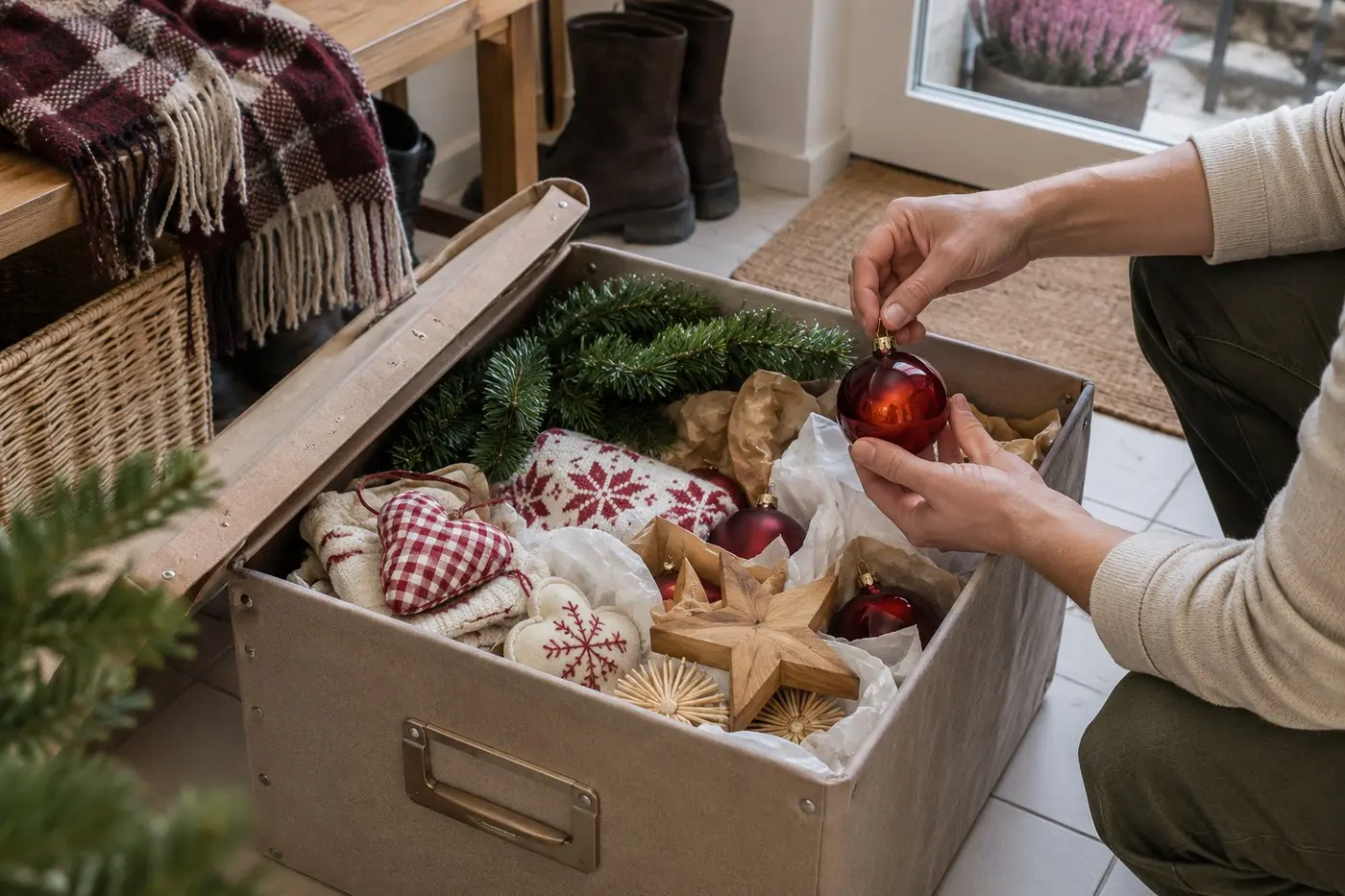
The first time I had to work out how to clean Christmas decorations from a cellar, I made the obvious mistake: I opened everything in the sitting room. The rug got dusty, one paper star smelled damp and suddenly the whole job was bigger. Open the box in the right place and sort before cleaning. Plain dust is usually easy. A musty smell needs investigation. Visible mold, especially on paper, felt or straw, changes the decision completely.
Open the boxes outside the living area first
A cellar box has no business on the living-room rug. In most Prague flats, the tiled entryway will do. A bathroom with an open window or a dry balcony works too. I put an old sheet underneath, not because it looks professional but because I can fold the mess inward and carry it straight to the washing machine.
Look at the bottom, corners and lid before reaching in. Soft damp cardboard, tide marks, a powdery coating or a persistent earthy smell all deserve attention. Avoid putting your face over the opening and shaking things out. If you can see mold, wear gloves, disturb the item as little as possible and move it into a separate bag or lidded container. Children and anyone with asthma or a weakened immune system should stay away from the sorting area. The CDC recommends gloves and an N95 respirator for mold cleanup, with protection suited to the scale of the problem.
My piles are not elegant. One is ready to display. One needs washing. Suspicious pieces go into a lidded tub, and broken ones stay by the door so nobody quietly puts them back. Ten minutes, usually less.
I saw the same mistake in a Prague 6 flat. A family unpacked paper stars on the dining table; only one smelled odd. Half an hour later the tablecloth had picked up the cellar smell, and so had the curtain beside it. Nothing dramatic. Just an evening of washing things that never needed to join the job.
Dust, a musty smell or mold are three different problems
Ordinary dust is dry and fairly even. It should not smell of much. On smooth glass or plastic, try a soft dry cloth first; tougher surfaces may take a barely damp one. Watch the cloth. Once it is grey, it is moving dirt around rather than lifting it. I used to finish the entire box with one cloth. The last baubles came out duller than when I started.
Mustiness tells you the box spent time somewhere enclosed and damp. It does not prove that every object inside is moldy. Smell the empty packaging, then check fabric seams, wreath folds and the underside of wooden figures. A clean, washable decoration may only need several hours in a dry room. Fragrance spray is tempting here. Skip it. You need to know whether the smell is actually fading.
Mold may look like speckles, a fuzzy film or irregular staining that does not disappear when dust is removed. You do not need to identify a species at the kitchen table. Ask a less glamorous question: is the object hard and washable, or can it absorb moisture?
On glass, metal or hard plastic, a small surface patch can usually be removed with water and mild detergent. Then dry the piece completely. That is also the EPA's advice for hard surfaces. Paper, unfinished wood, foam, straw and stuffing are different; mold can travel into the material. I would bag and discard a cheap, heavily affected ornament. An irreplaceable one deserves a conservator, not an experiment with whatever happens to be under the sink.
Bleach is not the universal shortcut people hope it is. It can strip colour, attack metal and weaken glue. The EPA does not recommend biocides such as chlorine bleach as a routine mold-cleaning method. Never mix bleach with other cleaners.
Clean glass, plastic, fabric, wood and paper differently
The maker's label wins. If it has vanished, test a hidden area and wait for the result before carrying on. This feels fussy until red paint comes off on a white cloth. Glitter, hand painting and old glue all need a lighter touch.
Glass and washable plastic
Hold a glass bauble by its body, not by the thin cap. Lift dust with a soft cloth. A fingerprint on plain undecorated glass may come off with lukewarm water and one drop of washing-up liquid, but do not leave the ornament soaking. Skip abrasive sponges and scouring powder. Old painted glass is safer with a dry soft brush; specialist restoration is a better bet than an energetic scrub.
Hard plastic can usually take a damp microfibre cloth. I still would not dunk a hollow piece unless the maker explicitly allows it: a pinhole, a glued seam or a forgotten battery compartment is enough to trap water. That is the sort of tiny January mistake you smell next November.
Fabric
The washing machine is not the first stop for every fabric angel. Turn it over. Check the stuffing, glued beads and wire frame, then test whether the colour moves. Often a soft brush is enough. On sturdier cloth I use a vacuum at low power with clean mesh between the nozzle and the decoration. It keeps small parts out of the machine, which I learned after losing one felt boot up a hose. Wash only when the care label allows it, then dry the filling as well as the outer cloth.
Moldy felt, cotton wool and stuffed figures are difficult to clean throughout. Wiping the surface cannot tell you what remains inside. In a home with allergies, keeping a low-value porous ornament is rarely worth the uncertainty.
Wood, paper, straw and hand-painted pieces
Do not soak these decorations. Loosen dust with a soft artist's brush and catch it with a HEPA vacuum held nearby rather than blowing it through the room with a hair dryer. Finished wood may tolerate an almost dry cloth, followed immediately by a dry one. Test unfinished wood at the back.
Do not dip a mold-marked paper star in vinegar. The paper may buckle, the dye may run and contamination can remain in the fibres. Discard an ordinary mass-produced piece. For a historic nativity set or a family keepsake, isolate the item in a clean container and contact a paper conservator.
Artificial trees and light strings need their own method
A compressor or hair dryer does not clean an artificial tree in the lounge. It relocates the dust, usually onto the sofa. Break the tree into sections over a sheet. I work from the top of each section down with a brush attachment on the lowest vacuum setting, then use a dry microfibre cloth on stubborn areas. An unlit tree may tolerate a well-wrung cloth if its instructions allow it. Give every branch time to dry.
Unplug pre-lit trees and light strings before touching them. Do not spray water onto bulb holders, control boxes or connectors, and never immerse the string. Wipe dust away with a dry cloth, unwind the cable and inspect its full length. Split insulation, green corrosion, a loose socket or a scorched connector is not a cleaning job. Retire the lights. The Electrical Safety Foundation International advises discarding strings with cracked or frayed wiring rather than carrying them into another season with a tape repair.
Store decorations dry so next November does not start with mold
The storage mistake I see most happens before the lid closes. A wreath feels dry, yet there is still moisture deep between the branches. The same thing happens in fabric seams and hollow plastic shapes. After cleaning, leave everything out for a full day in a dry, ventilated room. Yes, the half-packed room is annoying. It is less annoying than opening a moldy box next year.
Do not reuse a damp, smelly or mold-marked cardboard box. The replacement must be clean and dry. A plastic tote keeps out cellar dust and protects against a small splash, but it cannot rescue damp contents. Seal moisture inside and the box becomes a private greenhouse for mold.
Separate fragile glass with dividers and acid-free tissue. Keep textiles away from objects that shed glitter or show rust. Coil cables loosely and label indoor and outdoor sets. A silica-gel sachet can manage minor residual humidity, but it cannot compensate for a wet cellar or a leaking wall.
Write the contents and inspection date on the box. Next November you can check the sensitive fabric container first instead of opening five mystery boxes at once. If preparing the flat for the holidays has grown beyond the time you want to give it, ČistýKout offers a no-obligation cleaning enquiry for homes in Prague. We can help make the room ready for decorating. The decision about which family bauble gets the best branch stays with you.