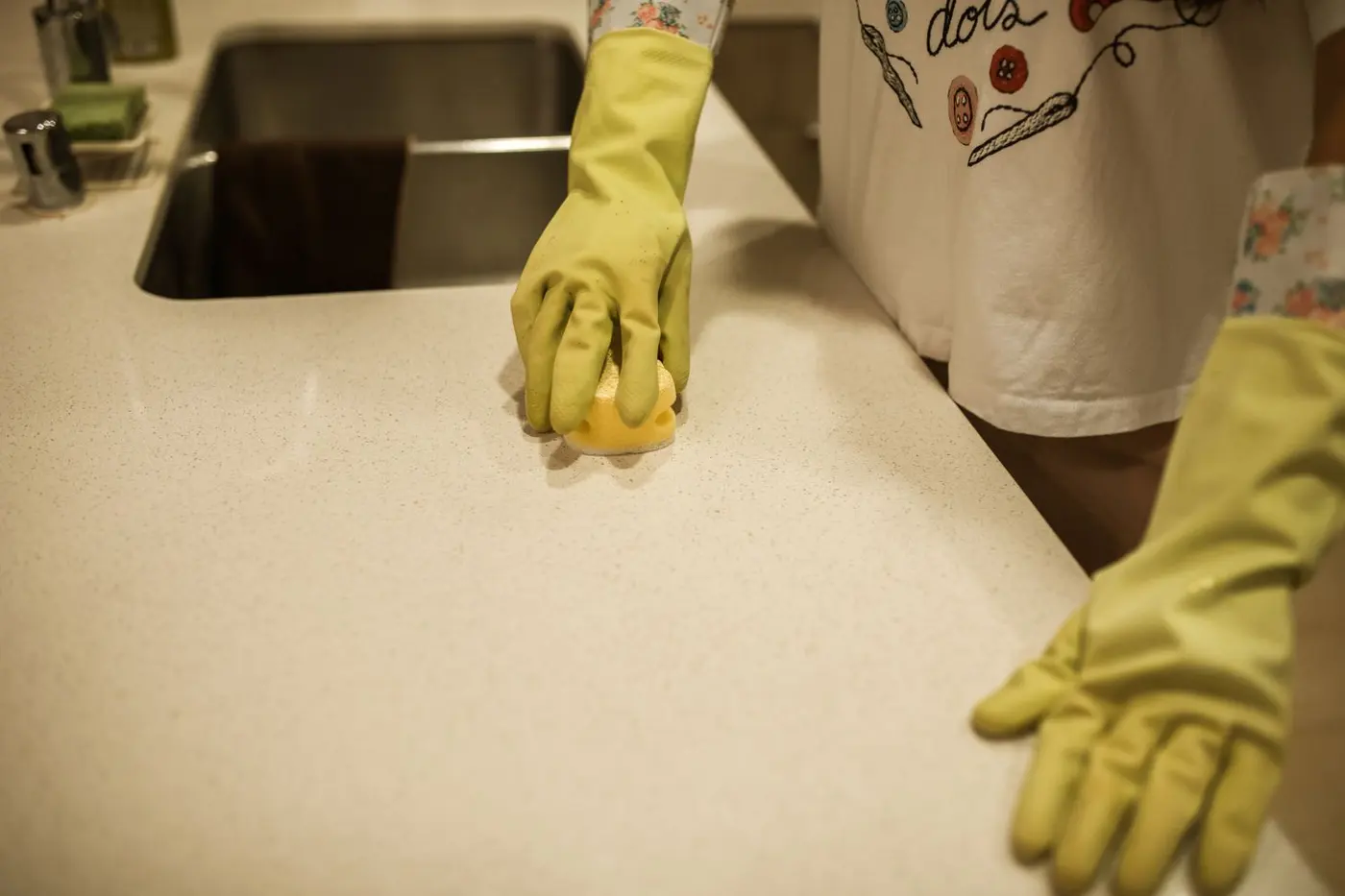
Someone will show me a greasy mark and ask how to clean different surfaces. Fair question, but I want to know what is underneath the grease first. Stainless steel, painted MDF and oiled oak can look equally grubby. Give all three the same blast of degreaser and you may get a clean fridge, a dull cupboard door and a pale patch on the table. I have seen all three. The nine errors in this guide are less about buying the “right” bottle and more about knowing when to put one down.
Work out what you are touching
A pale worktop in a Vinohrady rental once fooled me completely. I was convinced it was stone until the owner found the invoice: compact laminate. The flat downstairs had real marble in almost the same colour. Acid would not care that the two looked alike.
That is error number one: guessing the material from its colour. Check the care booklet, a label under the worktop, the handover report or an old invoice. With timber, “wood” is not enough. Is it lacquered, waxed or oiled? A fashionable black tap may have a very thin coating over ordinary metal.
No answer? I reach for lukewarm water, a clean white cloth and, if water alone does nothing, one drop of pH-neutral detergent. The same material-first thinking appears in our guide to cleaning wooden spoons; “wood” alone does not tell you what its finish can take. Put the test product on a hidden edge. Leave it only as long as the label allows, wipe, rinse and walk away until it is dry. That last bit matters. A wet patch can look beautifully even while the dry finish underneath has gone cloudy.
Then comes error two: extending the dwell time because five minutes must be better than one. It is not a free upgrade. Product left in a joint can continue working after the broad surface has been wiped.
My stop signs are simple: colour on the cloth, a tacky finish, fading, lost gloss or rainbow marks on metal. I do not “give it one more scrub”. That is usually how a two-centimetre problem becomes a twenty-centimetre one.
Toilet gel has a very small job description
A surprising number of damaged taps begin with a sparkling result. Someone puts acidic toilet gel on limescale, the deposit vanishes, and the chrome looks brilliant. By the time the fitting dries, pale stains have appeared. Error three is taking toilet cleaner beyond the ceramic bowl it was made for.
Strong acid may attack a coated fitting, cement grout or nearby stone. The first shine proves only that it removed the deposit, not that the finish survived.
I start ordinary tap deposits with a warm damp cloth and a little mild bathroom product approved for that exact finish. A short soak softens the crust. Then a soft cloth or brush, a clean-water rinse and a dry towel. Matte black, brass-look and gold-look fittings deserve their own instructions; I never borrow the chrome routine without checking.
Grout needs a quick diagnosis too. Dirt, mould and crumbling cement are three different problems. Cleaner cannot rebuild a joint. If nobody knows whether it is cement or epoxy, that is my cue to leave the strong acid capped.
Vinegar: useful, cheap and not remotely universal
Vinegar does dissolve some mineral deposits on acid-resistant surfaces. It is also responsible for plenty of vinegar cleaning damage. On marble, limestone or travertine, the acid can react with the stone and leave a dull etched mark. Coated metals, grout and appliance seals can be sensitive as well.
So error four is calling vinegar “natural” and assuming that means harmless. Chemistry does not award safety points for coming from the kitchen cupboard.
The bottle itself needs reading. In Czech shops, fermented spirit vinegar for food, clear white vinegar and cleaning vinegar can have different acid concentrations. Clear liquid tells you nothing about strength. Neither does a thirty-second video.
Where a manufacturer explicitly permits vinegar, use the weakest recommended dilution, keep the contact brief, rinse properly and dry. I would not pour it into a washer, dishwasher or coffee machine merely because a neighbour does. The seals and internal metals may not match.
There is a second trap here, error five: treating an etched stone mark as dirt and attacking it again. Etching is a change in the material, not residue on top. More acid will not undo it. Nor will enthusiastic scrubbing. For an expensive counter, call someone who works with stone before the small mark grows.
Stainless steel, glossy paint and screens
The most memorable fridge mishap I have seen was not dramatic. No smoke, no peeling paint. Just one powerful kitchen spray applied directly to the door and a web of streaks that returned whenever the light changed. That is error six: spraying an all-purpose degreaser straight at a coated appliance or control panel.
Liquid runs. It finds seams, speakers and buttons. Alcohol, alkaline ingredients or solvents may affect printed markings, paint and the oil-resistant coating on a screen. Even on stainless steel, an oversized dose often dries into stripes.
For steel, I use damp microfibre and follow the visible grain. If grease remains, a small amount of approved stainless cleaner goes on the cloth, provided the appliance manual agrees. A separate damp cloth removes residue; a dry one finishes. The method is covered in more detail in our guide to cleaning a stainless-steel cooker hood. Scouring powder and a rough pad are particularly unforgiving under a cooker-hood light.
Microfibre is not magic armour. Error seven is pressing harder because the cloth feels soft. One grain of grit caught in it will scratch glossy paint, a ceramic hob or a display. I keep the screen cloth in a separate drawer for exactly this reason. It never goes near the floor bucket. Before touching a display, I also check the device maker's advice; more often than not, it asks for dry or barely damp microfibre and no window spray.
Two cleaners do not make a better cleaner
This is where I am stubborn. If one chemical disappoints, I do not add another and hope for a livelier reaction. That is error eight. Chlorine bleach stays away from acids, including vinegar and some toilet products, and from anything containing ammonia. Those combinations can release toxic gas. The rule applies to a wet surface too: “one after another” is still a mixture when the first liquid has not been rinsed away.
One product. Original labelled container. Directions followed. In a small Prague bathroom I open the window or door and run the extractor before starting. Gloves go on when the label calls for them. I would never transfer cleaner to an unmarked drinks bottle; someone else has to live in that home after I leave.
Once the air smells sharp or my eyes start burning, the cleaning job is over. I leave for fresh air. Coughing or trouble breathing gets the same response, immediately. I would not pour in a third product to “neutralise” anything; that can trigger another hazardous reaction. Severe or continuing symptoms need the local emergency service, and the responders will want to see the original bottles.
My routine in a client's home
The last problem usually arrives disguised as speed. A new cleaner wants the client to see progress and reaches for the toughest bottle in the caddy. Material first, questions later. That is error nine. I understand the pressure, especially on a first booking, but a minute with the care label is cheaper than replacing a coated tap or kitchen door.
This is the routine in my notebook:
- Photograph the whole area and any old scratches, stains or lifting paint.
- Ask what the material is, how it was finished and what was used on it last.
- Read the surface instructions as well as the cleaner label.
- Remove dry dust from top to bottom. Try water and gentle mechanical action before chemistry.
- Spot test cleaner on a hidden patch, using little product and short contact. Judge it dry.
- Increase only one thing at a time: concentration, time, temperature or pressure.
- If the finish changes, document it and stop until the client agrees on what happens next.
The honest answer to how to clean different surfaces is not terribly glamorous. Use the mildest compatible method that shifts the dirt. That is what safe cleaning products are: not universally gentle liquids, but products matched to a known material and used as directed.
Not keen to use a rental flat as a chemistry test? Send ČistýKout a no-obligation enquiry through the contact form. Tell us what the surfaces are, or simply say that you do not know. That gives you a more sensible route to a Prague cleaner than gambling on the strongest spray in the cupboard.