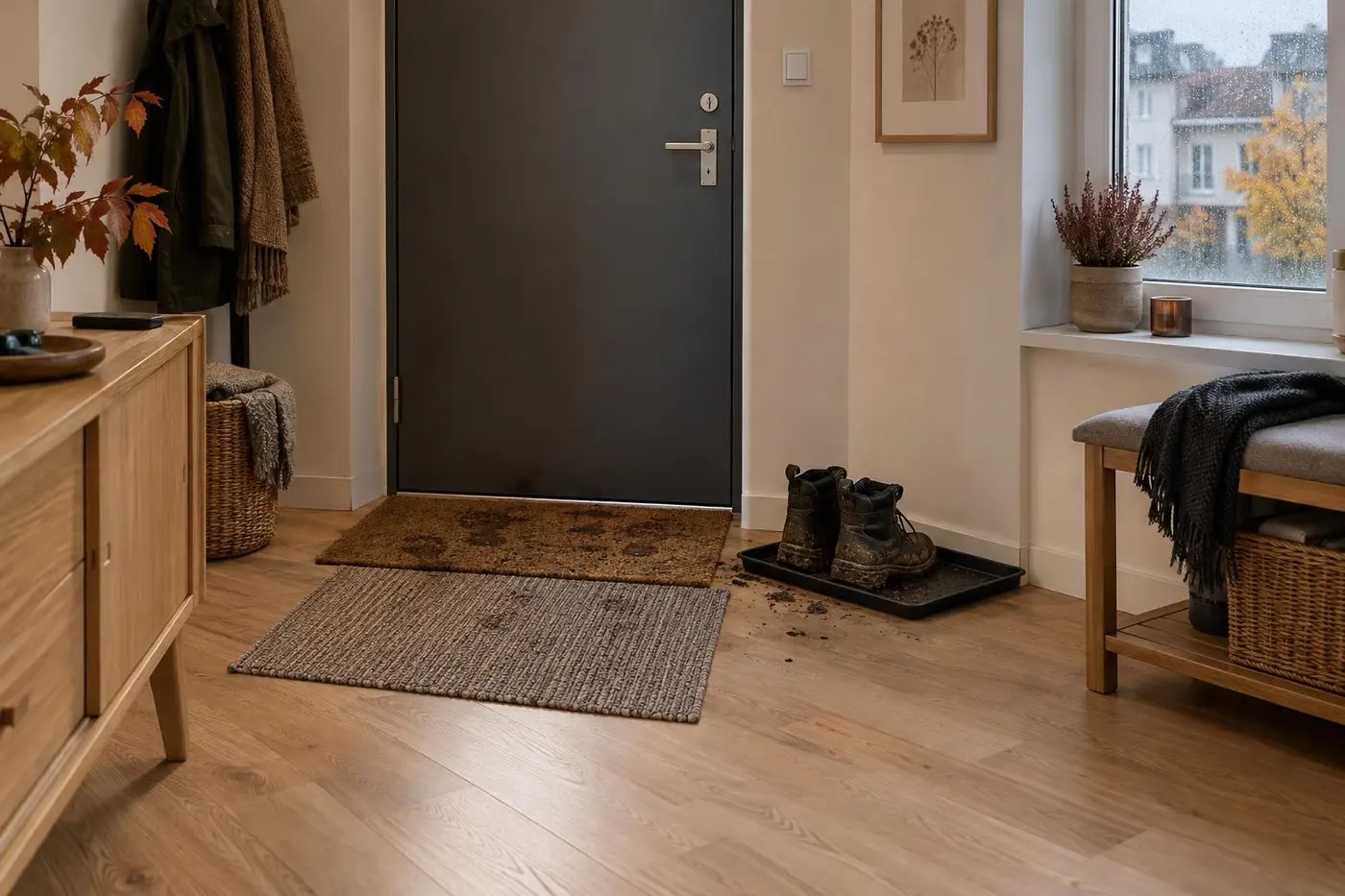
How to clean mud from entryway floors without mopping half the flat every rainy evening? Do most of the work before the mop comes out. Split the entrance into a scraping point, an absorbent zone and a short dry route to the shoe rack. Pick up grit first and wipe second. Reverse that order and three muddy footprints turn into grey slurry stretching towards the kitchen.
One small doormat will not stop most autumn dirt
A postcard-sized mat works only if everyone pauses and scrapes both shoes properly. That rarely happens when someone is holding shopping, a dog lead and the front door at the same time. Set up the entrance for the way people actually move through it.
The outdoor mat, or the one immediately outside the flat, should deal with coarse dirt: small stones, leaves and thick clumps of mud. Inside, add an absorbent mat that dries reasonably quickly. It does not need a clever slogan. It needs enough length for two natural steps and a backing that will not slide across the floor.
Now walk from the door to the shoe rack. If the route crosses a patch of clean floor, the system has a gap. Put the shoe tray, bench or rack at the end of the wet zone rather than around a corner. In a narrow Prague panelák hallway, rotating the shoe cabinet and running the inner mat along the wall can be enough. Nobody then has to balance on one sock while the other shoe drips on laminate.
Muddy entryway cleaning starts with the floor plan, not the detergent. When dirt cannot bypass the mats, much less of it reaches the rest of the home. The same layout also catches finer particles; this guide to where pollen and dust settle indoors explains the wider household route.
Wet shoes, umbrellas and dogs need their own landing spots
Wet belongings need somewhere deliberate to go. A low washable boot tray with a raised edge catches dripping water and the mud that flakes off as shoes dry. You can carry it to the bathroom without leaving a trail through the hall. If you add a fabric liner, choose one that can be washed and dried fast. Permanently damp cloth under a pair of boots becomes an odour source.
With a dog, "we will wipe the paws in a minute" is usually too late. Hang an old towel or absorbent cloth beside the door and keep a spare nearby. A few seconds spent on paws and the underside of the dog after a walk through Stromovka can prevent dozens of marks.
Give umbrellas a container that can be emptied and wiped. Do not lean them against a cabinet and let water run behind the plinth. Check the floor under furniture and beside threshold strips too. A hidden puddle beside a wood floor can cause more damage than the ugly patch of mud everyone notices immediately.
I once saw a handsome oak floor in a Prague flat protected by a generous entrance mat. The children's wet boots were always left just beyond it. Water sat under the edge of the shoe cabinet for hours. The mat was not too small. The missing piece was a boot tray thirty centimetres to the side.
Pick up sand before you start wiping
Blot fresh standing water straight away. A mound of mud can sometimes wait a few minutes, provided nobody will tread through it. Partly dried soil is easier to lift with a dustpan or vacuum than wet soil. The important part is removing sand and tiny stones before a mop drags them across the surface. Those particles are abrasive.
When I need to clean mud from the floor, I use this order:
- Stop foot traffic over the patch and move the wet shoes into their tray.
- Blot loose water with an old towel or absorbent cloth.
- Once the deposit is loose enough, vacuum with a suitable hard-floor head or sweep gently.
- Wipe the residue with a clean, well-wrung pad, moving from the cleaner edge towards the dirt.
- Change or rinse the pad before it turns grey. Dirty bucket water is not proof of effort; it is often mud being spread back across the floor.
A damp microfibre cloth may be enough for a small patch. A full mop wets the clean area as well. Measure floor cleaner according to its label. A stronger mix can leave a tacky film, and fresh dust will stick to that film faster.
Wood, vinyl and tile need different methods
The usual "warm water and detergent" advice is too blunt for an entryway. Identify the flooring and check its care instructions first. If you cannot tell whether the surface is oiled wood, sealed parquet or laminate, begin with the least wet method and test in an inconspicuous place.
Wood and parquet
Standing water and damp joints are the main risks. Remove loose dirt dry, then use a well-wrung pad and a cleaner approved for that finish. Dry joints and edges promptly. Keep a steam mop away unless the flooring manufacturer explicitly allows it.
Vinyl and laminate
Vinyl often tolerates moisture better, but damaged edges, adhesive and joins still deserve attention. Use even less water on laminate. Lift the doormat after a wet day and check underneath and beside transition strips. Repeated dampness likes to hide there.
Tile and grout
Tile can take a more thorough wipe, but dirty water settles in grout lines. Remove grit first, then wipe with a clean pad. If the floor is natural stone, avoid acidic homemade mixtures unless the manufacturer has confirmed they are safe. Standard ceramic tile does not need half a bottle of detergent either. Residue can dry into a slippery film.
Later in the season, road salt adds white marks. Vacuum dry crystals rather than grinding them under shoes. Wipe the floor with clean water only if the material permits it, then dry it. Persistent residue needs a product approved for that floor. Vinegar is not a universal rescue, particularly on stone, vulnerable grout or some wood finishes.
Clean the mat before it starts putting dirt back on shoes
A loaded mat stops behaving like a filter. Every footstep releases some of its trapped grit and moisture back onto the sole. In a home with children or a dog, check mats every couple of days during a wet spell rather than waiting for an end-of-month clean.
Vacuum the top first. Lift the mat carefully, vacuum its reverse and clean the floor beneath it. Check whether a rubber backing is damp, cracked or starting to curl. Washing, rinsing and detergent choice depend on the label and material. Coir, cotton and synthetic barrier mats do not share one cleaning method.
After wet cleaning, let the mat dry completely away from the floor. Returning it damp invites musty smells and marks; on wood, it can also trap damaging moisture. Replace a mat when the edge curls, the backing slips or an odour remains after proper cleaning. Keeping a failed mat for one more winter is false economy.
Adjust winter cleaning frequency, not the whole service
Autumn dirt does not turn every professional visit into a deep clean. A regular cleaner can give the entrance, mats, space under the shoe rack and connecting hallway a few extra minutes during the wet season. A lower-priority task can move, or the gap between visits can become shorter for a while.
Agree on three practical details before the visit: who clears shoes and the pushchair from the floor, whether mat cleaning is included, and where to find products suitable for the floor. A cleaner should not have to guess which finish is on an oak surface. Nor should half the booked time disappear into moving seasonal equipment.
Price higher frequency separately from a deep clean. One short extra visit during the wettest weeks may do more than a long rescue job after two months, especially in a home with a dog, young children or a door straight onto the garden.
A workable entrance is not complicated. It has two mats, a contained wet zone, a boot tray, a towel within reach and the right cleaning order. When the setup fails, the trail is visible at once. When it works, most of autumn stays by the door.
If you would like to adapt regular cleaning for Prague's wet season, Čistýkout is a local option. Send a no-obligation enquiry through the Čistýkout contact form and mention the floor type, entryway size and whether dog paws, a pushchair or road salt are the main issue. The scope can then stay focused instead of turning into an automatic deep clean of the entire home.