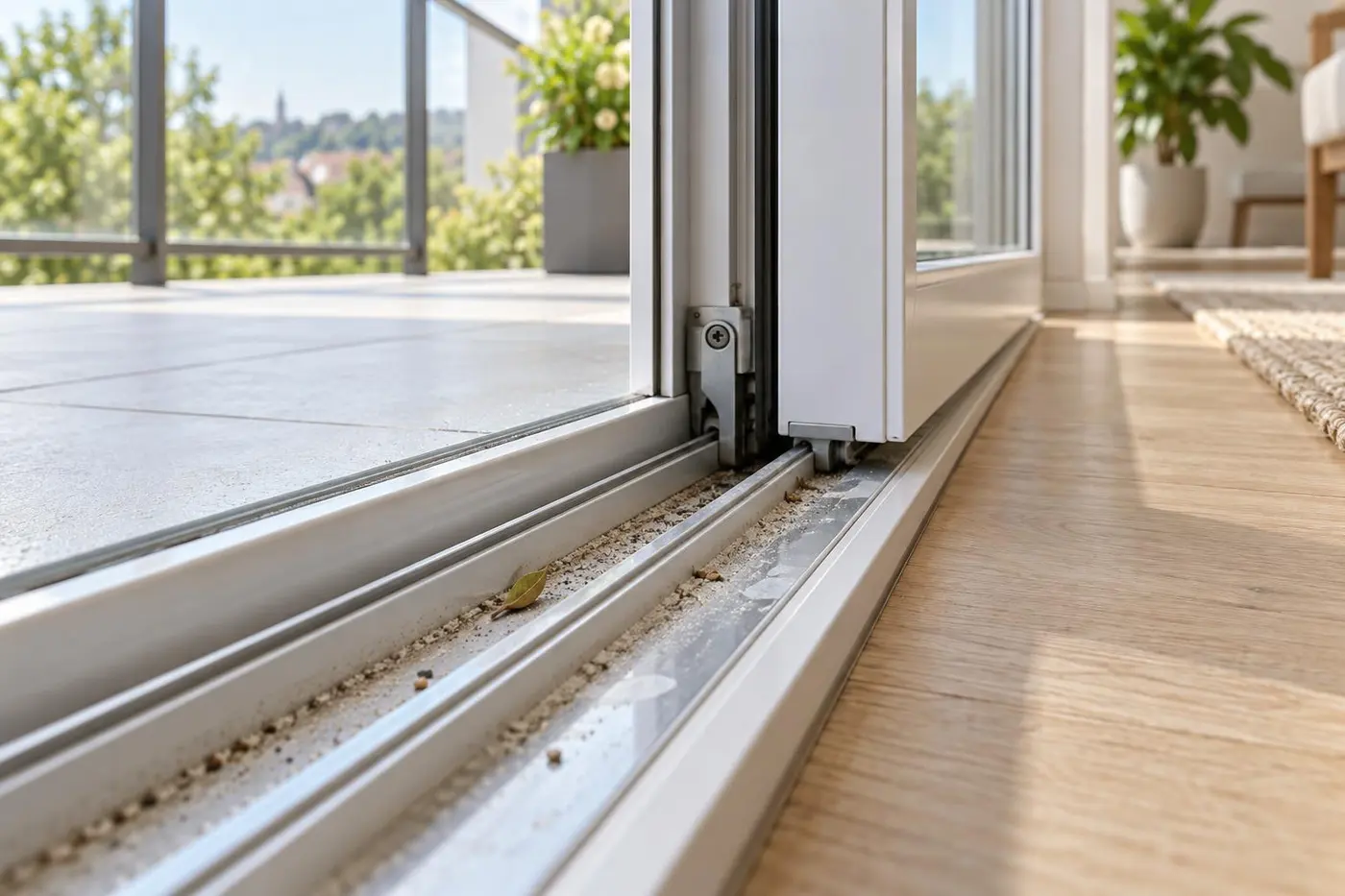
If you are wondering how to clean sliding door tracks, the safest sequence is dry debris first, carefully measured moisture second, and thorough drying last. A balcony-door channel is not simply a narrow shelf. It may contain drainage routes, moving hardware, rubber seals and brush strips that can be damaged by flooding, hard scrubbing or a piece of wire pushed into the wrong opening.
In a Prague flat, fine street dust can mix with pollen, insects and wind-driven rain within a few weeks. The result is a dark ridge at the end of the track. It looks like a five-minute wiping job, but adding water too soon creates mud and pushes it beneath the moving panel. Treat the track as a small mechanism and the job becomes both cleaner and safer.
Identify the track and drainage layout first
Slide the door in both directions and inspect the whole lower frame. A phone torch held at an angle makes small holes, loose seals and scratches easier to see. An aluminium track may have anodised or painted finish; a uPVC profile has softer edges that can be marked by the abrasive side of a sponge. You may also find a rubber gasket and a dense brush strip beside the fixed channel. Those bristles are easy to bend, pull out or gum together.
Now locate the sliding door weep holes. Depending on the system, they may sit inside the lower frame, along its outer face or behind a small plastic flap. Do not assume that every hole, screw recess or installation cavity is a drain. Check the manufacturer's care guide or identify the frame system before touching an uncertain opening. Never enlarge a hole with a drill or probe it blindly with metal wire. A membrane, seal or concealed drainage path may sit just behind it.
Test any cleaner on a hidden centimetre of the frame. This matters on dark aluminium, foil-wrapped uPVC and timber thresholds. I do not automatically recommend the popular baking-soda-and-vinegar trick here. Grit can dull a finish, acid may be unsuitable for nearby stone or seals, and energetic foaming can carry dirty liquid deeper into the frame. You can compare the general sequence with ALUPROF's window and door care guide, though the instructions for your own system still take priority.
Remove dry debris before adding water
Start with a clean crevice nozzle on the vacuum. Expose one section of track, vacuum it, then move the door and continue. Keep the nozzle away from brush seals and do not press it onto a rubber gasket. If it will not fit the narrowest groove, loosen the debris with a soft paintbrush while holding the vacuum beside it. The brush lifts grit from the corner; the airflow captures it immediately.
I once cleaned a track in a Prague 9 flat that seemed to contain nothing worse than grey dust. A soft brush released a small pile of sand, several dead flies and a knot of hair trapped near the carriage. Spraying that mixture first would have turned it into sticky paste. Paste wipes easily from the open rail and stubbornly from the closed end beneath the panel.
For dry material stuck in a corner, try a soft brush, a cotton bud or a blunt wooden stick wrapped in cloth. Leave knives and screwdrivers elsewhere. They scratch the coating and may nick the narrow running surface used by the roller. If the panel still drags after the channel is clean, or movement produces a metallic grinding sound, stop pushing harder. The door may need roller adjustment or repair.
A small, useful kit
- a vacuum with a crevice tool and soft paintbrush,
- two absorbent microfibre cloths, one damp and one dry,
- cotton buds or a blunt wooden stick,
- clean water and a small amount of neutral cleaner approved for the frame,
- an old towel to protect the floor beside the threshold.
Damp-clean without flooding the mechanism
Only introduce moisture after loose grit has gone. Put the cleaning solution on the cloth or soft brush, not into the channel. It should feel damp without dripping. Plain water with a tiny drop of mild washing-up liquid is often enough for routine dirt on uPVC or coated aluminium, but the manufacturer's instructions take priority. Strong alkaline degreasers, chlorine and abrasive powders add risk without adding much value.
Work in sections of roughly 20 to 30 centimetres. Loosen residue with one cloth and lift it straight away with the second. A cotton bud follows tight corners; for a wider groove, wrap cloth around a blunt wooden stick. Do not let grey water travel along the frame. Blot it with an absorbent cloth, or use a wet-and-dry vacuum if you own one. Never collect liquid with a standard dry vacuum.
Lay an old towel over laminate, timber flooring and the wall finish at the threshold. Water escaping from a low, nearly level balcony sill can disappear beneath a flooring trim before you notice it. This is why spraying directly into the rail is a poor bargain: it feels quick, but you lose control of the liquid.
Dampen a stubborn mark twice rather than soaking it once. Follow the product's stated contact time and watch the surrounding finish. If the coating turns dull, the rubber becomes tacky or colour transfers onto the cloth, stop and wipe the area with a clean, barely damp cloth.
Clean weep holes, seals and brush strips gently
Approach the drain only after vacuuming. Otherwise, you simply send grit into a hidden passage. Lift visible dirt at the entrance with a wooden tool or damp cotton bud. Test drainage only by the method described by the frame manufacturer. Some systems permit a small measured amount of clean water; others are checked from the exterior. A pressure washer, steam cleaner or forceful bottle rinse can drive debris and moisture into places that are meant to stay dry.
To clean sliding door seals, wipe along their length without stretching them. Hold the gasket close to the area you are cleaning so it cannot pull out of its groove. Vacuum a brush strip gently from a short distance, then comb it in the direction of the fibres with a dry, soft brush. If damp wiping is allowed, use an almost-dry cloth and avoid rubbing across the bristles. Missing, permanently folded or bonded bristles require replacement rather than stronger cleaning.
Press a dry microfibre cloth into every channel when you finish. Leave the door open until the track, seals and brush strips are completely dry. Closing a wet panel and hoping it will dry by itself traps moisture in the least ventilated ends of the frame.
Lubricant is not an automatic final step
A freshly cleaned rail does not always need lubrication. Some systems use self-lubricating rollers; others specify a particular silicone product at a defined point. Oil or grease spread along an exposed track catches the next load of dust. If cleaning has not restored easy movement, check the care guide and arrange adjustment rather than experimenting with a general-purpose spray.
Is it mould, corrosion or ordinary grime?
A black speck is not necessarily mould in window tracks. Dust mixed with oily residue forms a grey-black film, usually without a musty smell, and it wipes away evenly once dampened. Mould often appears as irregular colonies or spots and may smell stale. Corrosion belongs to the metal itself: it can look white and powdery on aluminium or orange-brown on a steel component. A mark that remains after gentle wiping is not an invitation to scrub harder.
For a small surface finding on a washable part, follow the frame maker's guidance and the label on a compatible mould product. Ventilate the room, wear gloves, and never mix chlorine cleaner with vinegar, acid or another cleaning chemical. Repeated growth on porous timber, failed sealant or a threshold that becomes wet after every rainstorm is no longer a simple cleaning problem. The moisture source needs attention.
Stop and seek technical help if water remains in the track long after rain, the floor beside the sill becomes damp, the gasket lifts, or staining returns beneath the frame. The same applies when a drain appears blocked beyond its visible entrance, corrosion is developing, or the door sits out of square. A service technician can inspect concealed channels, installation seals and rollers without damaging them.
Two minutes after rain prevents heavy scrubbing later
After a strong shower, remove leaves and insects, blot any standing water and look for mud at the visible drain entrance. A street-facing balcony or a flat beside a park may need a weekly check during the pollen season. A sheltered loggia several floors up can often go longer. Exposure to wind and direct rain matters more than a fixed calendar.
Vacuum the track about once a month. Damp-clean it when needed, commonly alongside spring window cleaning and again before wetter autumn weather. While cleaning the door seals, look for cracks, stretching or sections that remain flattened. Five minutes of light maintenance is kinder to the mechanism than one aggressive annual scrub.
If the track contains old mud, the drainage path is unclear or staining has reached the floor, take a photograph before cleaning. It helps a technician or cleaner separate safe surface work from a repair. For a fuller window-and-balcony clean, send ČistýKout a no-obligation enquiry. It is a Prague-based option; mention the frame material, the extent of the dirt and whether water remains in the track after rain.