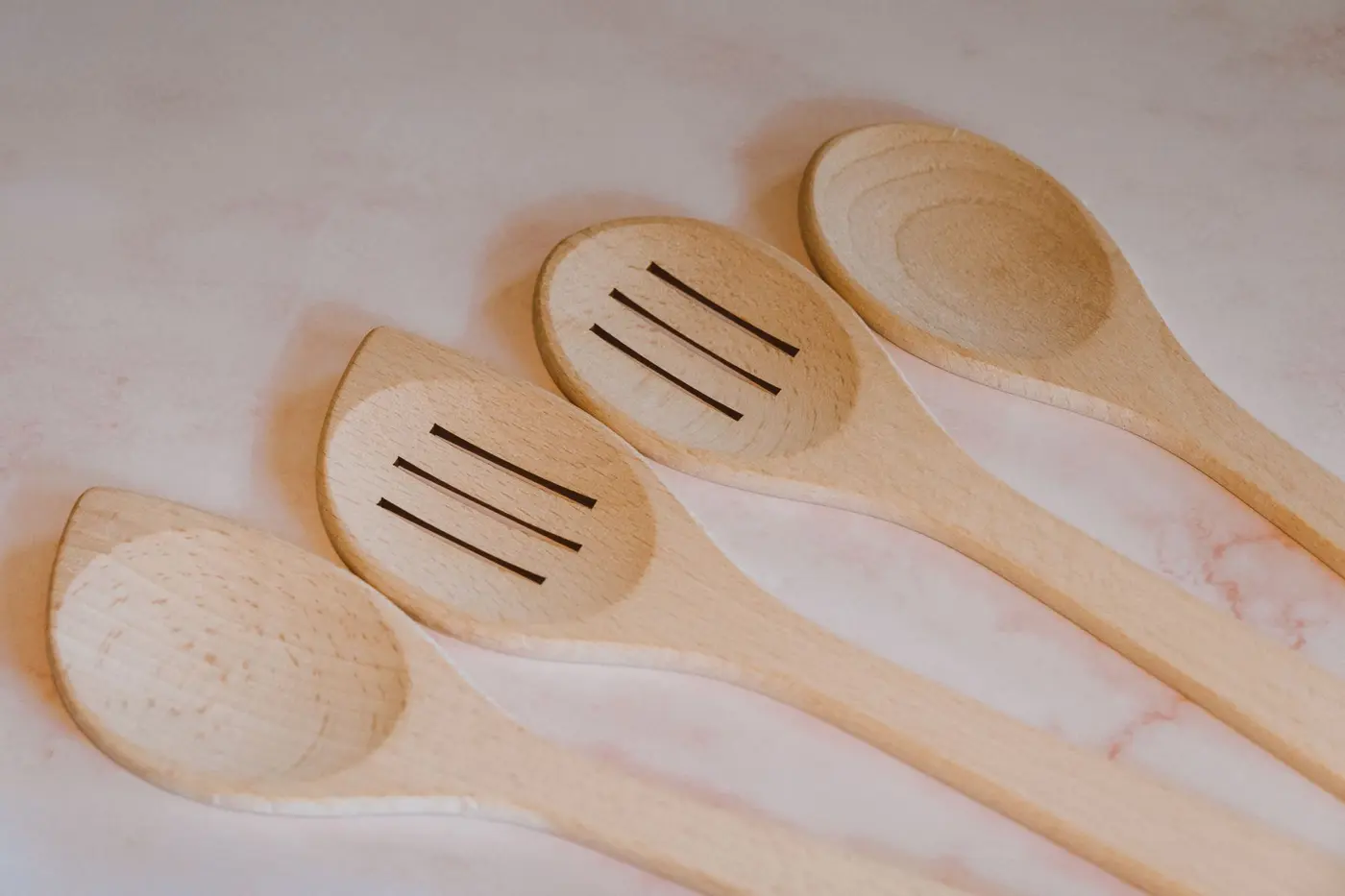
I once threw away a perfectly sound wooden spoon because it had turned orange after a pot of tomato sauce. A week later I kept another one that really should have gone: it had a fine split along the bowl and smelled faintly musty when dry. I had judged both spoons the wrong way round. That small mistake explains most of what matters here. When deciding how to clean wooden spoons, colour is less useful than hardness, smell, and the condition of the grain.
Why wood needs different treatment from plastic or metal
Pick up a used wooden spoon and look closely. The surface isn't sealed like steel or plastic; its pores and fibres take up a little water, cooking fat, and whatever was in last night's pan. Curry leaves a smell. Tomato gives pale beech a red cast. Neither automatically makes the spoon unsafe. If the wood is hard and smooth, a paprika tint is usually no more than a record of dinner.
The real nuisance is time spent wet. During a soak the fibres swell; later they contract. Do that often enough and the spoon starts to feel furry, bends slightly, or splits. Food then settles beyond the reach of a sponge. In our kitchen the danger isn't an elaborate cleaning mistake. It's the spoon left in a saucepan while we eat, then forgotten beneath two plates in the sink until breakfast.
So I check the material before worrying about its looks. A toasted tip, even grey patina, or faint stain comes with ordinary use. A musty smell on thoroughly dry wood is different. So are a soft patch, slime, splinters, deep grooves, or visible mold on wooden utensils. Those aren't charming signs of age.
How to clean wooden spoons after everyday cooking
Most evenings I do nothing clever. I wash the spoon by hand as soon as the pan is empty and keep the whole encounter with water brief.
- Scrape or wipe off food residue.
- Wash under warm running water with a drop of dishwashing liquid and a soft sponge.
- Clean the edges and the join between the handle and bowl without using steel wool.
- Rinse thoroughly so no detergent or perfume remains.
- Towel it off, then leave it where air can reach every side.
That is a one-minute job. After rinsing, I wipe the spoon and stand it handle-down, with some space around it. Left flat on a wet draining mat, the underside stays damp for ages. Wedged among three other wet tools, it isn't much better.
There is a small Prague-flat problem here. The utensil pot usually lives beside the hob because the worktop has nowhere else to spare. Steam and grease keep reaching it. In a Vinohrady kitchen I visited, the owner blamed old wood for a tacky feel; moving the pot to a shelf overnight solved most of it. Try that before buying anything.
Removing grease, stains, and a smell that will not leave
This is where internet advice tends to become one large bowl of baking soda. I don't find that useful. Grease, pigment, and odour behave differently, and the mildest treatment that matches the actual problem is usually enough.
For a greasy or sticky surface
First I wash it again, using warm water, new dishwashing liquid, and a genuinely clean sponge. That last detail caught me out once: the old sponge was putting grease straight back. A dry spoon that remains sticky may have been coated with olive or sunflower oil in the past, and the oil has gone rancid. Very fine abrasive paper will take off a shallow spoilt layer. I wipe away every speck of dust before treating the clean wood.
For tomato, beetroot, or turmeric stains
Deal with the mark while it is fresh. On pale wood, I use half a lemon and a pinch of salt, rub lightly, wait a few minutes, and rinse. The pigment often fades. The spoon won't look new, which is fine. Scrubbing hard enough to erase every orange trace does more damage than the trace.
For onion, garlic, or spice odours
I wash first and make no judgement until the spoon is properly dry. Wet wood always smells stronger. If the dry spoon still reeks of garlic, I dampen it, rub on a little baking soda, wait several minutes, then rinse and dry it again. Sometimes that settles the smell. No amount of soda, however, reaches food trapped down a crack.
Vinegar gets the same restrained treatment. I mix one part plain white vinegar with four parts water and wipe the wood; I don't give it a bath. It is rinsed and dried right away. Leaving the spoon submerged for an hour only swaps one problem for another. “Natural” doesn't stop acid and water from being hard on wood.
Boiling makes a persuasive video. The water turns cloudy and it looks as though years of dirt have been defeated. Some fat and pigment have indeed come out, but water has also travelled through the spoon. A twist or split may show up only during drying. I leave bleach, concentrated disinfectant, and harsh scouring powder out of this job too. Deep contamination in an inexpensive utensil calls for a new utensil.
Can wooden spoons go in the dishwasher?
No, although one accidental trip through the machine isn't necessarily a funeral. Wooden spoons in a dishwasher get hot water for far too long, a strongly alkaline tablet, and heated drying. The grain expands and contracts while its protective oil disappears. Mine survived one mistaken cycle without drama; repeated washes are what turn a smooth spoon rough and shorten its life.
After an accidental dishwasher cycle, I leave the spoon alone at room temperature. A radiator or warm oven would force the drying and may make a split worse. The next day, under a good lamp, I turn it over slowly and feel along every edge. If it is straight, solid, and uncracked, it stays. A little surface fuzz can be taken down with roughly 400-grit paper.
Only then do I reach for oil, and specifically food-grade mineral oil sold for chopping boards and utensils. The bottle of olive oil beside the cooker is tempting but wrong for this job; vegetable oils oxidise and can smell stale. I rub a small amount into clean, dry wood, leave it for a few hours, and wipe away anything that hasn't soaked in. A maker's own care note takes precedence.
This oil is maintenance, nothing more. It won't disinfect a spoon, glue a split, or imprison mold safely beneath a shiny finish. If the wood isn't sound before oiling, the bottle cannot rescue it.
When to save a wooden spoon and when to bin it
I will clean a stain, chase a mild odour, and sand a slightly furry patch. I will not bargain with a deep crack. Once an edge splits, the wood softens, or a groove catches my fingernail, food has somewhere to hide that ordinary washing cannot reach.
Visible mold ends the discussion, especially if it returns after washing, follows the grain, or smells musty. Sanding away one dark dot may look convincing. At home, though, I can't see how far the growth has travelled. A replacement spoon costs little; guessing isn't worth it.
My rule now is blunt: keep cleaning when the change is superficial and the dry wood stays hard, smooth, and odour-free. Bin it when damage goes into the grain, or when the spoon is soft, cracked, splintering, or moldy.
Every few months I empty the utensil pot while cleaning the kitchen. Dry pieces are lined up on the worktop, edges checked, handles flexed very lightly. Almost every household seems to have the same veteran hiding at the back: burnt at the tip, split near the bowl, kept mostly from habit. It has earned retirement.
My whole routine fits on one line: wash promptly, never soak, let air around the wood, and look at it now and again. The spoon still takes a minute. If the kitchen around it, or the entire flat, needs rather longer, send ČistýKout a no-obligation cleaning enquiry. We arrange cleaning help in Prague around the job and timing you actually have.