Getting cleaning reviews without sounding desperate or awkward is an art that starts long before you send that first request. Most small cleaning services in Prague don't lose potential clients because they do a poor job. They lose them the moment a prospect opens their profile and finds a couple of vague sentences, no recent proof, and zero concrete feedback from real people. When that happens, they simply move on to the next option. I see this pattern constantly: a cleaner delivers a solid, professional service in a Vinohrady flat or a Karlín office, the client says a quick thanks with a smile, and that’s where it ends. Yet, right there lies the most affordable and powerful trust signal you could ever hope to collect.
Why your first reviews matter more than any discount
When you’re starting out, it’s tempting to take the easy route: slash your prices. But while a discount might help you land a job once, cleaning service reviews keep working for you 24/7. For a new client, those reviews are the fastest way to build a mental picture of who you are—whether you’re reliable, if you show up on time, and if the apartment really is clean or just "tidied up" on the surface.
This is especially critical in an industry where you’re being invited into someone’s private home. In an e-shop, the biggest risk is a bad purchase. In cleaning, clients are handing over keys, granting access to their privacy, their pets, and often their most valuable possessions. That’s why genuine cleaning testimonials carry much more weight than a "10% off your first visit" offer. A discount says you want the job; a review says you’ve earned it.
You can see the difference clearly on any platform. Take two profiles side-by-side with similar pricing and services. One has four short but specific reviews: “She arrived exactly on time, tackled the kitchen grease perfectly, and the key handover was seamless.” The other has nothing. The first profile will almost always get the response.
Then there’s the price negotiation. If you have zero reviews, every conversation will inevitably revolve around your hourly rate. But as soon as you have five or eight quality ratings, the dynamic shifts. You’re no longer the one defending your price—your previous clients are doing that work for you. For solo cleaners and small teams, that’s a game-changer.
Remember, reviews don’t just stay in one place. When someone looks for "Google reviews for cleaners" or tries to vet you before a first meeting, they’ll check your Google profile, your website, or your social media. You don't need hundreds of them—just a handful that are recent, believable, and detailed.
When to ask for a review so it doesn't feel awkward
Timing is the difference between a natural request and an annoying one. The best moment isn’t "whenever you have a second," but shortly after a job well done while the positive experience is still top-of-mind. The client doesn't need to be jumping for joy; a simple signal is enough: they compliment the bathroom, thank you for the smooth communication, or book their next session right away. These are the moments when asking for a review feels like a natural next step, not a burden.
However, I strongly advise against messaging them five minutes after you’ve left the building. If they haven’t even had a chance to walk through the rooms yet, it’s too soon. Sending a quick note that evening or the following morning usually works best. For recurring clients, it often feels more natural to ask after the third or fourth visit, once you’ve transitioned from being "the new cleaner" to someone they truly trust.
Keep an eye out for these three signals:
- The client gives you a specific, unprompted compliment.
- They respond quickly and warmly, rather than with a cold "ok."
- They take the next step—like booking another date or asking for your contact info to give to a neighbor.
If you see any of these, you’re in the clear. You’re not begging; you’re simply turning their private satisfaction into a public endorsement.
Another great opportunity arises after you’ve solved a small problem. If a client in Dejvice was struggling with limescale and you handled it better than they expected, that’s your opening. These specific details make a review credible. Instead of a generic "great service," you get: "The shower screen was finally crystal clear after the first visit."
And when should you hold off? If there was any tension, if you were late, or if you’re currently resolving a complaint. In those cases, focus on fixing the relationship first. Reviews should be a reflection of trust, not a way to bypass it.
Simple messages that actually work
A common mistake is overthinking the request and writing something that sounds too stiff or corporate. People don’t want to read a mini-newsletter. They want a short, human message that respects their time. If you’re wondering how to ask clients for reviews, follow this simple formula: say thanks, mention the specific job, and provide a direct link.
The Short SMS Version
"Hi, thanks again for the cleaning in Karlín today! If you were happy with the results, a quick review here would help me out a lot: [link]. Thanks, Jana."
That’s it. No "we would be extremely grateful for your feedback" fluff. Nobody actually talks like that.
The WhatsApp Message
"Good evening, thanks again for the trust and today’s cleaning. If everything looks good, would you mind leaving a short review here? It really helps me find new clients in Prague: [link]"
WhatsApp allows for a slightly warmer tone, but the rule remains: shorter is better. If the client has to scroll through a block of text, they’ll likely put it off for later.
Asking In-Person
This works best once you’ve built a bit of rapport. You could say: "If you’re still happy with everything tomorrow once you’ve had a proper look around, I’ll send you a link for a quick review. It helps me more than any ad ever could."
This works because it removes the immediate pressure and explains why the review is important to you. Most people are happy to help when they know it makes a real difference.
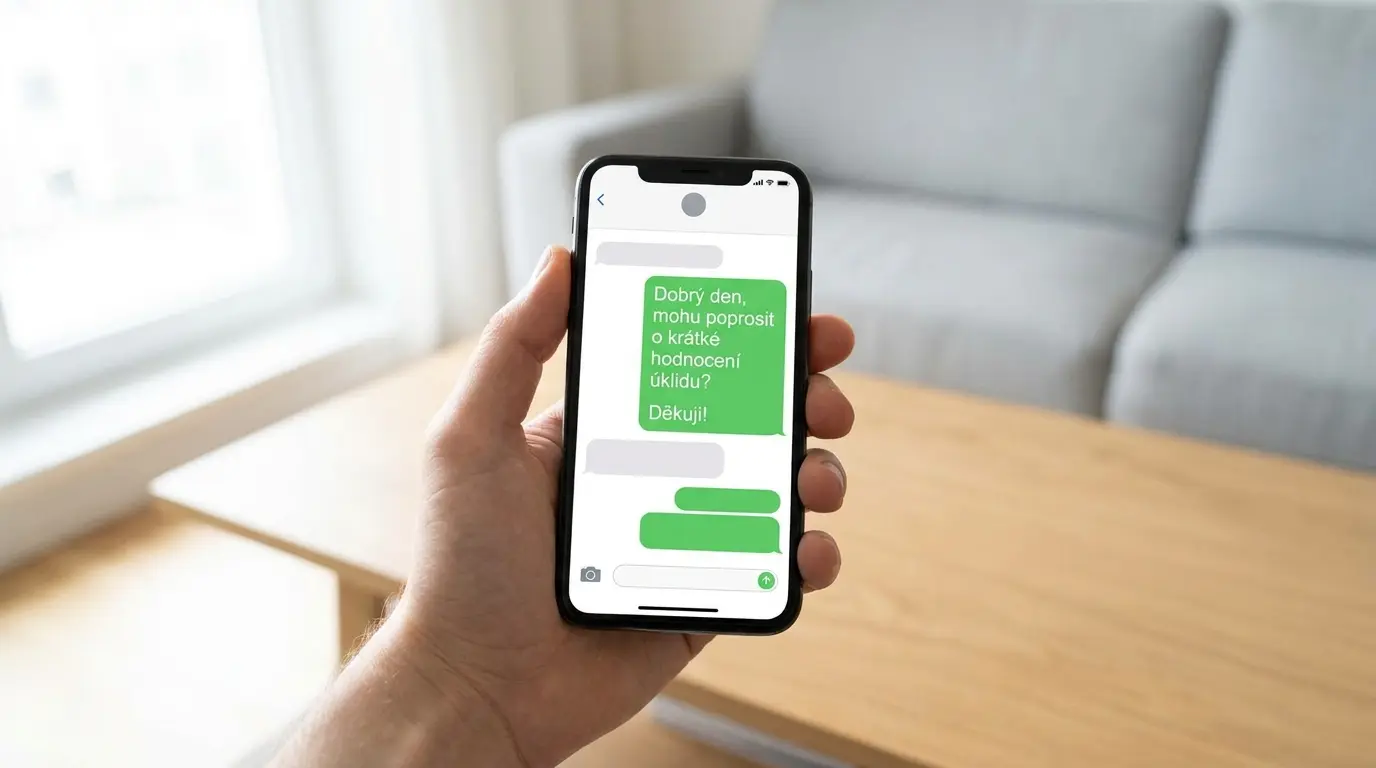
I’ve also found it helpful to nudge them toward a specific detail. Don't ask for a novel, but maybe suggest: "If you want, feel free to mention the communication or how the kitchen turned out." Specific testimonials are far more persuasive than generic praise.
One technical tip: always send just one link. If you give them three different options, they’ll likely get overwhelmed and do none of them. Pick your priority—whether it’s Google or your profile on ČistýKout—and make that first click as easy as possible.
How to organize reviews without the chaos
The secret to how to get cleaning reviews isn't just the wording; it's the process. If you rely on your memory, you’ll miss half your opportunities. After a busy week, it’s hard to remember who you messaged, who promised a review, and who would find another reminder annoying.
A simple checklist is all you need. It could be a Google Sheet, a note on your phone, or a basic CRM. Just track the essentials:
- Date of the job
- Client name and neighborhood
- Was there a "satisfaction signal"?
- Review link sent (Yes/No)
- Reminder sent (Yes/No)
- Where the review was posted
This keeps your head clear and helps you identify who is a great candidate for feedback and who you should leave alone.
Consistency with follow-ups is also key. If they don't respond to the first message, one gentle nudge after 4 to 7 days is perfectly fine: "Just a quick reminder about that review link in case you have a spare moment. Thanks again!"
That’s it. No need for a second paragraph. If they still don't respond, let it go. Chasing too hard only risks undoing a good impression.
Also, don't ignore private praise. If a client sends you a lovely WhatsApp message, ask if you can use it as a testimonial on your website or profile. Not everything has to live on Google. High-quality private feedback works wonders when included in your profile description or when sending quotes to new prospects.

Lastly, use templates, but don't use them like a robot. Have a few versions ready and always customize them with a small detail from the job. A client will notice the difference between a generic "thank you for your business" and "thanks for the post-build cleaning results in Nusle today."
What to do with negative or lukewarm feedback
Negative reviews sting, but lukewarm feedback can be even trickier because it’s harder to act on. Yet, it’s a vital part of the business and often more useful than a dozen polite compliments.
First rule: don't get defensive. If a client says the clean was "just okay" or they expected more detail, it’s not an attack on you personally—it’s an insight into their expectations. Responding with "but we did exactly what was ordered" might be technically true, but it’s almost always a losing move commercially.
A much better response looks like this: "Thank you for being so honest. I’m sorry the results didn't quite meet your expectations. If you can let me know the specific areas that were missed, I’ll take a look and suggest how we can make it right."
Keep it calm and professional. Offer a remedy when it’s a clear, verifiable mistake, like a missed shelf or smudged glass. If the issue was that the client expected a deep clean for the price of a standard visit, use it as an opportunity to explain your scope more clearly for next time.
Don't ignore the middle-ground feedback either. If someone says the cleaning was great but the arrival time was confusing, that’s gold. It might mean you need to send a confirmation text the night before or narrow your arrival window. These are the small adjustments that truly sharpen your service.
Ironically, a well-handled negative review can actually build trust. New clients don't expect a perfect world; they expect a fair, professional response. When they see you can take criticism and offer a solution, your credibility often goes up.
Turn your reviews into an engine for growth
Once you have those reviews, don't let them just sit there. Take the strongest quotes and put them in your profile, on your site, and in your initial messages to new leads. A well-placed testimonial can convince a prospect faster than any discount or hourly rate discussion. If you want to grow your cleaning business in Prague smartly, this is where you start.
Quality work gets you in the door, but it’s the reviews that turn that work into a steady stream of new orders. If you’re looking for a platform where your hard work and great reputation can truly shine, take a look at ČistýKout and send a no-pressure inquiry via our contact form.