
Getting your pricing wrong is the fastest way to burn out in a small cleaning business. It drains your margin, your energy, and eventually, your motivation. If you’re trying to figure out how to price cleaning services in the Czech Republic, the real danger isn’t looking expensive - it’s quietly accepting work that keeps you busy but broke.
Pricing shouldn't be a guess or a copy-paste of the first competitor you find on Google. A weekly apartment clean in Prague follows a completely different logic than a deep clean in a small town. A 120 m² office cleaned every night is another story entirely. The right model depends on the client, the predictability of the work, and how much travel and risk you’re taking on.
Why solo cleaners and small firms often underprice
It usually starts the same way. You look at a few local price lists, see an hourly rate around 300 CZK, and pick something similar to stay competitive. It feels safe. In reality, you’re often inheriting someone else’s margin problem.
Competitor prices tell you almost nothing without context. You don’t know if those businesses work solo or in pairs. You don’t know if they include transport, if they charge for supplies, or if they’re even counting their admin time. Plenty of cheap competitors aren't running a lean model - they’re just not counting their full costs.
Most of the money is lost in the "invisible" work. The client sees three hours on-site. You see the hours spent answering messages, scheduling, driving, finding parking, hauling equipment, washing cloths after the job, and invoicing. That time is real, even if you aren't holding a mop.
A regular 2+kk apartment clean in Prague 7 might look like a three-hour job for 1,000 CZK. Sounds okay, right? But once you add 70 minutes of round-trip travel, time spent on access, and the cleanup you do back home, that job has swallowed five hours of your day. Your effective rate drops much faster than you think.
This hurts most on repeat work. If you mess up a one-off quote, it’s annoying. If you mess up a weekly client, you’re repeating that mistake four or five times every month. A small error becomes a systemic leak in your business.
Pricing models: which to use and when
There’s no single "magic formula" for the Czech market. Prague and Brno can support higher rates than smaller regions. Households and offices have different needs. The trick is matching the right model to the specific job.
Hourly rate
An hourly model is best when you can’t predict the workload exactly. This usually applies to regular home cleaning or small offices where the condition of the space changes from week to week.
The main advantage: it lowers your risk. If the scope is clear and the client understands they’re paying for time, you’re protected from hidden surprises. The downside is that some clients start watching the clock instead of the results. You can fix this by being very clear about what your standard cleaning includes and what counts as an extra.
For an apartment in Prague, hourly rates often make more sense than a fixed quote, especially if the client keeps adding tasks - like cleaning the fridge one week or doing extra ironing the next. Without clear boundaries, a fixed price quickly stops working for you.
Fixed price per job
Fixed pricing works when you can estimate the work with confidence - usually after a site visit, seeing photos, or having done similar jobs dozens of times. Clients love it because the number is clear upfront. You’ll love it if you’re fast and well-organized.
The risk is obvious: if the job takes longer than expected, your margin disappears. An end-of-tenancy clean might look like a 4,500 CZK job from a few photos. Then you arrive and find heavy grease in the kitchen and three extra windows you didn't see. Use fixed pricing only when the scope is genuinely clear and you’ve included a buffer for surprises.
Price per square meter
This is useful, but mainly for environments with a repeatable standard - like offices, corridors, or commercial spaces. A 120 m² office cleaned every evening follows a predictable pattern.
In homes, square meters are a trap. A 160 m² family house with stairs, two bathrooms, and pet hair can take twice as long as a simpler apartment of the same size. Dirt levels and layouts matter more than raw area. Think of square meter pricing as a rough frame for a first estimate, not a final shortcut.
Comparison of pricing models
| Model | Best fit | Main advantage | Main drawback | Typical case | | --- | --- | --- | --- | --- | | Hourly rate | Regular homes, variable condition | Lower risk of bad estimates | Client may watch the clock | Weekly 2+kk apartment | | Fixed price | One-off jobs with clear scope | Clear price for the client | Margin risk if job expands | Deep clean after lease | | Price per m² | Offices, common areas | Fast quoting for standard spaces | Ignores complexity/dirt | 120 m² evening office |

What your price has to cover
A healthy price isn't just about your time on-site. It has to carry the full cost of staying in business.
At a minimum, your price should account for:
- actual cleaning time,
- travel and transfers between jobs,
- cleaning products, gloves, bags, and cloths,
- maintaining and replacing equipment (vacuums, mops, etc.),
- admin work, scheduling, and invoicing,
- marketing and the time spent finding new clients,
- taxes, insurance, and social contributions,
- a buffer for cancellations or slow weeks.
The non-billable gaps are what usually break a business. You might work 160 hours a month, but you might only be able to invoice for 100 of them. If your pricing assumes every hour is billable, the math will fail you eventually.
Before every quote, ask yourself: How long will this really take, including the drive? What materials will I use? Is there a risk of hidden buildup? Setting a minimum call-out fee is a great way to protect your time on smaller jobs.
Calculating your minimum rate
You don’t need complex accounting for this. A simple formula works:
(monthly income target + fixed costs + operating costs + buffer) / real billable hours = minimum hourly rate
Focus on those "real billable hours." Only count the time you can actually charge to a client.
Example for a solo cleaner:
- target income: 35,000 CZK,
- fixed costs (rent, insurance): 8,000 CZK,
- operating costs (supplies, fuel): 7,000 CZK,
- buffer: 5,000 CZK,
- real billable hours: 100.
The math: (35,000 + 8,000 + 7,000 + 5,000) / 100 = 550 CZK
This doesn’t mean you charge exactly 550 CZK to everyone. It means you should have a very good reason to go below that line. If a job is right next door and highly stable, maybe you can afford to go lower. If not, you’re just absorbing the loss yourself.
To turn this into a fixed quote: estimated hours x your internal rate + risk buffer = fixed quote.
If a deep clean will take 8 hours and your rate is 550 CZK, your base is 4,400 CZK. If the condition is uncertain, add 10-20% as a safety net. Your final quote should land around 5,000 CZK.
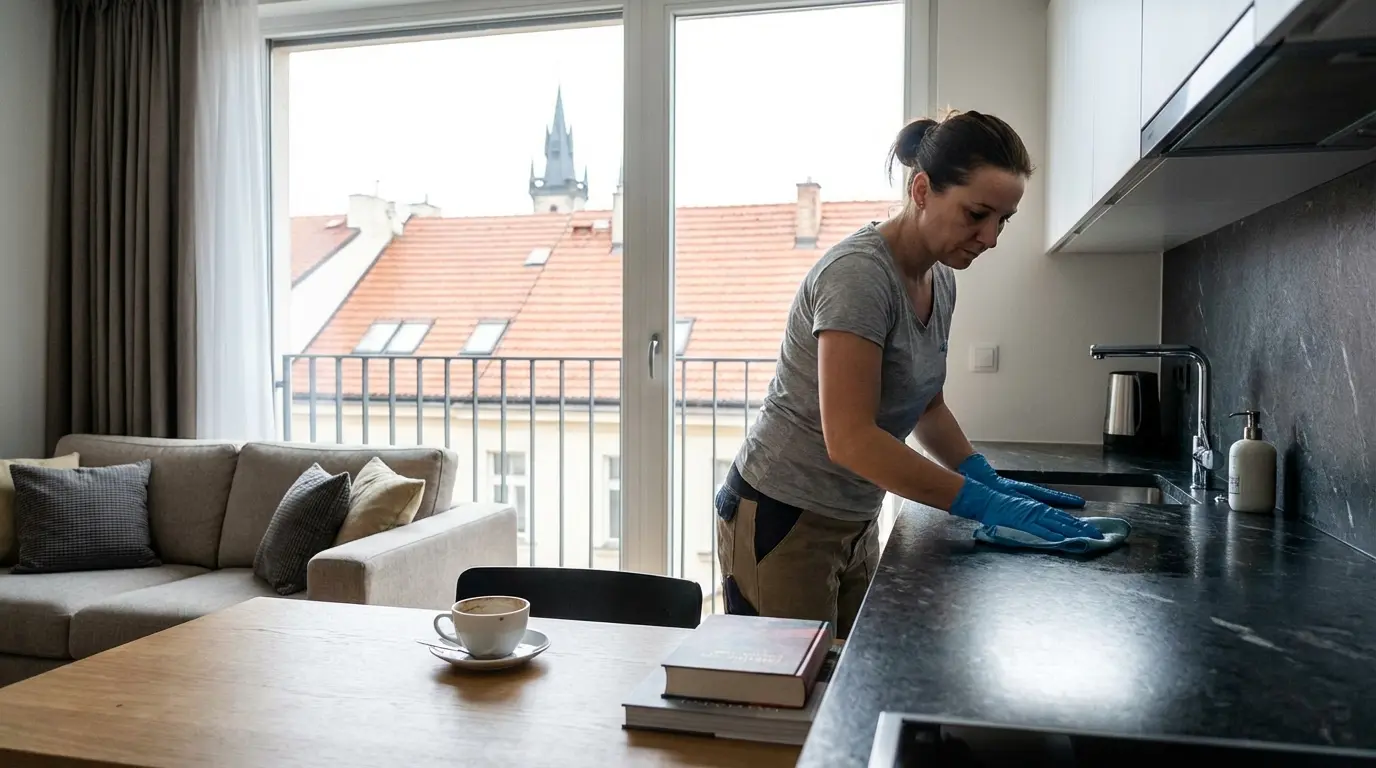
Fixed quote vs. hourly rate: which to choose?
Give a fixed quote when you know exactly what you’re getting into - usually after seeing the site or getting detailed photos. It’s perfect for clients who want price certainty and for jobs with a clear endpoint, like an end-of-tenancy clean.
Stick to hourly pricing for irregular, neglected, or unpredictable jobs. If a client asks for a "standard clean" but you suspect their version of standard is very different from yours, go with an hourly rate and a minimum call-out fee. It’s the safest way to do business.
You can also use a hybrid approach. For example: "The estimate is 3 to 4 hours (1,400 to 1,800 CZK) depending on the actual condition, with a minimum visit price of 1,200 CZK." This gives the client a range while protecting you if the job expands.
Always define the scope. Most disputes happen because of inside appliances, window cleaning, or ironing. It’s rarely about the money itself; it’s about a mismatch in expectations.
Common pricing mistakes
The biggest mistake is copying the competition without knowing your own numbers. A low price from a competitor isn't proof of efficiency - it might just mean they’re ignoring their costs.
Another trap is setting your first price too low just to win your first clients. It’s a hard habit to break. A client you win with a deep discount will expect that rate forever. Raising it later is much harder than setting it fairly from day one.
Don't forget the minimum job price. Short jobs are often the most expensive to organize. Driving across town for one hour of work for a low fee almost never makes sense.
Finally, watch out for vague language. "Deep clean" means different things to different people. If your offer doesn't spell out exactly what you're doing, you're asking for friction.
Defending your price
When a client says someone else is cheaper, you don’t have to offer an instant discount. Explain what your price covers. Talk about the scope, your reliability, the materials you use, and the specific result they can expect.
Try saying: "I could offer a lower price, but it would mean a smaller scope or a different standard of service. This quote is set to ensure the result matches what we discussed." This isn't pushy - it’s professional.
It helps to have your pricing logic visible on your profile. When clients see your call-out minimums and service scope in advance, there’s less friction during the quote. A strong profile on CistýKout can do a lot of this heavy lifting for you, building trust before you even send the first message.
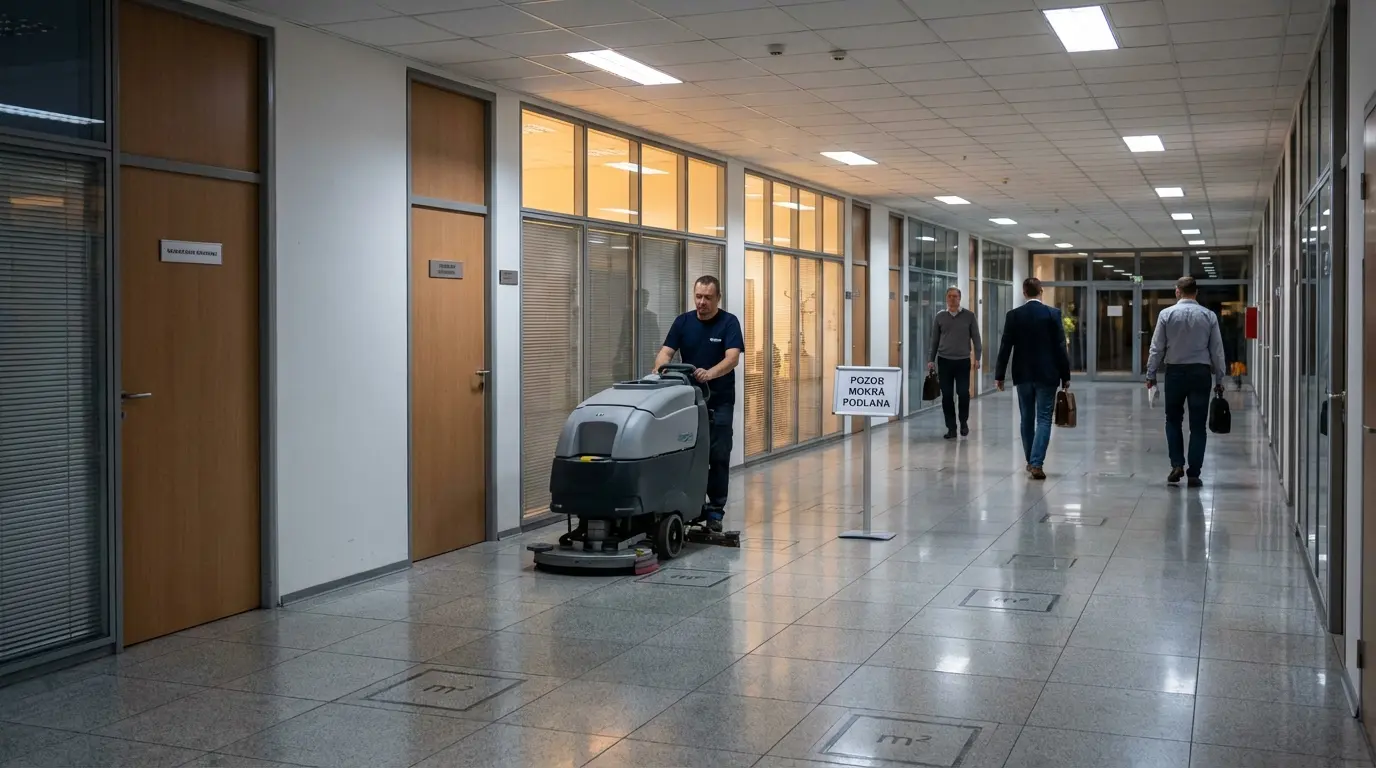
Quoting checklist
Check these points before hitting send:
- Do I know the exact scope?
- Have I included travel time?
- Have I counted supplies and equipment?
- Is there a minimum call-out price?
- Is it clear what’s NOT included?
- Have I added a buffer for high-risk jobs?
- Does the price work for the region and client type?
- Am I using my own numbers, not just the competitor's?
- Can I explain the quote in two simple sentences?
A lower price doesn't mean a better deal. In cleaning, it often just means someone isn't counting all the costs. Build your own pricing framework, track your actual time and costs, and adjust based on data, not instinct. Once you do that, quoting gets easier, and clients will trust your professionalism more.