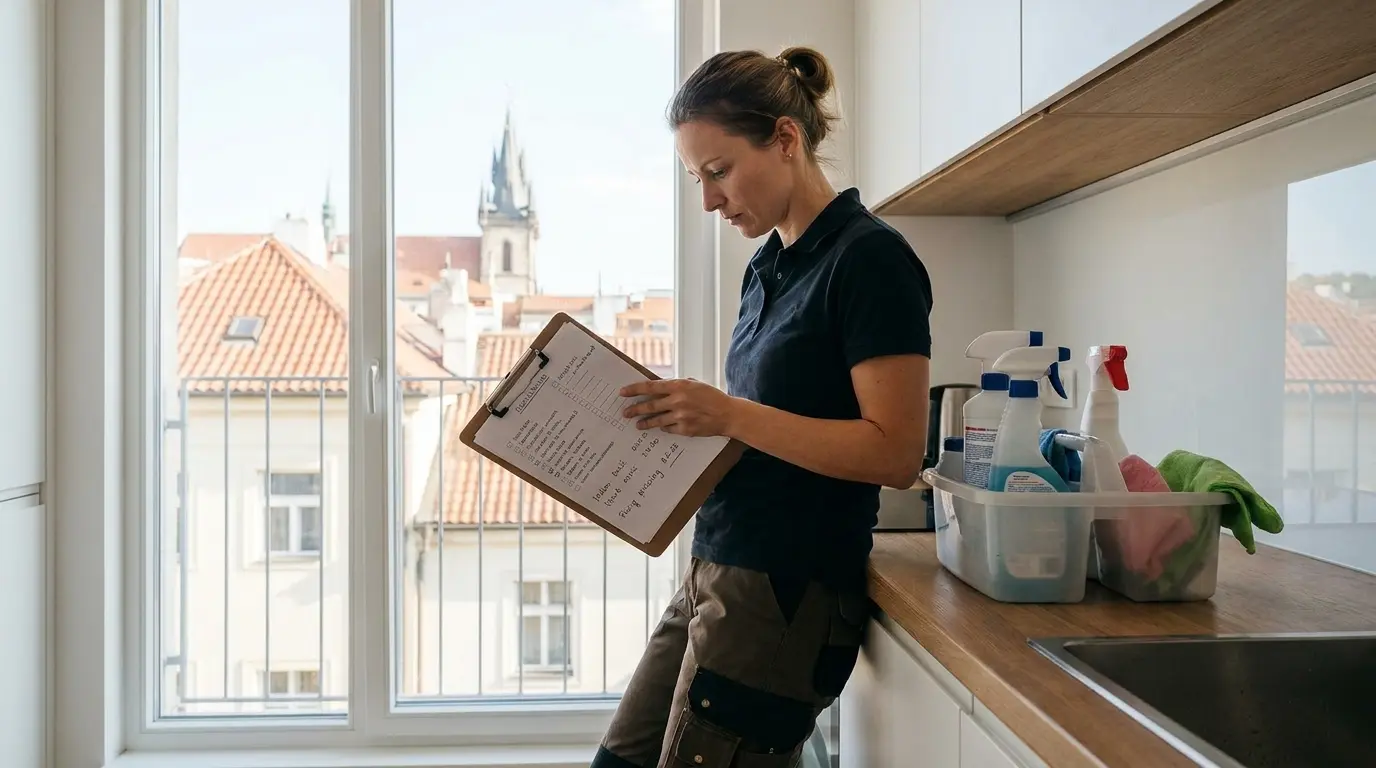
The easiest way to lose money in cleaning is to win the wrong first client. A new cleaner gets a message about a flat in Prague 6, wants the job badly, gives a low number, and feels relieved when the client says yes. Then the visit takes longer than expected, parking costs more than expected, the bathroom is rougher than described, and the "good first job" quietly becomes a bad business decision. That is why learning how to price cleaning services matters earlier than branding, uniforms, or a polished Instagram page.
Why bad pricing burns people out fast
Cheap first jobs look harmless. That is the trap. On paper, a one-off clean for 1,500 CZK seems like momentum. In real life, you may spend four hours cleaning, forty minutes traveling across Prague, another fifteen minutes finding parking, then extra time texting the client because they forgot to mention the oven, balcony doors, and limescale around the shower screen.
A lot of beginners watch revenue instead of profit. I get why. Revenue feels visible. Profit is hidden inside small boring costs. But cleaning is a physical service, and those boring costs are exactly where the business either survives or starts draining you.
Say you charge 1,500 CZK for a first visit. Sounds decent. Now break it down. Travel and admin take 50 minutes. The clean itself runs 4.5 hours because the flat was not in "normal condition" at all. You use your own products, cloths, gloves, and bin bags. Maybe you pay for parking in Vinohrady. Suddenly your effective hourly cleaning rate is nothing to celebrate.
That is the gap between turnover and real earnings. It matters more in cleaning than many new providers expect. You are not just selling a shiny kitchen sink at the end. You are selling reliable arrival, judgment, stamina, supplies, problem-solving, and a willingness to carry uncertainty when the job description is vague.
I have seen solo cleaners underprice themselves because they think a higher quote will scare away the client. Sometimes it will. Honestly, that is fine. A client who wants central Prague service for a bargain-bin rate is usually not a great long-term fit. They fill your calendar and starve your margin.
What your cleaning price actually needs to cover
If you want a pricing model that holds up, the price has to carry more than the visible cleaning time. Cleaning service pricing only works when it includes the whole job around the job.
Travel time
Prague is not huge, but it can eat time in awkward ways. A trip from Chodov to Dejvice is not just distance. It is traffic, tram delays, parking, elevators, and hauling products from the car or stop to the building. If you never account for that, you are subsidizing logistics for the client.
There are two practical ways to handle this. One, charge a travel fee in some areas. Two, build travel into a minimum booking or a higher rate for one-off visits. For a solo cleaner, short jobs with no minimum often look busy and pay badly.
Supplies and equipment
New providers often tell themselves supplies are minor. A spray bottle here, a microfiber cloth there. Then a month passes and the total says otherwise. Degreasers, bathroom products, disinfectants, gloves, bin liners, cloth replacement, mop heads, vacuum maintenance, laundry for reusable textiles. It adds up.
If you bring your own professional kit, that is part of the value. It also means your fixed cleaning price or hourly rate must carry those costs. Otherwise the better your service becomes, the more you quietly fund it yourself.
A simple method works well here. Add up your monthly supply and equipment costs, include a buffer for replacement, then divide that by your realistic billable hours, not by every hour you are awake. The number is often higher than beginners expect.
Communication, gaps, and cancellations
Clients are paying for more than mopping and dusting. They are paying for reminders, reliable arrival, clear communication, planning, and the fact that you handle surprises without turning the visit into a drama.
Irregular work is especially tricky. A weekly clean is easier to price because the rhythm becomes predictable. A one-off clean, a "can you come tomorrow" request, or a client who cancels late creates friction around the actual cleaning time. That friction belongs in the price. If you ignore it, your schedule becomes expensive to run.
When to charge hourly and when to use a fixed price
This is not a religion. Both models work. The point is to use the right one for the right kind of job.
Recurring work vs one-off jobs
For recurring maintenance cleaning, an hourly cleaning rate can be fair and simple, especially in the early phase of a client relationship. After two or three visits, you know the flat, the client knows the scope, and the time settles down. In Prague, many providers end up somewhere around 350 to 450 CZK per hour depending on area, condition, and whether products are included.
One-off jobs are different. Deep cleans, first visits, post-rental jobs, and neglected homes are where hourly pricing can become uncomfortable for both sides. The client multiplies the rate by their most optimistic estimate. You feel pressure not to look slow. The job becomes tense. In many of those cases, a fixed cleaning price is safer, as long as you build in enough margin.
Smaller flats vs dirty jobs
This one catches people out. A studio is not automatically easy. A neglected studio after a tenant moves out can take more effort than a tidy three-room flat. That is why pricing only by layout is risky.
A better approach is to combine layout, condition, and scope.
For example:
- recurring 2-room flat in good shape, Prague 9, normal family use, predictable scope, hourly works well,
- one-off 1-bedroom flat with grease, limescale, inside-fridge cleaning, and oven work, fixed quote with a buffer is safer,
- larger family apartment with children and a dog, expect more detail work and more reset time.
Minimum booking matters
A minimum booking is not rude. It is basic self-protection. Without one, you end up with too many short visits that look productive on the calendar and feel disappointing in the bank account.
A lot of providers in Prague do better with either a 3-hour minimum or a visit minimum in CZK. That covers transport, setup, and the fact that every booking takes a chunk of your day whether the visible task is short or not.
A simple model for pricing your first jobs
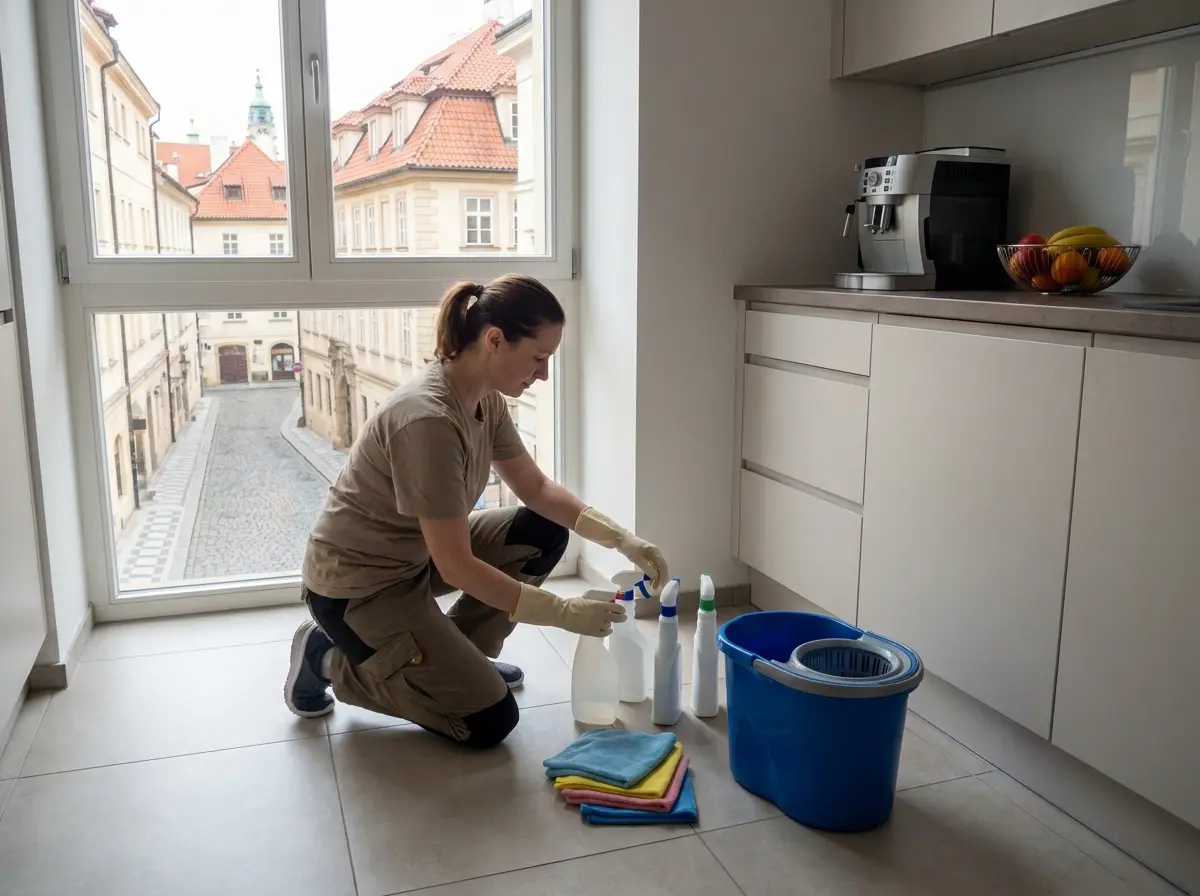
You do not need a giant spreadsheet. You need a method that stops you from guessing too low.
Step 1: Estimate realistic cleaning time
Start with the actual work. Not the best-case version. The realistic one. If your first instinct says three hours, ask yourself whether that still sounds right if the client has underdescribed the kitchen, there is no lift, and the bathroom needs real descaling. If the answer is no, your estimate was not realistic.
A rough first framework might look like this:
- recurring maintenance clean for a small flat: 2.5 to 4 hours,
- recurring mid-size family flat: 4 to 6 hours,
- one-off clean in rougher condition: add 30 to 60 percent,
- first visit with a new client: always add at least 30 minutes, often more.
Step 2: Add non-cleaning time
Now add the time around the clean. Travel, unloading supplies, parking, short client handover, quick messaging after the visit. That is working time. It belongs in your quoting process for house cleaning jobs even if a mop is not in your hand during that part.
Step 3: Add supplies and a risk buffer
Then layer in supply cost and a buffer for uncertainty. For a first visit, I would rather add 10 to 20 percent and be honest about it than underquote and regret it the moment I walk in.
Step 4: Convert it into a quote
A very usable formula is this:
(cleaning time + non-cleaning time) × target hourly rate + supplies + risk buffer = final price
Example:
- 4 hours cleaning,
- 1 hour travel and admin,
- target rate 380 CZK,
- supplies 120 CZK,
- risk buffer 250 CZK.
Calculation: 5 × 380 + 120 + 250 = 2,270 CZK.
That number often feels higher than a beginner wants to say. But it is much closer to reality than the nervous guess many people give in messages.
How to explain the price without apologizing
This part matters. A lot of providers quote the number and then immediately soften it: "but we can discuss," "it is just a rough idea," "maybe we can reduce it." That weakens trust before the job even starts.
A stronger version is simple: "For the first one-off clean of this flat, I would expect 2,200 to 2,400 CZK depending on final condition. That includes travel within Prague, my own products, and extra time reserved for a first visit." Calm. Clear. No apology.
How to raise prices without losing your best clients
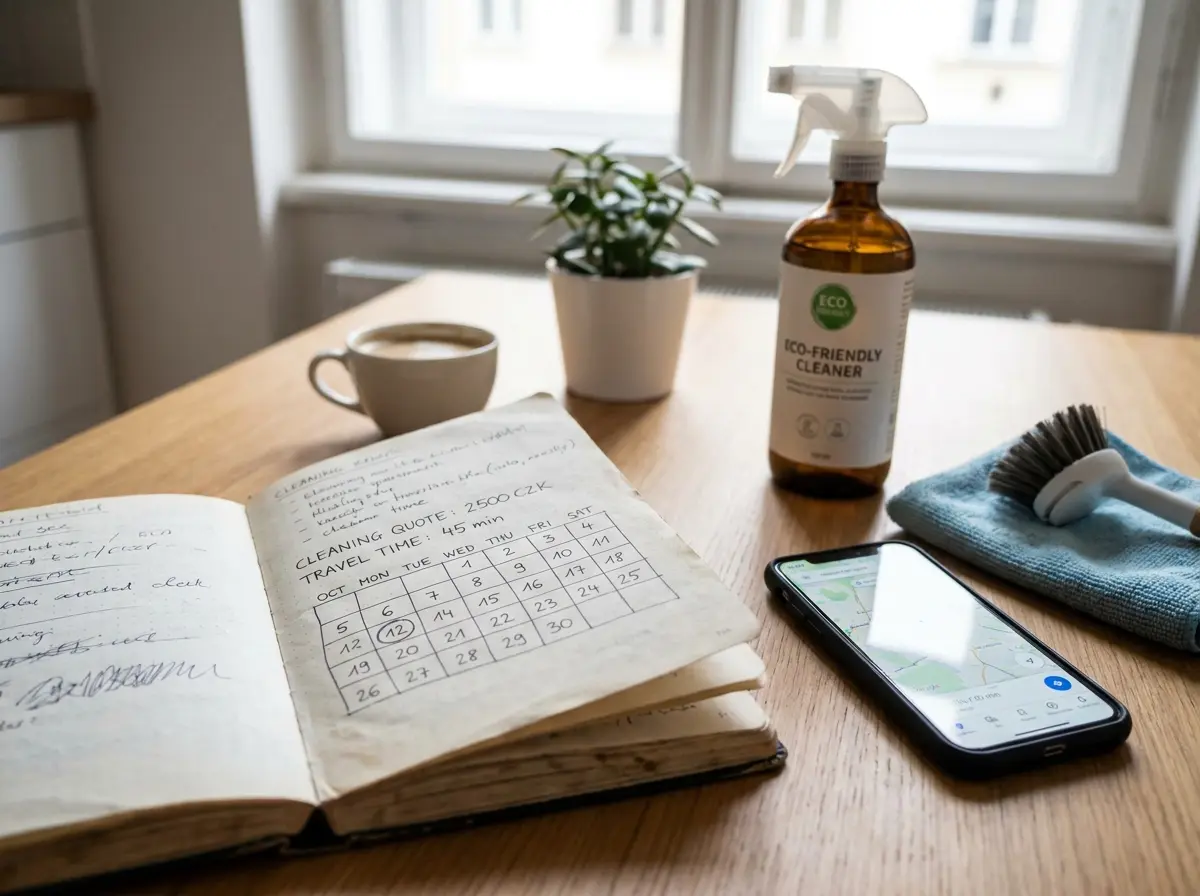
A price increase is not a betrayal. Sometimes it is just overdue.
When a higher price is justified
Usually in three situations:
- your real hourly earnings are too low once you track the work properly,
- the job turned out to be more demanding than originally described,
- your transport, product, or staffing costs have gone up.
Good clients can handle a sensible increase when the service is consistent. What people hate is confusion. Sudden numbers with no notice. Vague explanations. A feeling that the pricing is random.
How to tell clients
Keep it short and early. Something like: "From 1 June, my recurring cleaning rate will change from 380 CZK to 420 CZK per hour. This reflects higher operating costs and the service standard I maintain for your home." That is enough.
How to defend the value
Do not defend it with "everyone is raising prices." That is weak. Defend it with the value the client already experiences: reliability, quality, your own products, smoother communication, consistent results, and less need for them to supervise the work.
There is an uncomfortable truth in residential cleaning. The cheapest offer often becomes the expensive one once the client counts missed details, no-shows, redos, and the stress of replacing an unreliable cleaner. If your service is solid, you do not need to fight for every client on price.
The takeaway
If you are figuring out how to price cleaning services, do not start with "What is the lowest number the market will accept?" Start with what the job really costs you in time, energy, travel, supplies, and uncertainty. That is the base. The quote comes after.
Your first jobs should teach you the market, not drain you. A realistic time estimate, a minimum booking, a first-visit buffer, and a calm explanation of your quote will already put you ahead of a lot of new providers.
And if you are on the client side looking for a Prague-based cleaning option, CistýKout is one practical place to start. A quick contact request is often enough to define the scope, compare expectations, and get a cleaner quote from the beginning.