
Too many solo cleaners set up their cleaning services price list the wrong way around. They pick a number they think a client might swallow and just hope the math works out at the end of the day. In reality, that is exactly how you end up exhausted, busy, and still underpaid. I have seen this happen across Prague more times than I can count. A cleaner blocks out half a day, earns what looks like good money on the surface, then watches it disappear into travel costs, supplies, gaps between jobs, and all the invisible admin work that never makes it into the quote. If you want to learn how to price cleaning services in 2026 without quietly losing money, you need a model that reflects your actual day, not just the hours you spend scrubbing a floor.
Why so many cleaners still work below a sustainable rate
The first trap is simple: confusing total revenue with actual profit. You can bill 1,400 CZK in a single day and still barely make a living once you factor in transport, cleaning supplies, WhatsApp messages, rescheduling, and the dead time between bookings.
Look at a typical day in Prague: you clean a standard 2+kk in Vinohrady for 900 CZK in the morning, then head over to a studio near Anděl for another 700 CZK. On paper, that is 1,600 CZK. But once you add 70 minutes of cross-city travel, restocking your kit, chasing a client for a key, and the fact that you cannot always fit another job into that specific gap, that headline number shrinks fast.
Then there are the costs that feel too small to track. Gloves, microfiber cloths, descaler, degreaser, bin liners, vacuum maintenance, and doing laundry for all those used rags. No single item breaks the bank, but together they represent the difference between running a real business and running yourself into the ground.
Finally, there is the emotional side. Plenty of great cleaners feel guilty about asking for a fair cleaning rate. They worry that if they raise the price, the client will leave. Sometimes they do. But honestly, losing a client who insists on paying "pocket money" rates is rarely a loss. People who haggle over every 50 CZK are usually the same ones who push the boundaries on scope, timing, and your patience.
What your minimum rate actually needs to include
Before you start worrying about what the market will tolerate, you need to find your floor. This is the absolute minimum number below which the job simply does not make sense.
For a solo provider, a grounded model has four parts:
- time spent on site
- time spent traveling
- direct cost of supplies and equipment
- a reserve for cancellations, slow weeks, and unpaid admin time
Time on site sounds straightforward, but it is constantly underestimated. A first clean is almost always slower than regular maintenance. If a client tells you they have a "standard 3+1," it means nothing. An older family flat in a Prague panel building can take twice as long as a well-kept, modern apartment of the same size.
Travel time is working time, even if you are just sitting on a tram. If a booking takes 45 minutes of travel each way, that is 90 minutes of your life dedicated to that client. If your house cleaning rates do not reflect that, you are essentially working for free during the commute. For small jobs outside your usual area, this is exactly why the price has to go up.
Next are your supplies and wear-and-tear. You do not need a fancy spreadsheet; a simple monthly total is fine. Add up what you spend on chemicals, gloves, filters, and laundry, plus the cost of eventually replacing your vacuum or mop. Most cleaners find that these "small" costs add up to 30–70 CZK per productive hour.
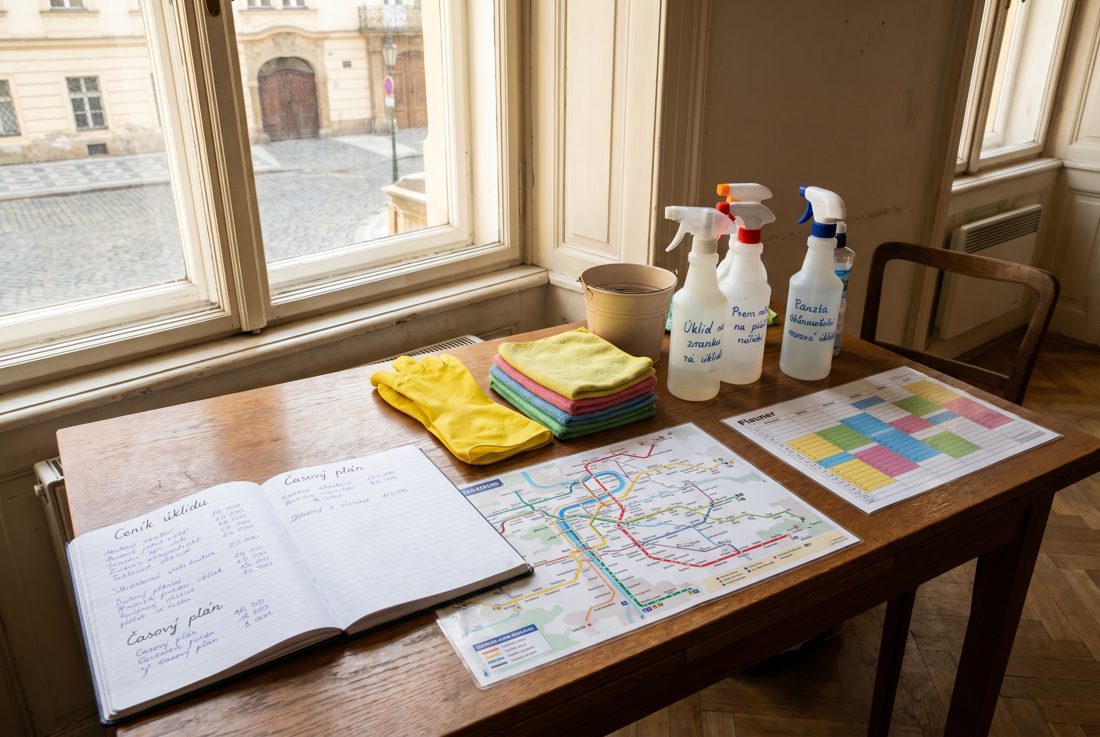
The last piece is the reserve. Most people skip this, which is why one cancellation can ruin their whole week. A realistic price model has to absorb no-shows, seasonal dips (like January or August), and the time you spend on the phone. If your price does not have this buffer, you are paying for those risks out of your own pocket.
Here is how a real-world baseline might look:
- target net reward for your work: 250 CZK per hour
- supplies and equipment wear: 50 CZK per hour
- reserve for admin, gaps, and cancellations: 60 CZK per hour
- minimum value per productive hour: 360 CZK
This isn't necessarily what you quote the client, but it gives you a sober starting point. If a job involves significant travel, your quoted rate will have to be even higher to stay profitable.
How to choose the right pricing model
Most independent cleaners use one of three methods: hourly pricing, a fixed job fee, or a guide price based on flat size. All of them have a purpose, but the trouble starts when you try to use one model for every situation.
Hourly pricing is the safest way to start, especially when you are entering a home for the first time and do not know what to expect. For initial visits, quoting a range—like 380 to 450 CZK per hour depending on the work—is much smarter than making a blind promise. It ensures you don't get stuck on a job that takes twice as long as you thought. The downside? Some clients will hover and watch the clock.
A fixed job price is better for recurring clients. Once you know that a specific 2+kk in Letná takes exactly two hours and 45 minutes every two weeks, a flat fee is easier for everyone. The client knows the cost, and you know the goal. Just make sure the fee accounts for the occasional day when things take a bit longer.

A flat size guide is a great marketing tool. It helps potential clients see if you fit their budget. But it should always be a guide, not a rule. An 80-square-meter flat with one tidy adult is a completely different job than an 80-square-meter flat with two toddlers and a dog. Same size, but very different labor.
You also need a clear price gap between one-off and recurring work. One-off cleaning company pricing should always be higher because there is more uncertainty and much more deep-cleaning involved. Recurring maintenance can be more efficient, so you can afford to price it more competitively—as long as the client commits to a schedule.
Which factors must push the price up
This is where most misunderstandings happen. You give a base price, but the exceptions stay fuzzy. Then you and the client both realize—too late—that you were imagining two different levels of work.
Heavy dirt has to cost more. If the kitchen is covered in old grease, the bathroom is calcified, or the flat is a "move-out" clean that hasn't been touched in a year, that is not standard maintenance. The same applies to cleaning windows, scrubbing inside the oven or fridge, ironing, or dealing with heavy pet hair.
It is much better to name these as clear add-ons or separate services. If your quote is just a vague "cleaning company pricing on request," you will end up negotiating under pressure once you are already inside the flat.
Evening and weekend slots should also carry a premium. If a Tuesday morning slot costs the same as a Saturday evening, you aren't managing your schedule—you're giving it away. It might sound blunt, but that is the reality of running a service business.
Finally, distance matters. If your usual zone is central Prague and a client wants a clean in Říčany or Jesenice, your price needs to reflect the extra hour of travel and the fact that you cannot book another client in that time slot.
A simple surcharge checklist can stop awkward conversations before they start:
- heavy dirt or neglected conditions
- windows and blinds
- ovens, fridges, and inside cabinets
- ironing or laundry beyond the basic scope
- homes with multiple pets or smoke exposure
- evening slots, weekends, and holidays
- travel outside your standard zone
How to communicate the price without apologising for it
The hardest part of pricing isn't the number on the page; it's how you say it. A lot of cleaners state their rate as if they are already bracing for an argument. Clients pick up on that hesitation immediately.
A better way is to quote the price alongside the specific scope. For example: "A regular 2+kk clean for your home usually lands between 1,300 and 1,500 CZK, depending on the state of the kitchen and whether we include ironing. That price covers the maintenance clean, all professional supplies, and travel within Prague 1–7." That sounds professional and grounded. It tells the client exactly what they are paying for.
In every offer, make three things clear:
- what is included
- what is not included
- what conditions change the final price
This structure protects your time and prevents conflicts later. It also makes you look like a pro who knows exactly how their business works.

If a client asks for a discount, do not just drop your rate. Instead, offer to narrow the scope. If their budget is tight, you can say: "To fit that price, we can skip the windows this time or adjust the frequency." This way, you keep the value of your time intact while still being helpful.
One thing to keep in mind: low prices do not attract the "best" clients. They often attract the most demanding ones. A fair cleaning services price list acts as a filter. It brings in the people who value reliability, clear terms, and a job well done.
If you want to check your own prices, take your last five jobs and add up the total time spent—from the moment you left your house until you got back. Include the supplies, the travel, and the time spent on the phone. Only then will you know if your price for house cleaning is actually working, or if you're just busy for the sake of being busy.
And if you are a client in Prague looking for a service with clear terms and honest communication, you can contact CistýKout. For providers, the lesson is simple: your price should cover the real work, the real day, and the real cost of staying in business.