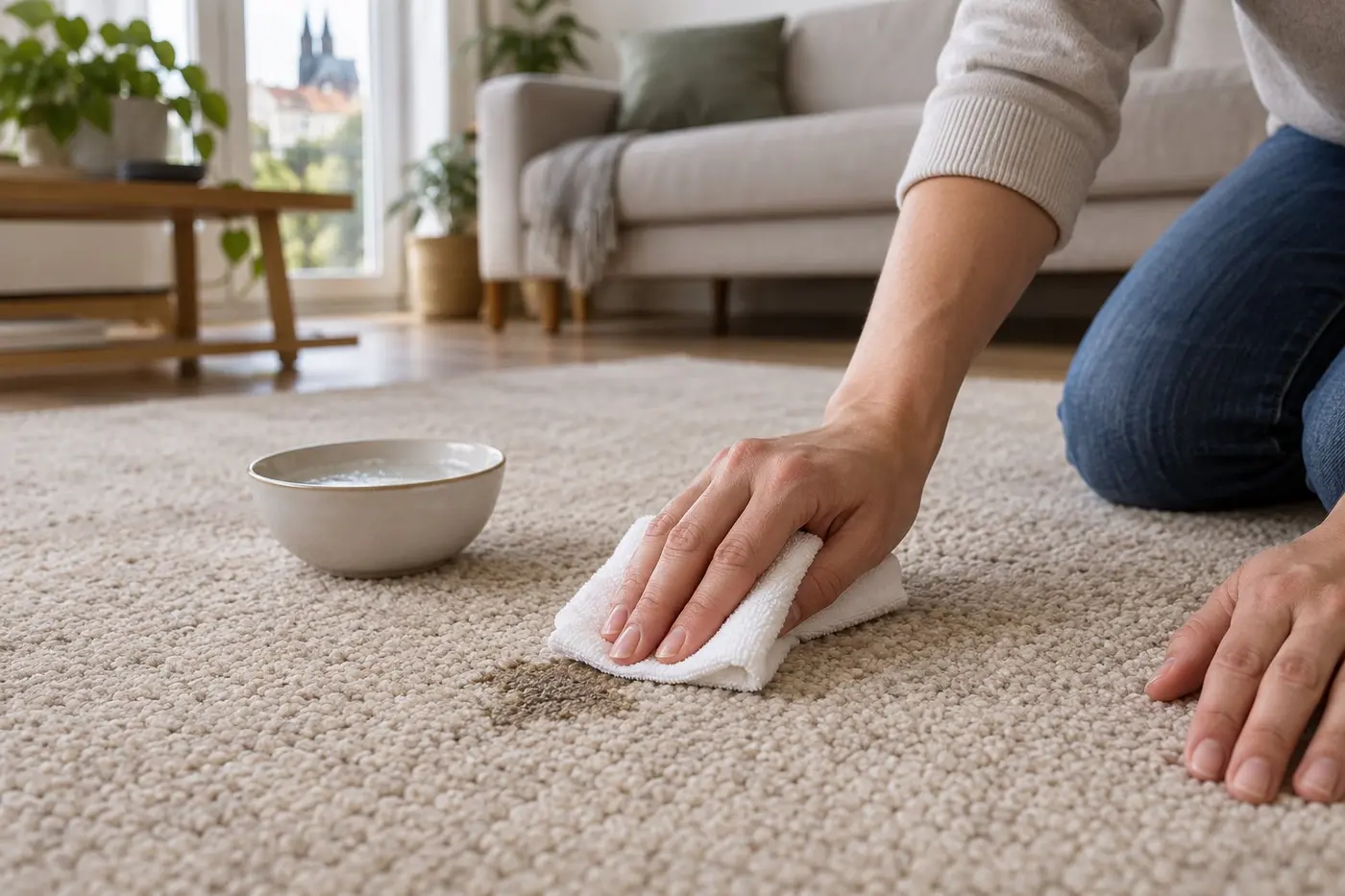
A greasy mark beside the dining table rarely looks urgent. Then it dries, collects dust and turns into a dark patch. If you are working out how to remove a grease stain from carpet, treat it as three separate jobs: lift what is still loose, release the residue with very little solution, then remove the cleaner. That last part is what prevents a pale ring from replacing the original stain.
Before you start: identify the spill and the carpet
Cooking oil is almost entirely fat. A spoonful of gravy also carries pigment, protein and salt. Hand cream may contain waxes and fragrance, while bicycle grease brings dark additives that a mild washing-up liquid may not shift. Before reaching for a bottle, reconstruct the accident. What landed on the carpet? How long has it been there? Has anyone already sprayed or scrubbed it?
Now check the carpet itself. A loose rug should have a label on the reverse. Polypropylene and many other synthetic fibres usually tolerate careful spot cleaning better than wool or viscose. Strong alkaline degreasers can change the feel and colour of wool. Wet viscose pile may flatten, distort and catch the light differently, leaving a pale or shiny patch that looks worse than the stain. A fitted carpet has another vulnerable part: moisture can reach its backing, adhesive or the floor below.
Test colourfastness somewhere hidden, perhaps under the sofa. Dampen a white cloth with your proposed solution and press it against the fibres a few times. Stop if colour transfers. I would also stop with an unlabelled carpet, a hand-knotted rug or any piece that would be painful to replace.
One instruction applies almost everywhere: do not rub. Rubbing spreads grease sideways, drives it down and can roughen the pile. Flooding the area is no better. Oil resists the water while the carpet backing soaks it up.
Lift fresh grease before you wash it further into the pile
If solid food, butter or sauce is still sitting on the surface, lift it with a spoon or the blunt edge of a plastic card. Move towards the centre. Leave the kitchen knife in the drawer; its edge can cut a loop or scrape a noticeably lighter track through the pile.
Blot liquid oil with dry white paper towel or an absorbent white cloth. Press, lift, move to a clean section. Do not make circles. Once grease stops transferring, the first job is done. Only then should you tackle what remains on the fibres.
On a colourfast synthetic carpet, a little dry absorbent powder such as cornflour may help with a fresh spill. Sprinkle it without rubbing, allow it to absorb the oil, then vacuum thoroughly once everything is dry. Do not use powders on wool, viscose or an expensive rug unless its care instructions allow them. Fine powder can lodge deep in the pile and turn into paste the next time it gets wet.
Working from the edge towards the centre is not fussy housekeeping. Pressure pushes oil outward. Wiping away from the centre simply gives you a larger patch to clean.
For a dried stain, use very little cleaning solution
A dried mark is usually grease mixed with household dust. Vacuum the area dry first, avoiding a rotating brush if the pile is delicate. For a colourfast synthetic carpet, make a weak solution with one or two drops of clear hand dishwashing liquid in about 250 ml of lukewarm water. More foam does not mean more cleaning power here. It means more residue to rinse out.
Do not spray the carpet directly. Put the solution on a white cloth and wring it until damp, not wet. Press at the outside edge of the stain. After a few presses, turn to a clean part of the cloth. A grey-brown film transferring to the fabric is a useful sign; soaking the backing is not.
I once saw the predictable result in a Vršovice flat: a small oil drop by the sofa had received three generous rounds of degreaser. The oil was gone, yet a stiff pale oval remained. Cleaner was trapped in the pile and began attracting soil again. A fourth, stronger treatment would have made matters worse.
After a short contact time, take a second cloth lightly dampened with clean water and blot out the detergent in the same way. Finish by pressing with a dry towel. If two or three careful rounds produce almost no change, stop. Repeated wetting is not patience; it is a risk to the backing.
How to clean carpet without water rings
A ring does not always mean lost dye. Sometimes the centre is simply cleaner than the normally soiled carpet around it. Detergent can also migrate to the edge as moisture dries. Blend a narrow transition around the treated spot with a barely damp clean cloth, still working from the outside in and changing the cloth as it picks up soil.
Cleaning solution must come back out of the fibres. On a robust synthetic carpet, use no more clean rinse water than you can immediately recover with towels or a wet vacuum. If pressing the pile reveals moisture at the backing, you have used too much. The limit is lower on a glued-down carpet.
Let the area dry quickly and keep feet and paws away. Brief cross-ventilation helps, as does a fan blowing horizontally across the surface. Do not blast the spot with a hairdryer or put furniture back while it is damp. If the manufacturer permits it, lightly reset the pile with your fingers or a clean soft brush during drying.
Judge the result only when the carpet is fully dry, often the following day. Wet fibres change colour. Cleaning again while they are still damp is how a modest repair becomes a water ring.
What to avoid on wool, viscose and glued-down carpet
Skip hot water, steam, concentrated degreaser, chlorine bleach and strong alkaline multipurpose sprays on sensitive carpet. Do not improvise with an iron over paper. Heat can drive grease further in, alter the pile or soften adhesive.
Wool contains natural oils and reacts badly to harsh chemistry. Viscose is less forgiving still: it loses strength when wet, and a change in pile direction may show as a pale sheen. Even clean water can leave a brown tide mark on sisal or jute. With these materials, a home experiment is not the cheaper option if the next step is restoration or replacement.
A rented extraction machine is not automatically safe either. It sprays solution and recovers some of it, but inexperienced users often make repeated passes until the backing is saturated. Correctly used extraction can work well on ordinary synthetic fitted carpet. A wool rug, viscose, unstable dye or an adhesive installation calls for knowledge of the fibre, the product and the machine's recovery strength.
If the label specifies dry cleaning only, believe it. A mixture of vinegar, bicarbonate of soda and washing-up liquid is not gentle simply because all three products came from a kitchen cupboard.
When to hand the stain over to a professional
Call before a small oil stain becomes a large repaired area. Professional help is sensible when the fibre has not been identified, dye transfers during testing, the rug is wool or viscose, grease has reached the backing, or a ring keeps returning after earlier attempts. A rancid smell is another warning. It suggests oil remains deeper than a cloth can reach.
With professional carpet extraction, a technician applies compatible chemistry in a controlled amount and recovers it promptly with the released soil. That is different from soaking the carpet. For a sensitive rug, the right recommendation may instead be low-moisture cleaning or treatment at a specialist workshop.
Give the technician four useful details: the source of the stain, its age, the carpet material and every product already tried. Add one photograph of the whole area and a close-up in daylight. “We tried dish liquid, vinegar and a rented extractor” is far more informative than “it will not come out”.
If the material is uncertain or the dried stain keeps returning, send a no-obligation enquiry through the Čistýkout contact form. Čistýkout can connect you with a Prague-based cleaning option and help you decide whether the carpet needs a small local treatment or full professional extraction.