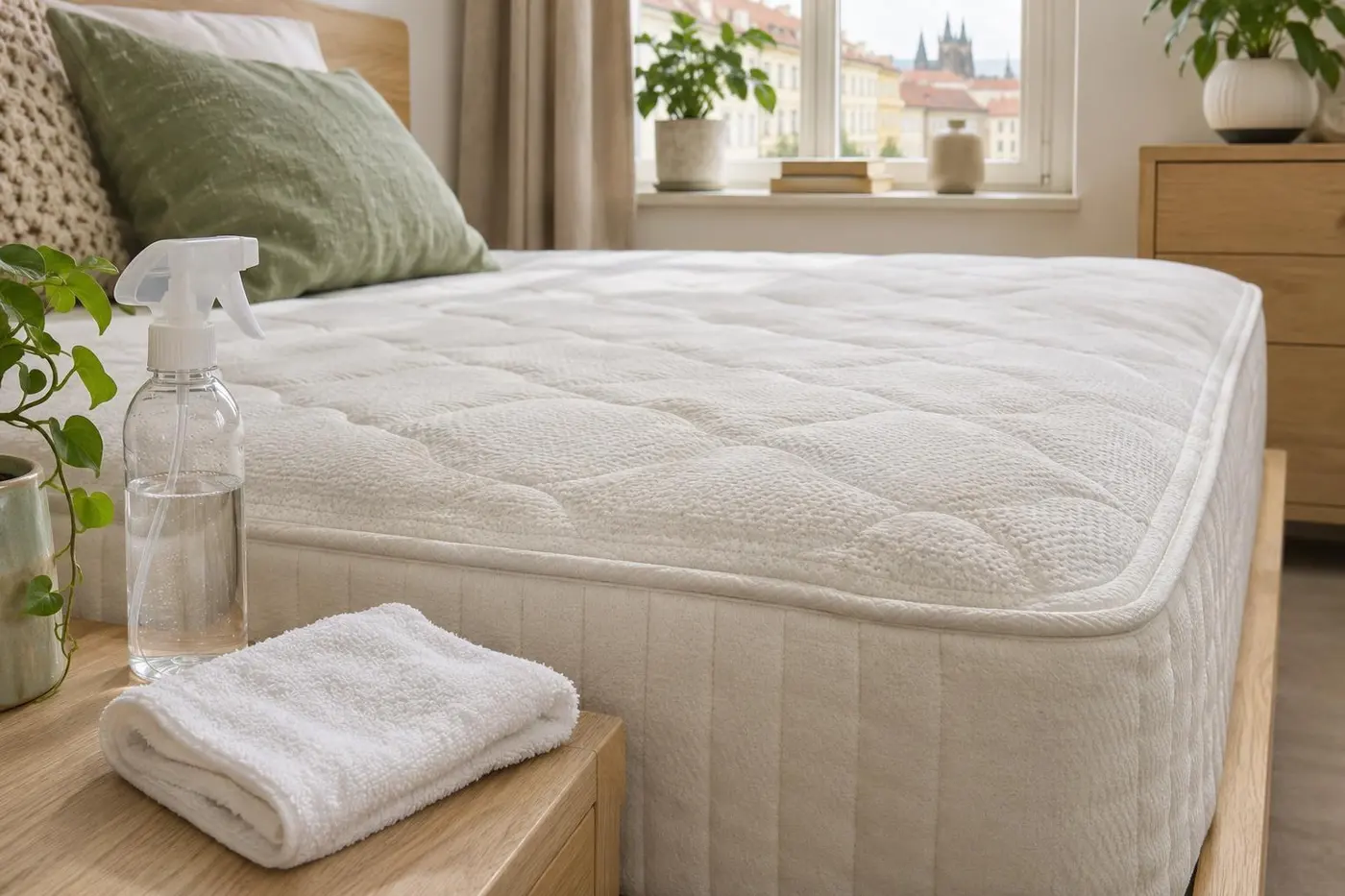
If you are working out how to remove blood from a mattress, the first few minutes matter, but so does restraint. Blot a fresh mark with a white cloth barely dampened with cold water. Loosen a dried mark gently, then use short cleaning and blotting cycles. Hot water, steam and hard scrubbing can set the protein stain while driving moisture further into the mattress.
Before you start, protect yourself and date the stain
Put on disposable gloves first. If this is your own blood from a nosebleed, a small cut or a period, the main questions are the age of the stain and what the mattress can tolerate. Blood from another person, especially when you cannot confirm their health status, needs a different response. Do not spray it, brush it or run a domestic vacuum over it. Bag used absorbent towels, and call a specialist if the contaminated area is more than a small surface mark. The CDC guidance for blood and body-fluid spills also starts with gloves and removing visible fluid with disposable absorbent material.
Now look closely:
- Fresh blood is wet and transfers readily to a dry white cloth.
- A partly dried stain has a darker rim but still releases colour under a damp cloth.
- An old stain is usually brownish red, dry and bonded to the cover fibres.
Remove the sheet, protector and detachable cover, if there is one. Read the label before putting that cover in a washing machine. A zip is not proof that the fabric is washable; some covers shrink or lose their fire-retardant treatment. Check the mattress care guide as well. Foam mattress makers commonly limit owners to spot cleaning, little water and full air drying. For the wider routine around dust, allergens and seams, see mattress cleaning before pollen season.
Here is the test I use. Press a folded white cloth on the mark for ten seconds. If colour transfers, keep blotting. If nothing moves and the surface feels crusted, switch to the dried-stain method. That is more reliable than guessing when the accident happened.
Blot fresh blood with cold water instead of rubbing it into the filling
Blood contains proteins. Heat coagulates them and helps them bind to textile fibres, rather like egg white firming in a hot pan. Skip hot water, a warm hairdryer and a steam cleaner. Finding fresh blood on mattress fabric is unsettling, but the safest first move is still a barely damp cloth and immediate blotting. The University of Georgia's stain guide likewise warns that heat makes blood stains difficult to remove and recommends cold water first.
Set out a bowl of cold water, several white absorbent cloths and a dry towel. Coloured fabric may bleed dye. Paper towel can disintegrate on a textured knit cover. Do not pour water over the mattress. Wet one corner of a cloth and wring it out hard.
Work in this order:
- Pick up free liquid with a dry cloth. Press, lift, and turn to a clean face. Do not scrub.
- Blot with the barely damp cloth from the outer edge toward the centre.
- Follow immediately with a dry cloth to pull out diluted blood and water.
- Repeat until the white cloth shows almost no transfer, then stop.
I once saw a small nosebleed mark on a foam mattress in a Vinohrady flat. The owner had a half-litre jug ready because more rinsing felt safer. Four damp-cloth and dry-cloth cycles removed all visible transfer. The jug would not have improved the result; it would only have filled the foam.
If cold water is not enough and the label allows wet spot cleaning, use a tiny amount of mild upholstery cleaner or an enzyme product labelled for protein stains. Put the working solution on the cloth, not on the mattress. Follow the product's dilution and contact time. Never mix cleaning chemicals. Chlorine bleach can strip colour, weaken fibres and remain trapped in a surface that cannot be rinsed properly.
A dried blood stain needs patience and a hidden patch test
A dried blood stain on mattress fabric rarely disappears after one pass. More pressure and more water are not the answer. Use the blunt edge of a spoon or a plastic card to lift only loose crust from a sturdy woven cover. Keep the tool almost flat. Skip this step on knitted, woollen or looped fabric if the yarn starts to catch.
Patch-test every cleaner near a lower seam. Put one drop of the diluted product on a white cloth, press it onto the hidden area, and check again after it dries. Look for colour transfer, a roughened surface or sticky residue. Judging the test while it is wet is a common mistake because damp fabric naturally looks darker.
For an older mark, use short rounds:
- lightly dampen with cold water or the approved solution,
- wait only for the label's stated contact time,
- blot with clean white fabric,
- allow a short drying pause and reassess.
After two or three cycles, give the mattress a proper break. If the mark is paler but no longer transfers, another soaking may do more harm than good. Some household guides suggest 3% hydrogen peroxide on pale fabric. It can bleach a cover, however, and the mattress maker may prohibit it. I would not use it on an expensive foam mattress without explicit care instructions and a successful hidden test.
A faint shadow can remain in an old stain even after the removable residue is gone. Annoying, yes. Flooding the mattress to chase the last trace of colour is still a poor trade. The same surface-first logic appears in our guide to cleaning dried food stains.
Prevent a water ring, odour and moisture inside the mattress
The ring around a treated area often comes from uneven wetting rather than blood. If only the centre is soaked, dissolved material can travel outward and collect at the drying edge. On the final pass, feather a barely damp cloth just across that sharp boundary. This is not an invitation to wet an extra 30 centimetres of fabric. You are softening the edge, not washing the whole bed.
After every wet pass, lay down a dry terry towel and press with both palms. Change it when it feels damp. With foam, extraction is at least as important as the cleaner. Mattress makers are blunt about this: Sealy recommends light spot cleaning without soaking, while Bear advises against excess water and steam cleaners.
Leave the bed bare. Create a cross-draught, run a fan across the surface, and stand the mattress on its side if its construction and weight allow. Air needs to reach both faces. Avoid direct heat. A mattress in a compact Žižkov flat may dry much more slowly in November than one in a home with mechanical ventilation, so a two-hour kitchen timer proves very little.
Before making the bed, press a dry tissue against the cleaned area and compare its temperature with the surrounding fabric. A cool patch may still hold moisture. Feel the lower surface and seams as well. Any musty smell means more drying time, not fresh sheets.
Stop home cleaning when the stain is deep, large or uncertain
The method above is for a small, shallow mark of known origin. The plain-language search is often “clean mattress without soaking”, and that is exactly the boundary: stop if blood has entered the foam, covers an area larger than a few handprints, appears on the underside, or develops a dark rim again after drying. A mattress that stays cool and damp inside, or begins to smell, has also crossed the sensible limit for home blood stain removal.
Call a professional for wool, silk, natural latex or any mattress labelled for professional cleaning only. A trained cleaner can assess the textile before using controlled extraction with immediate recovery. Even professional equipment cannot promise to rescue filling after deep contamination. Replacement may be the safer and cheaper choice.
Do not experiment with home mixtures on a large biological stain whose source you cannot verify. Removing the colour is not the same as making an absorbent object hygienically safe. Tell the cleaner that the stain is blood, how old it is and every product already used. Hidden peroxide, bleach or enzyme cleaner can change what they do next.
If you are in Prague and cannot tell whether another wet cycle is safe, send a no-obligation enquiry through the ČistýKout contact form. Include a photo, the mattress type and the approximate age of the stain. A cleaning provider can then tell you whether controlled extraction is worthwhile or replacement is the more responsible answer.