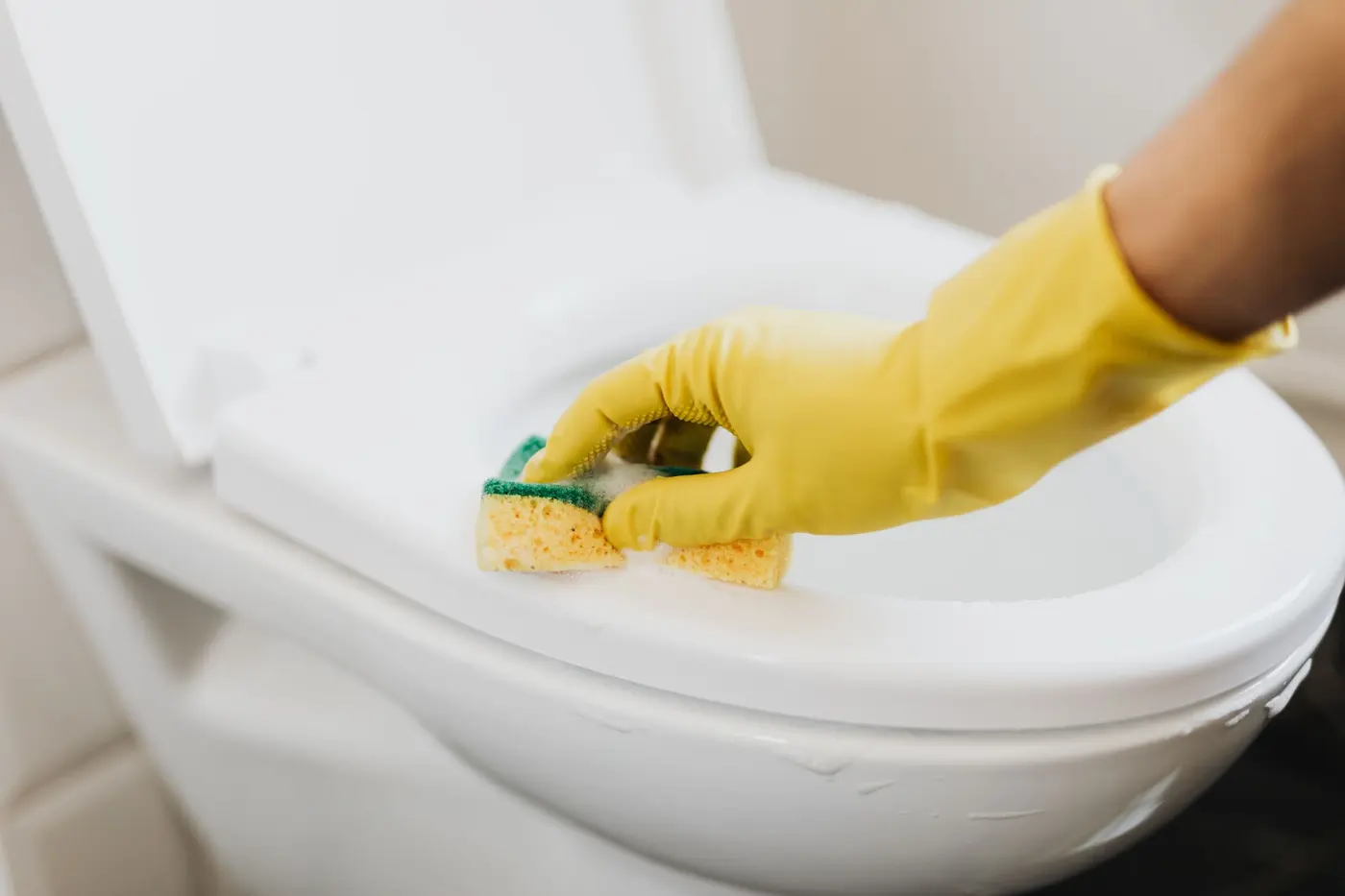
Yellow or brown marks in a toilet bowl do not automatically mean poor hygiene. In homes with hard water, mineral deposits catch dirt and gradually turn into a stubborn crust. If you are wondering how to remove limescale from toilet surfaces, do not begin with the strongest bottle in the cupboard. Work out what the deposit is, check the bowl's finish, and find out what cleaner may already be present. Acid can dissolve mineral scale. Gentle scraping can lift scale once it has softened. Chlorine bleach may lighten a stain, but it does not solve limescale, and it must never meet an acidic product.
First work out what is actually on the bowl
Limescale comes from minerals in water, mainly calcium and magnesium compounds. On white ceramic it may look chalky, grey, yellow, or rusty brown, depending on the water and the grime caught in its rough surface. Above the waterline, a vertical streak below the cistern outlet often points to a slow leak. Below the waterline, scale tends to form a rough ring or a hard patch near the trap.
Urine scale is a deposit of mineral salts from urine mixed with soil and existing limescale. It commonly builds beneath the rim, at the front of the trap, and wherever the flush does not rinse well. It can be yellow to brown, smell unpleasant, and feel like stone under a brush. In a real household the two deposits often overlap, so colour alone is not a reliable diagnosis.
Surface staining behaves differently. The ceramic stays smooth, the brush does not catch, and an ordinary toilet cleaner may fade the mark. Iron in the water or old pipes can leave a rusty tint. Dark spotting beneath the rim is more likely to be biofilm or mould than mineral scale. Acid is not the universal answer to those problems.
Try a simple check after flushing: move a toilet brush across the mark. A raised, gritty surface suggests a deposit. A smooth mark is more likely to be pigment, rust, or damage to the glaze. Keep your gloves on rather than testing it with a bare finger.
There is one awkward limit. If the glaze looks permanently matt, crazed, or scored, more scrubbing will not restore it. Damaged ceramic catches soil faster. In a Prague rental, photograph an old bowl before you start. At handover, those pictures help separate removable dirt from wear that an aggressive last-minute clean could make worse.
Preparation determines whether the cleaner works
The product needs direct contact with the deposit. Pouring acidic gel into a full bowl dilutes it, while the worst patch remains under water. Close the supply valve, flush, then use the toilet brush to push the remaining water through the trap. A dedicated cup can remove the last small amount. Protect the floor with an old towel and keep that equipment away from sinks and kitchen surfaces.
Open a window or run the extractor fan, put on chemical-resistant gloves, and read the full label. Look for active ingredients, prohibited combinations, contact time, and compatible materials. If you do not know what somebody poured into the bowl earlier, do not chase it with another bottle. Flush several times, ventilate the room, and postpone the job.
I have seen the same yellow trail return three weeks after a careful clean in an older panel flat. The gel was not the problem. A tired cistern valve kept sending a thin stream down exactly the same path. In a newer wall-hung toilet, the visible ceramic may be smooth while the narrow trap hides most of the scale beneath the water.
Check the surrounding materials too. An acid suitable for vitreous china may etch natural-stone flooring, attack cement grout, or mark metal fittings. Do not spray it into the air. Apply it slowly and close to the surface, where splashes are easier to control.
Acid cleaner, vinegar, or mechanical cleaning?
For a light, recent film, use a descaler specifically labelled for toilet ceramic. Depending on the product, it may contain citric, lactic, formic, phosphoric, or another acid. The name of the acid does not tell you a safe concentration or contact time. The directions on that particular bottle do.
Vinegar or a citric-acid solution can loosen a thin mineral layer when it has enough time in direct contact. "Natural" does not mean harmless. These liquids are acidic, can irritate eyes, and must not be combined with hypochlorite bleach. On a crust that has been growing for years, kitchen vinegar is often a long experiment with a poor result.
Use one controlled cycle at a time:
- Lower the water and apply one chosen product to the deposit.
- Leave it for the label's stated contact time, not an improvised overnight soak.
- Work the surface with a nylon toilet brush or a non-scratch pad reserved for the toilet.
- Flush, rinse the tools, and inspect the result before deciding on another cycle.
Heavy scale rarely disappears at once. That is not a failure. A second gentle pass is safer than guessing a stronger concentration. The acid softens and breaks down the mineral layer; mechanical action then removes what has released.
For glazed ceramic, choose a plastic scraper with a rounded edge, a pad explicitly sold as non-scratch, or a standard toilet brush. Keep the scraper nearly flat and stop if it bites into the surface. Metal putty knives, screwdrivers, steel wool, and abrasive paper can remove the crust quickly and leave permanent scratches. Those scratches make the next deposit easier to anchor. Pumice products need extra care: follow both the bowl manufacturer's and tool manufacturer's instructions, because they are not suitable for every finish, and never use one dry.
After two careful cycles, a thick remaining ridge is a good reason to stop improvising. During a rental handover, or with an expensive designer bowl, professional deep cleaning is cheaper than replacing scratched sanitaryware.
Combinations that do not belong in a toilet
The main safety rule is blunt: never mix chlorine bleach with an acidic toilet cleaner, vinegar, or citric acid. Chlorine products usually contain sodium hypochlorite. In acidic conditions they can release toxic chlorine gas. CDC guidance says not to mix household bleach with other cleaners; exposure can irritate the eyes, nose, throat, and lungs.
The chemicals do not have to meet in a mixing jug. Pouring acidic toilet gel into a bowl that still contains bleach gel from the previous step is enough to create a risk. Vinegar counts as an acid. Do not add ammonia-based cleaner either, because hypochlorite and ammonia can form irritating chloramines.
The sensible gap between methods is not a magic number of minutes. Use one chemical product during a cleaning session whenever possible. If you must change methods, remove the first product with repeated flushing as directed on its label, ventilate well, and allow time. A clock cannot replace dilution, rinsing, or the manufacturer's instructions.
If a sudden harsh chlorine smell appears, your eyes sting, your throat burns, or you begin coughing, stop. Leave for fresh air and keep other people out. With breathing difficulty, chest tightness, or symptoms that persist, call emergency services. In the Czech Republic, use 155 or 112. Do not go back into the room simply to flush the bowl.
Mixing two toilet gels because their packaging looks similar is no safer. A marketing name does not reveal the chemistry. Keep products in their original labelled containers. If you cannot identify the residue left in the bowl, rinse thoroughly and wait instead of experimenting with another product.
How to slow the return of yellow stains
Once the bowl is clean, spend a minute each week brushing beneath the rim and around the waterline. That removes a fresh film before it hardens. With hard water, brief regular maintenance usually beats a monthly dose of aggressive gel.
Watch for a fine stream down the back of the bowl. Several minutes after flushing, hold a small piece of dry toilet paper against the ceramic above the waterline. If it becomes wet, the cistern may be leaking. Repairing the valve saves water and stops the same patch from receiving a constant mineral supply. Your water utility may publish hardness data, or a test strip can give you a rough reading. The result does not automatically justify buying a softener; it simply explains why scale returns faster in one home than another.
A one-off deep bathroom clean makes sense when an old toilet has a continuous, layered deposit. A professional can work through several controlled rounds, protect adjacent finishes, and recognise when the remaining mark is surface damage rather than dirt. After that reset, routine upkeep is much easier.
If an end-of-tenancy deadline is close and the bowl needs more than another supermarket gel, contact Čistýkout for a no-obligation cleaning enquiry. We are a Prague-based cleaning option and can help assess what can be removed safely without turning old scale into permanent scratches.
Safety sources
- CDC guidance on bleach and why cleaners should not be mixed
- Poison Control on chlorine gas from mixing bleach with acid