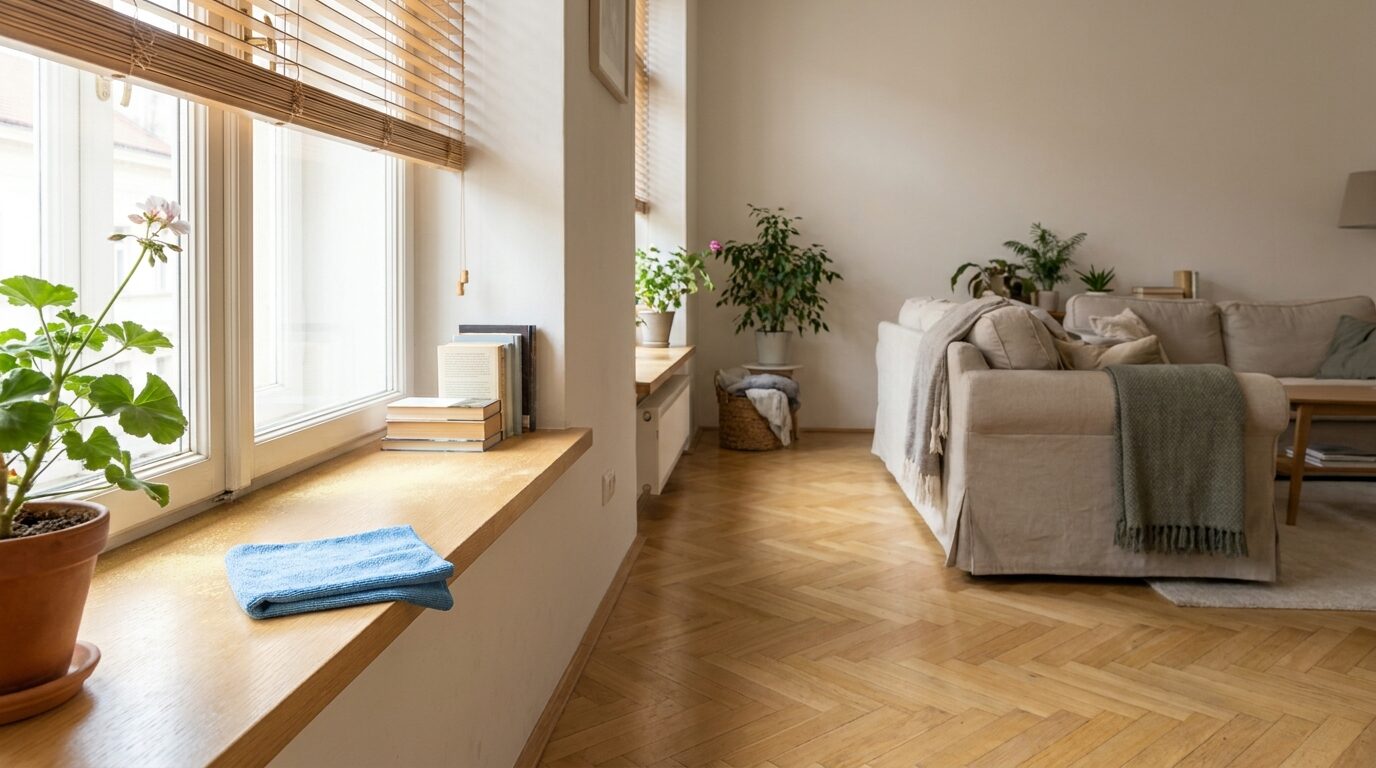
If you have been trying to figure out how to remove pollen from home and still feel like the dust keeps coming back, I would suggest starting near the windows rather than in the middle of the room. This is the one area many tidy households tend to overlook. The floor is vacuumed, the kitchen looks spotless, the bathroom is under control, and yet the windowsill turns yellow again by evening. In May, especially in a city like Prague, this is often a "window-zone" issue rather than a failure of your overall cleaning routine.
I see this same pattern over and over. People clean regularly, often quite thoroughly, but they treat the area around the window as a single surface. In reality, it is a cluster of small pollen traps: the sill, the frame, blind slats, screen mesh, seals, the handle area, nearby fabrics, and even the strip of floor directly below. If just one of these stays dirty, the room never feels fully settled. If you want the broader seasonal context, this article works well alongside our guide to pollen and dust in May.
Why the area around windows still feels dirty in May
Pollen behaves in a frustrating way once it gets indoors. It is light enough to travel through the air with ease, but sticky enough to cling to almost anything it lands on. It catches on slightly damp surfaces, static-prone plastic, textured paint, and that thin edge where the frame meets the sill. This is exactly why pollen on windowsills seems to reappear so quickly, even in homes that are cleaned religiously.
Blinds and screens only complicate the problem because they act as filters without you even realizing it. Slatted blinds catch a thin layer of dust on every single edge. A screen catches what drifts in from outside and holds onto it until you touch the window, open it wider, or create a draft. At that point, the settled material simply moves back into the room. It is a quiet loop that fools a lot of people.
Dry dusting usually makes this cycle even worse. A feather duster or a dry cloth might make the surface look clean for a split second, but fine pollen lifts easily into the air. Before long, it settles right back onto the same sill, the side table, or the sofa arm near the window. If you have ever finished cleaning in the morning only to wonder why the room looks dusty again by dinner, this is likely why.
There is also the matter of ventilation. In many Prague apartments, especially older buildings with tilt-and-turn windows, people leave the windows cracked for hours on end. It feels fresher, which is understandable, but during peak pollen days, long periods of micro-ventilation mean a steady stream of fine particles landing exactly where you want them least.
Which spots to check first
When dust around your windows keeps returning, do not start with a full-room reset. Instead, focus on the small surfaces that are actually acting as collection points.
Windowsills and frames
The sill is the most obvious candidate, but the hidden grime is usually along the back edge, in the corners, and right where the sill meets the frame. That narrow line often holds a mixture of pollen, urban dust, and the faint film that forms from everyday indoor life. On busier Prague streets, you can see the difference quickly. The deposit is not just yellow; it turns grey or beige and becomes slightly tacky to the touch.
Frames matter just as much. The lower lip of the frame, the drainage channels, the inner corners, and the locking side are all very easy to skip. In older flats, dust can settle into tiny imperfections in the frame material. Every time you open the window, a little bit more of it comes loose.
Cleaning blinds and shades
Cleaning blinds is a task almost everyone puts off. It is fiddly and time-consuming, so the hesitation is fair. However, blinds are usually the biggest trap in this entire micro-zone. Every slat gives pollen another ledge to settle on. When you add a bit of kitchen grease drifting from another room or ordinary indoor dust, that layer really starts to take hold.
With roller shades, I would check the bottom bar and the side channels first. With Venetian blinds, the top rail and the cords are also key spots. If your blinds are positioned directly above a radiator, the warm airflow can move fine dust back into the room much more easily than you might expect.
Screens, seals, and the handle area
A specialized pollen screen can help, but many homes are just using a standard insect screen. It might stop larger debris, but it also becomes a storage surface for everything it catches. If that mesh is not cleaned regularly, you are essentially keeping a dusty filter right in your window opening.
The seals and the area around the handle are also easy to miss but surprisingly important. Fine dust settles into the folds of the rubber and around the hardware. If you have pets or children, body oils and fur make that grime cling even more. The result is subtle, but it is enough to make the whole window zone look permanently dull.
How to remove pollen without stirring it up again
If your goal is to remove pollen from home without having to do the job twice, the order of operations matters more than the cleaning product you use. I always suggest working from the window inward.
First, use a vacuum only where it is truly helpful: tracks, corners, mesh, and grooves. A narrow attachment is your best friend here. A HEPA filter is definitely worth it during pollen season because you do not want your vacuum blowing those fine particles right back out the other end.
Next, switch to damp wiping. Not soaking wet, just properly damp. A microfiber cloth is ideal because it grabs the fine residue instead of just pushing it around. Wipe the sill toward yourself, wipe frames from top to bottom, and rinse the cloth frequently. Once the cloth starts leaving a muddy film behind, it is time for a fresh one.
For blinds, close them fully in one direction, wipe each side, then reverse them and repeat. Going slow is actually faster in the long run here. Rushing just turns the task into a dust cloud. If the buildup is heavy, a lightly damp cloth followed by a dry finish on any metal parts will prevent streaks.
For screens, a two-step method works best: a light vacuum first, then a wash with lukewarm water and a tiny bit of gentle cleaner. Let the screen dry completely before putting it back. Reinstalling a damp screen is a common mistake that just attracts fresh grime almost immediately.
Finally, do not forget nearby fabrics. Curtains, cushion covers near the window, pet beds, or even that throw blanket on the chair in the sun can all hold pollen and release it later. When people say they cleaned the window area but the dust still came back, fabric is often the missing piece of the puzzle.
How often to clean during peak pollen season
During peak weeks, one big weekly clean is rarely enough to keep up. A short routine performed two or three times a week actually works much better. Five focused minutes on the main living room windows can do more for the air quality than a massive Saturday reset.
My practical approach is simple. Every few days: the sill, the frame edge, the handle area, and the strip of floor directly below the window. Weekly: blinds or shades, plus a quick vacuum of any nearby fabrics. Monthly (or more often during a bad spell): remove the screens and give them a proper wash.
I would increase this frequency if someone in your home has allergies, if pets spend a lot of time near the balcony or windows, or if your flat is near both trees and heavy traffic. That combination is very common in the wider central streets of Prague. You can open the window for just a few minutes, and by the evening, it looks like nobody has cleaned for a week.
Your ventilation habits also play a role. Short, vigorous airing sessions are usually better than leaving a window tilted for hours. It is not a magic fix, but when paired with damp wiping, it significantly cuts down the cycle of dust.
When professional deep cleaning starts to make sense
Sometimes this remains a manageable home routine, but other times it can feel like a losing battle. If pollen keeps returning despite your best efforts, or if the buildup has moved deep into your upholstery, mattresses, curtains, or air-conditioning vents, a deeper clean can save you a lot of time and frustration.
Professional help is also worth considering after painting, moving, or any kind of renovation where different types of fine debris overlap. This is often when ordinary household cleaning starts to feel impossible. You wipe one surface, and another turns dusty before the first one is even dry.
This is exactly where a Prague-based service like ČistýKout comes in. We do not just offer vague promises; we provide a focused reset of the specific areas that keep feeding dust and pollen back into your rooms. If you would like some help, the easiest next step is to send a no-obligation enquiry. If the buildup has spread beyond the window zone, it is also worth looking at professional deep cleaning in Prague. A one-off deep clean of windows, blinds, and fabric-heavy areas might be all you need to get your home back to a state you can easily maintain.