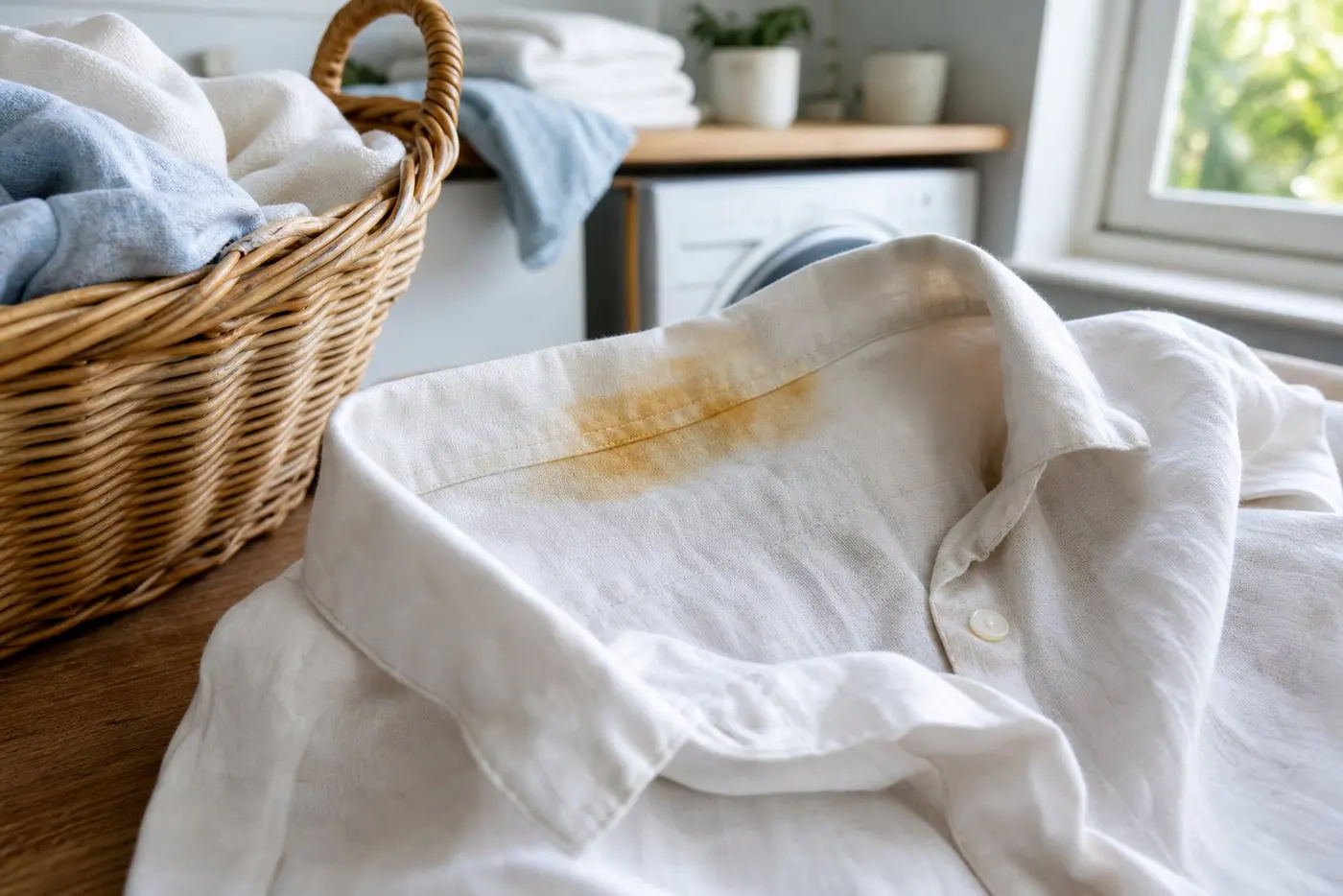
Sunscreen stains can change in the wash. That is why a collar that feels merely greasy at breakfast may come out of the machine with an orange ring. Before choosing a stain remover, work out which problem you have: fresh oily cream, or yellow-orange discolouration linked to a UV filter and iron in the water.
Why sunscreen leaves greasy and yellow stains
A sun cream has to survive sweat and swimming. Its oils, waxes and film-forming ingredients do not suddenly give up when they meet a shirt. They sit between the fibres. At this stage, the mark behaves much like grease.
Orange marks have another cause. Some sunscreens contain avobenzone, a UVA filter. Traces of it can react with iron ions in wash water and turn yellow, orange or rust-coloured. Tide and Consumer Reports both describe the reaction. Water described as hard may cause more trouble, although its actual iron content is the useful clue.
I first noticed the difference on a child's white T-shirt after a day at Žluté lázně in Prague. The neck felt waxy before washing. Afterwards, it had a copper half-moon. The machine had not failed to remove an ordinary oil stain. The nature of the mark had changed.
Keep the item away from a tumble dryer and iron. Heat can make residue much harder to shift. Air-dry it, preferably where you can inspect it in daylight.
First aid for a fresh mark
Lift off the surplus cream with a spoon, a blunt knife or a clean white cloth. No circles, no furious rubbing. I learned that lesson on a linen travel shirt: a thumbnail-sized blob became a palm-sized halo because I kept trying to wipe it away.
The care label gets the deciding vote. If I'm dealing with washable cotton, I use a little liquid laundry detergent made for oily marks. Fingers are enough to work it in. Then I set a kitchen timer for whatever the detergent label says, because leaving it for the rest of the afternoon isn't more scientific. With an unfamiliar colour, I sacrifice the inside hem to a small test.
The sequence on my laundry shelf is written on an old luggage tag: lift the cream; put a white cloth behind the spot; pretreat; wash at the permitted temperature; hang it up and look again. Nothing clever. It works because the shirt doesn't reach the hot stage before I've checked it.
The last step catches mistakes. Wet white fabric can conceal a pale yellow shadow. So can the warm light in a bathroom. I once nearly ironed a shirt that looked clean indoors; the balcony light exposed the collar immediately. A second pretreatment worked because I had not used heat.
An orange tone after washing is a reason to stop and reassess. More degreaser may achieve nothing once the oily part has gone.
Treating a dry yellow or orange mark
Yellow sunscreen stains that remain after drying or washing need a more careful diagnosis. Look at the sunscreen's ingredient list if you still have it. Avobenzone may be listed as butyl methoxydibenzoylmethane. Next, identify the garment. White cotton, dyed viscose and stretch swimwear do not tolerate the same treatment.
Sturdy white or pale cotton
Remove any remaining oily film with liquid detergent. A rust-orange shadow may need a laundry rust remover that is approved for that fabric. Use the stated dilution and timing. Doubling either is not a clever shortcut.
Citric acid and vinegar turn up in almost every discussion about orange collars. The chemistry isn't nonsense: acid may help with a mark involving iron. The kitchen version is where things get vague. How strong is the solution? Will the dye move? Is there elastane in the weave? Try the hidden seam and let it dry. For a shirt I care about, I'll take a textile product with actual directions over a bowl mixed by eye.
Coloured clothing
Test colourfastness on an inside seam. Rinse the test and let it dry fully; damp fabric can hide fading. If the colour remains stable, treat only the mark and keep to the stated contact time. Stop when colour transfers onto the white cloth used for testing.
Viscose, wool, silk and blends
Do not improvise with strong acids or alkaline products. Wet viscose can suffer from rubbing. Acetate blends may develop a permanent shiny patch. If the label asks for professional care, take the item to a cleaner and explain what happened, including previous washing and every treatment already used.
Rinse between attempts. Then air-dry and inspect. Several products layered onto wet cloth are both unsafe and impossible to troubleshoot.
What not to use blindly
Chlorine bleach is the obvious trap. With residues from certain UV filters, chlorine and high alkalinity may deepen or fix yellow-orange marks. The problem also appears in patent literature about sunscreen stains in textiles. Bleach can strip colour and weaken fibres too. A garment being white does not settle the question.
Never mix cleaning products. In particular, chlorine bleach must not meet acids, ammonia or another stain remover unless the product labels expressly permit the combination. Dangerous gas can form. Use one product, rinse it away completely and let the item dry before making another decision.
Hard scrubbing is poor compensation for the wrong chemistry. It can pull elastane out of shape, abrade performance fabric and leave swimwear shiny. The mark may go; the damage stays.
And no dryer yet. If you can still see a shadow, air-dry.
Swimwear, covers and upholstery
Sunscreen stains on swimwear are rarely caused by sunscreen alone. They come with sweat, salt or pool water, perhaps with fine sand. Rinse the suit promptly in cool or lukewarm water. Choose a mild product for synthetics, do not wring it, and keep it off a radiator. Elastane dislikes heat and force.
Treat a removable cover according to its label. Fixed upholstery needs much less water than most people expect. Blot away cream with a white cloth. Put a small amount of suitable solution on the cloth, not straight into the cushion, and work from the edge towards the centre. Finish with a nearly dry cloth so the wet patch does not leave a ring.
Valuable upholstery, silk, wool and unstable dyes belong with a professional. The same applies after several failed home attempts. Tell the specialist exactly what has touched the fabric.
Preventing stains over summer
Put sunscreen on before dressing and allow the time stated on the pack for it to settle. During reapplication, watch collars, sleeve edges, swimsuit straps and shorts. Repeated light contact builds a larger deposit than one obvious spill.
Inspect pale clothes after a pool day or a train trip out of Prague. Do it before they disappear into a full laundry basket. A greasy collar treated that evening is easier than an orange one that has already completed a hot wash and dry. Leave enough room in the machine for the wash liquor to move through the fibres.
The working rule is not glamorous: lift, pretreat, wash by the label, air-dry, check. When a mark turns orange, stop treating it as grease alone.
Sunscreen also lands on outdoor cushions, mattresses and upholstered furniture. If the problem has grown beyond one shirt, contact Čistýkout for a no-obligation enquiry. It is a Prague-based cleaning option for the wider seasonal job.