How to start a cleaning business in Czechia is not really a question of big investment. It is a question of starting with a tight scope, clear prices and basic order in the work behind the scenes. Most new providers do not need an office, a big brand story or ten services on day one. They need a legal setup that makes sense, a small offer they can actually deliver well and a simple way to talk to clients without confusion.
That matters even more in the Czech market because new cleaning providers are judged on reliability long before they are judged on scale. A client wants to know what exactly is included, how quickly you reply, whether you show up on time and whether anyone can vouch for you. Price matters, of course. Still, trust is what converts the first few enquiries into paid work.
Why it makes sense to start small instead of trying to do everything
Solo cleaner or small team?
A lot of people say they want to build a cleaning company, but in practice they are starting alone or with one other person. That is normal. At the beginning, process beats size. If you can answer enquiries, confirm the appointment, arrive on time, do consistent work and issue an invoice, you already look more professional than a bigger-sounding business with messy operations.
The common beginner mistake: an offer that is far too wide
Beginners often try to look established by offering homes, offices, windows, carpet extraction, post-construction cleaning and sofa cleaning all at once. It sounds ambitious. Operationally, it is a headache. Each service needs different timing, different tools and different pricing logic. One cleaner in Brno started that way and quickly hit the same wall many new providers hit: too much quoting, too many exceptions, too much running around for supplies. Once she narrowed the offer to recurring home cleaning and one-off deep cleans, her pricing became simpler and her schedule stopped falling apart.
The first months are for testing demand, pace and margin. A short service menu that you can deliver well looks better than a long list you cannot control.
The legal and admin minimum you should sort out before you start
What business setup usually makes sense
For many beginners in Czechia, the practical route is to start as a self-employed provider. That means handling your trade licence and related registrations according to the current rules that apply to your situation. The details can change, so it is worth checking the latest requirements with the relevant Czech authorities before you take your first paid job. This is not legal advice. It is a practical reminder that you need to know how you will invoice, record income and operate before money starts coming in.
Why liability insurance is worth having from the start
Liability insurance should not be treated like an optional extra. Cleaners work around stone worktops, glass, electronics, taps, flooring and all sorts of surfaces that can be damaged by the wrong product or rushed handling. One avoidable mistake can turn a normal job into an expensive argument. Insurance does not replace care, but it gives you and the client a basic safety net.
What you need for invoicing, record keeping and client agreements
Your admin setup does not need to be complicated. You need a working contact channel, a clear price list or price range, a short description of your services, a booking method, job records and invoices. Just as important, you need to define what the service includes and what falls outside the scope. That matters because recurring cleaning and deep cleaning are not the same thing. The timing is different, the dirt level is different and the client expectation is different too.
Which services to offer first so you do not drown in your own offer
Strong starter combinations for solo providers
A realistic starter package is usually two to four clearly defined services. For example: recurring home cleaning, one-off deep cleaning, Airbnb turnover cleaning and small offices. That is enough to look credible without creating operational chaos. The right mix depends on your town, your travel time, your physical capacity and how many hours you can actually work each week.
Which services are better left for later
It is often smart to leave high windows, carpet extraction, post-construction cleaning and large commercial sites for later. Those jobs may need different equipment, more experience, stronger insurance terms and more accurate quoting. They look attractive on paper, but they are exactly where beginners can lose margin fastest.
Describe the service by outcome, not by a vague promise
Do not write “I offer cleaning.” Write what the client gets. A better description sounds like this: recurring cleaning of a one-bedroom flat includes bathroom, toilet, kitchen surfaces, vacuuming, mopping, dusting of reachable areas and taking out rubbish. It does not include windows, laundry or heavily neglected spaces. That kind of wording makes selling easier because the client sees the result and you protect the scope at the same time.
How to price early jobs without undercharging yourself
Hourly rate, fixed task price or starter packages?
If you are wondering about cleaning services pricing for beginners, do not start by copying someone else’s rate. Start with your real time cost. For new or unclear jobs, an hourly rate or a guided price range usually makes sense. Once you know the property and the routine, recurring jobs can move to a cleaner package price.
What your price actually needs to cover
Your price should cover more than the minutes spent inside the property. It needs to account for travel, supplies, messaging, scheduling, small admin tasks and a buffer for bad estimates. Deep cleaning is not just a longer version of recurring cleaning. It often means heavier build-up, slower detail work and more product use.
Why a cheap start often becomes an expensive mistake
New providers often go too low because they think reviews must come first and profit can wait. That sounds safe, but it tends to attract clients who shop almost entirely on price. A familiar example: you quote a deep clean as four hours because the flat looks manageable from the description. In reality it takes seven hours, plus travel and an extra stop for supplies. The job is finished, the client is happy, and you still learn the hard way that you priced yourself into almost nothing.
A better habit is to review every early job once it is done. Write down how long it took, what extra materials you used and where your estimate was wrong. That is how your starter price list becomes a real one.
What equipment you need at the start and what can wait
A sensible starter kit
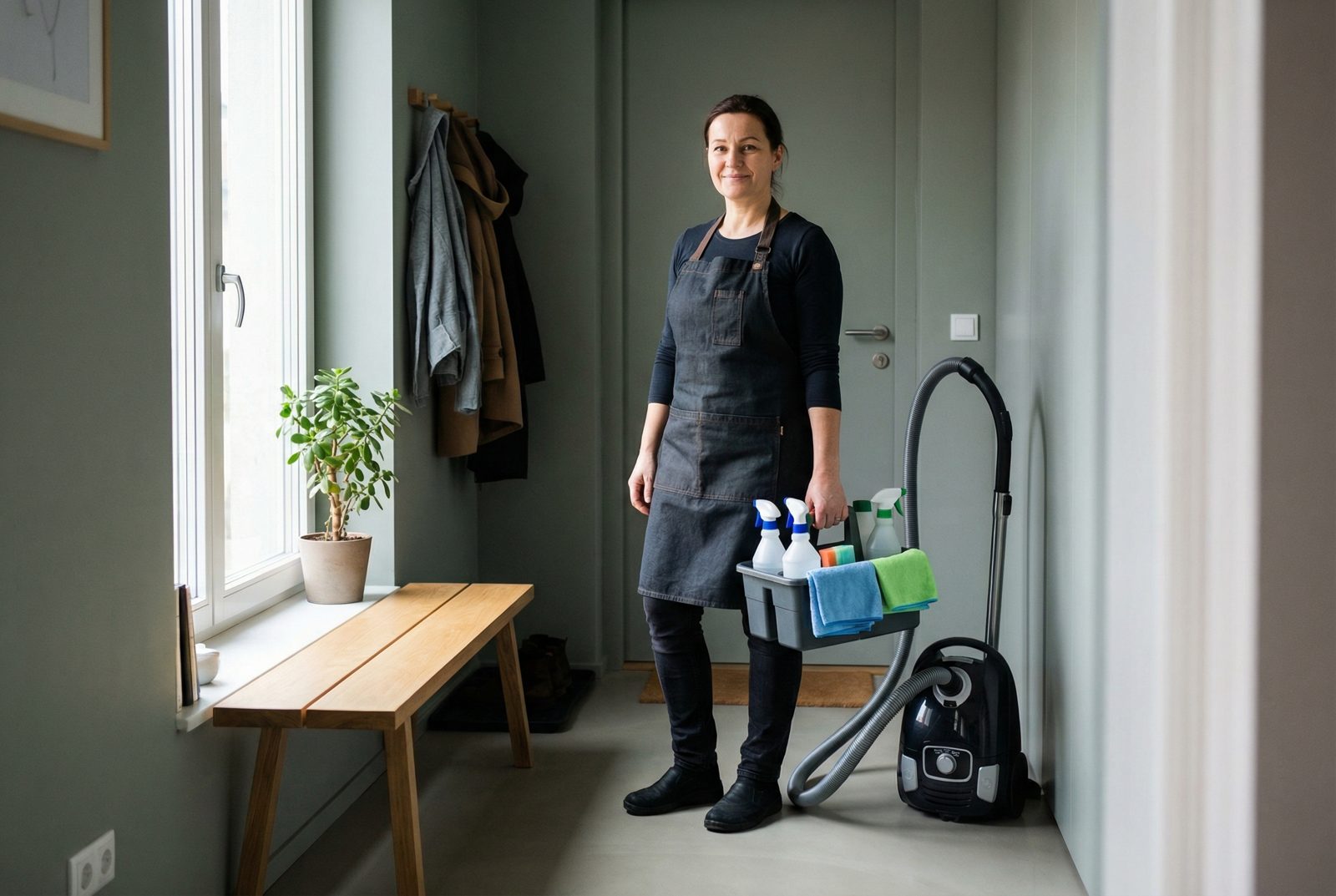
A solo cleaner business setup does not require a van full of equipment on day one. A sensible kit is enough: reliable cloths, gloves, a mop, basic products for bathroom, kitchen, glass and floors, bin bags, sponges, protective gear and a portable organiser. The key is consistency. Clean tools, clear separation by surface and a tidy setup make you look more credible straight away.
When to invest in better equipment
Buy better equipment when the volume of work proves the need, not before. If you only handle a couple of jobs a week, a simple organiser and well-planned supplies are usually more useful than an expensive machine that mostly sits at home.
How to get your first cleaning clients and build trust fast
Personal network, local groups and recommendations
If you want to get first cleaning clients without a big marketing budget, start where trust is cheapest. Personal contacts, local Facebook groups, neighbourhood communities, small listing sites and referrals are often enough for the first wave of jobs. The message should be simple: what you offer, where you work, what types of jobs you take and how people can book you.
Why a simple online profile matters
A phone number on its own is weak. New clients want to see your services, location, price range, contact method and early reviews in one place. That is where a clear provider profile helps. On CistýKout, a solo cleaner or small team can show services, pricing range, reviews and client communication in a way that feels organised from the start. For a new provider, speed of reply and clarity often sell better than a discount.
Ask for reviews in a specific way
Do not ask for a review with a generic one-liner. Ask right after a successful job and make it easy. For example: if you were happy, I would really appreciate a short review saying what mattered most to you, maybe punctuality, communication or the final result. That kind of prompt gets better responses because it gives the client something concrete to say.
Your first month: what to track so chaos turns into a system
What to record after every job
Track five things after each job: actual time, difficulty, materials used, where the client came from and whether you would price the same work differently next time. Without that, you are guessing.
When to adjust your offer or your prices
If the same problem keeps showing up, change something fast. Shrink your area if travel is killing the day. Raise the price or tighten the scope if deep cleaning is not paying well. If recurring home cleaning keeps coming up, lean into it.
When you need a better client system
The moment you stop remembering who expects a key handover, who wants their own products used and who is still waiting for a time confirmation, you need a better setup. A simple provider profile, service overview, review collection and client communication flow help a new business look reliable long before it looks big. That is the kind of foundation worth building first.
Quick FAQ
- Do I need a company right away? In many cases, no. A self-employed setup is the more realistic starting point for beginners in Czechia, depending on their situation.
- How much should I charge for my first job? Enough to cover time, travel, supplies and a buffer for a bad estimate. Going very low is rarely a smart long-term move.
- Which services should I offer first? Usually recurring home cleaning, deep cleaning and in some areas also small offices or short-term rental turnover.
- What do I need to look trustworthy? Clear scope, quick replies, punctuality, reviews and a clean online profile that shows what you offer.