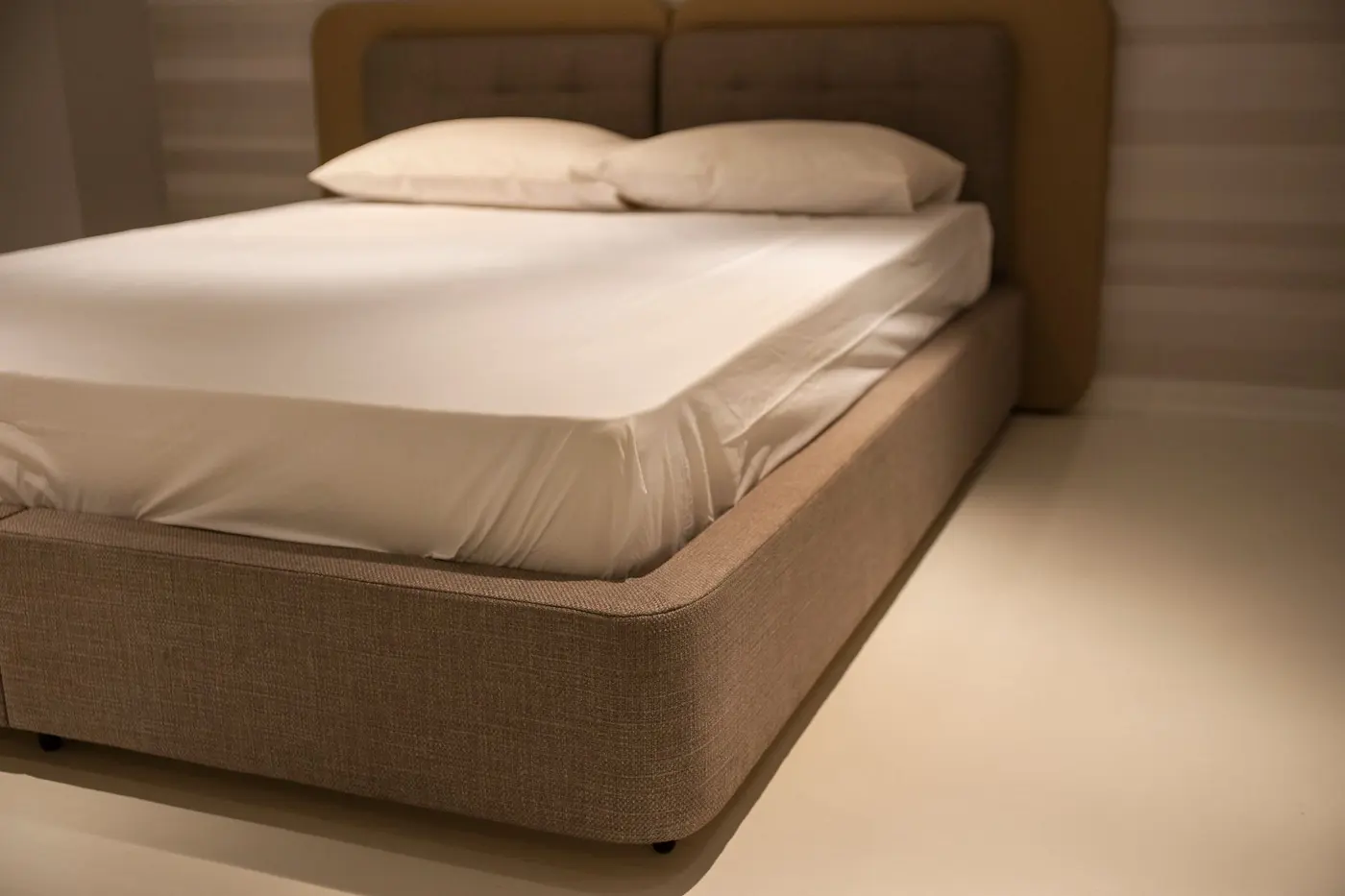
If you are wondering how to wash a mattress cover, do not start by choosing a temperature. Start with the care label. Two white zip-off covers may look almost identical while containing very different blends, quilting or bonded layers. The usual mistake is not a slightly imperfect detergent choice. It is washing at 60°C “to be safe,” followed by a hot dryer cycle. The cover comes out clean but no longer reaches around the mattress.
First, confirm that the cover is actually washable
Look for a sewn-in label near the zip or along the underside. The wash-tub symbol and its temperature take priority over advice for a similarly named model online. Manufacturers sometimes change a cover during a mattress range’s lifetime, so an old product page is not enough.
Check four instructions before removing anything:
- whether the cover may be washed in water;
- the maximum washing temperature;
- whether tumble drying is allowed, and at what heat;
- whether bleach or professional dry cleaning is permitted.
A crossed-out wash tub means no machine or hand washing. A hand in the tub means hand wash. One line beneath the tub calls for a gentle cycle; two lines mean very gentle treatment. For drying, read the square containing a circle. A cross rules out the tumble dryer, while the dots state the permitted heat.
If the print has faded, find the manual for the exact mattress model. Guessing a higher temperature is a poor substitute. This matters particularly for people with allergies, who may understandably want a hot hygiene wash. The label is still the limit.
A zip does not automatically make a mattress cover removable. Some mattresses have a service zip used during manufacture or repair. Warning signs include no washing label, a concealed or unfinished zip pull, and an inner textile layer attached to the foam. In that situation, leave the zip alone and follow the maker’s cleaning instructions.
Take three phone photos before you begin: the top, the underside and the head end. White fabric looks obvious while it is on the bed. Six hours later, when two nearly identical panels are dry, the orientation is surprisingly easy to forget.
How to remove the mattress cover without harming the zip or foam
Strip the bed, remove any separate protector, then vacuum loose dust from the cover and seams. Lay the mattress flat on a clean floor or support it so its weight is not pulling against the fabric. Do not drag the zip around a tight corner. Feed a little slack towards the slider with one hand and open it slowly with the other.
Handling is often the hardest part in a Prague flat. A double mattress leaves little working room in a panelák bedroom, and pulling seems easier than moving a bedside table. Make the space. Five minutes of rearranging furniture is preferable to a torn slider or a ripped inner sock around the foam.
A zip running around the full perimeter often separates the cover into top and bottom panels. Wash the panels separately if both the label and zip construction allow it. Each piece then has room to move, rinse and spin without becoming one heavy knot. Treat both panels in the same way, though. Washing only the stained half can eventually leave the two pieces with different tension, colour or dimensions.
With a shorter opening, roll the fabric away from each released corner rather than hauling it by a seam. Keep fingernails and jewellery away from the foam. The thin protective fabric around the core tears more easily than many owners expect, and a damaged layer catches on the zip when the cover goes back on.
Temperature, cycle and detergent
There is no universal mattress cover washing temperature. One label may permit 60°C, another 40°C, and a quilted or bonded cover may be limited to 30°C. Treat the printed temperature as a ceiling. If your label says 40°C, an online suggestion to “wash hot for hygiene” does not override it.
Close or secure the zip as the manufacturer directs before loading the machine. A loose slider can snag, while a long open zip takes unnecessary strain. Put the cover in loosely. Once wet, a thick panel becomes much heavier. If the dry cover already fills nearly the entire drum and cannot shift when you move it by hand, the washer is too small.
I favour a gentle cycle with a thorough rinse and low to moderate spin. Hard spinning pulls at the seams and leaves deep creases. Use a modest dose of mild liquid detergent without bleach. Powder may remain in bulky quilting if the load cannot rinse freely. Skip fabric softener unless the manufacturer expressly permits it; residues can coat fibres and alter the performance of treated fabrics.
Do not add towels, sheets or clothes to make up a “full load.” The removable mattress cover needs the space. This is one wash where squeezing in an extra item works against you.
Treat stains according to what caused them
Blot fresh liquid first with a clean white absorbent towel. Press from above and keep moving to a dry part of the towel. Scrubbing spreads the mark and pushes moisture farther into the padding. For blood, begin with cold water because heat can set the protein into the fibres.
For ordinary body-oil or sweat marks, dilute a small amount of liquid laundry detergent in water. Apply it only to the affected area, work it gently with your fingers or a soft white cloth, and give it the contact time stated on the product. Test first beside the zip or on the lower edge. Brightening treatments, coloured piping and surface finishes do not always react like a plain cotton sheet.
Do not combine chlorine bleach, vinegar, peroxide, ammonia or improvised household mixtures. Mixing a chlorine product with an acid or ammonia can release dangerous fumes. A harsh cocktail will not fix moisture that has already reached the foam core either.
I once saw a removable cover with one brilliantly white treatment circle and a greyish surface everywhere else. The spot might have been sanitised, but the cover looked worse than before. Start mild. Move to a stronger stain product only when its label and the mattress-cover instructions both allow it.
Drying determines whether the cover will fit again
Washing is often easier than working out how to dry a mattress cover safely. Wet quilted fabric is heavy. Hang it from two narrow pegs and it can stretch out of shape. Spread each panel over a broad drying rack so one seam is not carrying all the weight. Turn it during drying and straighten the corners and zip tape by hand.
Keep it off a hot radiator and away from a space heater. Strong summer sun on a Prague balcony can fade dark piping and heat the fabric more than expected. Shade, airflow and an open window are gentler. A fan usually does more useful work than extra heat.
Use a tumble dryer only when the care symbol permits it. Select the stated low setting and remove the cover promptly. Do not test a prohibited dryer “for just ten minutes.” A brief blast of high heat may shrink a cotton component or damage a foam-backed or functional layer.
Drying may take roughly 6 to 24 hours, depending on thickness, room humidity and airflow. The clock cannot tell you whether it is ready. Feel inside the quilting, along the seams and beneath the zip tape. Refit only when the whole cover is dry, not merely the surface. Moisture trapped next to foam creates a stale smell and conditions in which mould can develop.
Use your photos when refitting. Line up the head end, seat the corners first and ease the fabric along the sides. Never force the zip under tension. If the two sides remain a couple of centimetres apart, pliers are not the answer. Reposition the cover, let it settle fully at room temperature and try again with a second person.
When the cover will not fit in the washer, or has no zip
A thick cover from a 180 × 200 cm mattress often overwhelms a typical 6 or 7 kg household machine. Do not force it inside. An overloaded drum cannot wash or rinse the fabric properly and may damage the appliance. A self-service laundry with a large-capacity washer can work if the care label allows machine washing. Otherwise, ask a professional textile cleaner what process they use for that exact cover.
Measure the folded cover and photograph its label before leaving home. A laundry attendant can then see the material and restrictions. A larger drum provides room, not permission to increase the temperature.
Do not cut a seam to remove a cover without a zip. Vacuum the surface with a clean upholstery attachment and spot-clean with as little moisture as possible. Put cleaner on the cloth rather than pouring it onto the mattress. Memory foam and cold foam dry slowly, and you cannot see how much water remains in the centre.
If urine, vomit or another biological fluid has passed through the fabric into the foam, washing the cover solves only part of the problem. The same applies to visible mould, major soaking or a stale smell that keeps returning. Check the core and the manufacturer’s guidance. Deep contamination may call for professional assessment or mattress replacement.
The safest sequence is pleasantly unglamorous: label, photos, careful removal, an uncrowded drum and slow drying without excess heat. If the cover is too large or a spill has affected other bedroom textiles, contact Čistýkout for a no-obligation cleaning enquiry in Prague.