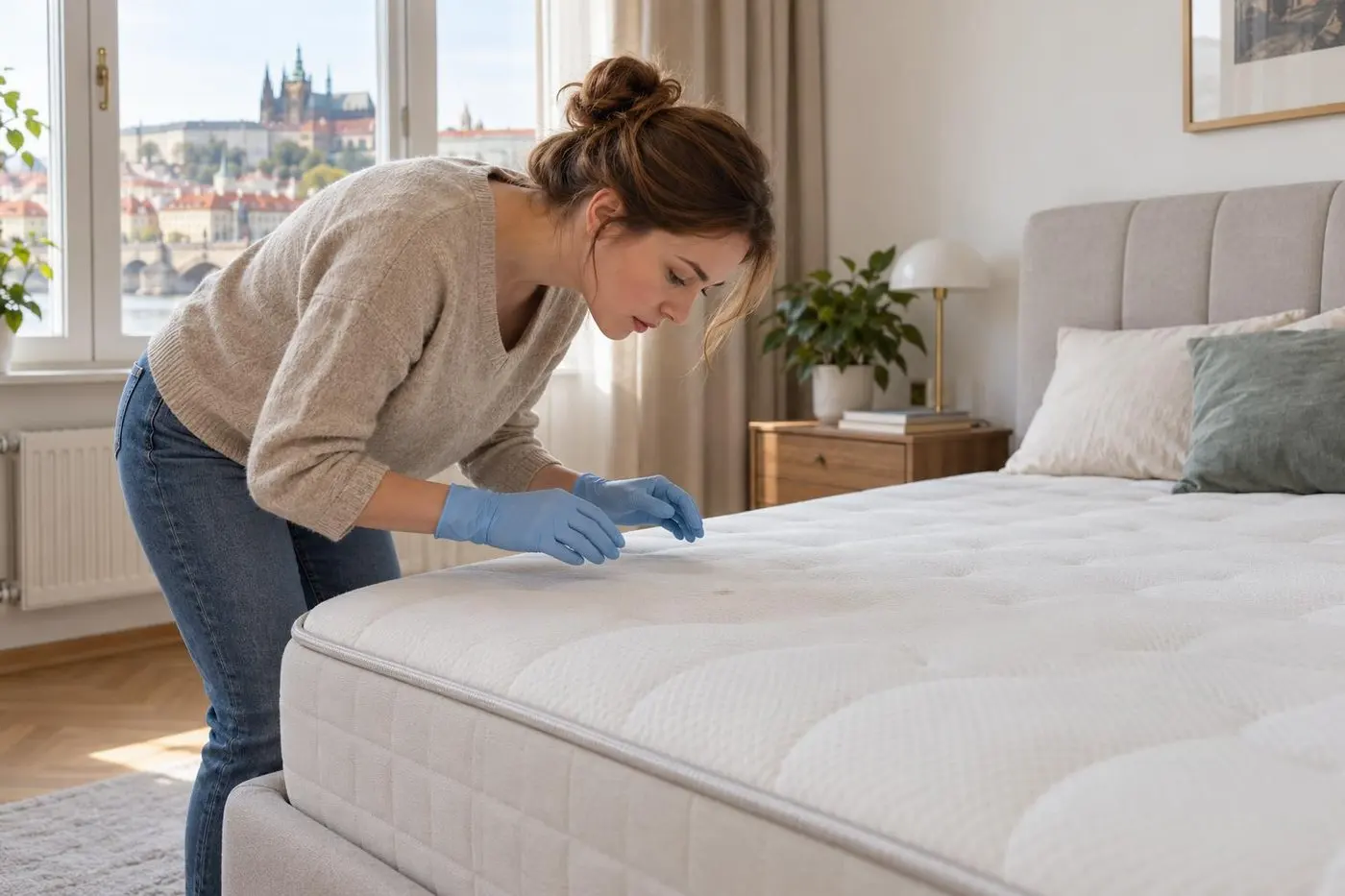
An unidentified mark invites a fast reaction: spray it, scrub it, hope for the best. With mattress cleaning, that is exactly when I would pause for ten minutes. Colour alone does not identify a stain, and the wrong product can turn one small patch into a permanent ring. Check its edge, smell, likely age and the cover material first. Then run the smallest safe test you can.
This method is useful when you have taken over a rented room, found a mark on a child's bed, or opened a bedroom that has been unused for months. It is not another universal mixture. It is a way to avoid two common mistakes: soaking the filling and setting an unidentified stain with heat or incompatible chemicals.
Find four clues before you reach for cleaner
Work in daylight. Strip the bed, move the mattress away from the wall and check the sides and underside as well as the top. You are looking for four clues: colour and outline, odour, approximate age, and cover material.
A yellow patch could be perspiration, urine or an old drink. Rust-brown might resemble dried blood, but tea can look similar. Grey-green specks near the lower edge raise a different concern: mould. A sharp boundary points towards a spill; a pale ring may come from an earlier cleaning attempt. These are clues, not proof.
Context helps. Who used the room? Could a child have spilled cocoa, a pet had an accident, or condensation built up under a poorly ventilated bed? I once saw a brown patch in a Žižkov rental that the new tenant assumed was coffee. It sat directly above one bed slat, and the underside felt cold and smelled musty. The real problem was trapped moisture between the mattress and a solid board, not a mug.
Find the maker's care label. A zipped cover is not necessarily washable: some shrink, while others cannot take bleach or heat. If the label has vanished, treat the cover as delicate and keep the test small.
Test a stain of unclear origin with the mildest option first
Vacuum loose dust with a clean upholstery attachment. Move the nozzle gently and do not grind dry material into the fabric. You can lift a dried crumb with the edge of a spoon. If the deposit is powdery or crumbles easily, wear gloves and keep your face away from it.
For the first damp test, wet one corner of a white cotton cloth with cool water and press it against a hidden seam. Let the test dry because damp fabric can hide fading. Stop if the cover loses colour or puckers.
If the fabric stays stable, test the outside edge of the mark. Start with water alone and use very little. Press and lift; do not rub. Work inward so you do not spread the outline. Turn to a clean section of cloth after every press. It feels slow, but it lets you see whether soil is actually moving or you are merely making the mattress wetter.
If water is not enough and the care label permits upholstery cleaner, test a diluted product as directed. Do not stack vinegar, peroxide and bicarbonate because each appears in a different online recipe. An earlier tenant may have left another residue behind.
Water control matters as much as the chemistry
People trying to remove an unidentified mattress stain usually focus on the bottle. I look at where the water will go. A mattress has no drain, and the filling dries far more slowly than the ticking. The surface may feel dry while foam a couple of centimetres below it is still damp.
Put solution on the cloth, not directly on the bed. After a short contact time, absorb it with dry white fabric. Press through a folded towel until moisture transfer becomes faint. A small patch often needs less liquid than two pulls of a trigger spray.
A domestic extractor helps only when it is suitable for upholstery and you make several dry passes for every wet one. To deep clean a mattress does not mean flushing it like a carpet. High flow drives soil deeper and adds hours to drying, especially with memory foam.
Drying depends on temperature, moving air, humidity and construction. A thick foam bed in a Prague 2 flat in November behaves differently from one beside an open window in July. Use a fan, never an iron, heat gun or hot radiator.
Blood, urine, drinks and mould require different decisions
Once the test or the room history suggests a cause, change your approach. Suspected blood calls for cool water. Blood contains proteins that heat can set in fibres, much like egg white firms in a pan. Hot water, steam and a hair dryer may make an old blood mark harder to remove. If a careful cool test transfers nothing, do not force the result with heat.
Urine presents two jobs: reducing colour and neutralising the source of the smell. The odour can return on a humid day. An enzyme product is more useful than fragrance, but it must suit the cover and stay for the stated contact time. Surface treatment may not reach an accident deep in the foam.
Coffee, tea and soft drinks leave colour and sometimes sugar or milk residue. Gentle blotting with cool water is a sensible first move. Still, do not declare every brown patch to be coffee. Stop if it smells musty, appears on the underside too, or grows without a new spill.
Possible mould is not cosmetic. Inspect the bed base, wall, underside and the inside of any removable cover. If the mattress repeatedly feels wet, the affected area is broad, or the sleeper has asthma or allergies, do not keep spraying it. Fix the moisture source and consider assessment or replacement.
Stop cleaning when the next step would mean more soaking
An old mark may never disappear completely. That does not justify a fifth wet pass. Old stains on a mattress may have oxidised, faded in sunlight or reacted with a previous product. A hygienically clean cover can retain a shadow. Chasing perfect white fabric can do more damage than the original mark.
Stop when:
- the stain expands or develops a fresh pale or dark ring;
- the cover's own dye appears on your white cloth;
- the fabric pills, turns sticky or begins to ripple;
- the filling remains cool and damp after the surface dries;
- the odour grows stronger after drying or quickly returns.
Do not add another home recipe. Let the mattress dry, then choose professional spot treatment, controlled extraction, an encasement or replacement. Tell a cleaner what you used. With widespread mould, biological contamination of unclear origin or crumbling foam, replacement may be safer than trying to clean a mattress without soaking it again.
Put the mattress back only after a full drying check
Stand the mattress on its side so air reaches both faces. Open the window when outdoor air is not markedly more humid, and use a fan. Do not place it straight back on a solid board or cover it with bedding. Both moves trap moisture that you have just tried to remove.
Check more than the surface. Press a dry paper towel onto the treated area and the underside for a moment, then compare the temperature with the surrounding fabric. A distinctly cool patch is often still damp. Smell it only after the room has aired; otherwise the cleaner's perfume can masquerade as success.
Once everything is dry, fit a washable protector. It cannot cure mould or rescue wet filling, but it catches the next accident before it reaches the foam. I write the last wash date on the care label. That small habit saves guesswork later.
If the stain is large, still unidentified, or wet after several attempts, ČistýKout is a Prague-based cleaning option. Send a no-obligation enquiry through the ČistýKout contact form and describe the material, affected area and products already tried. With a mattress, an honest assessment sometimes ends with advice not to clean it again.