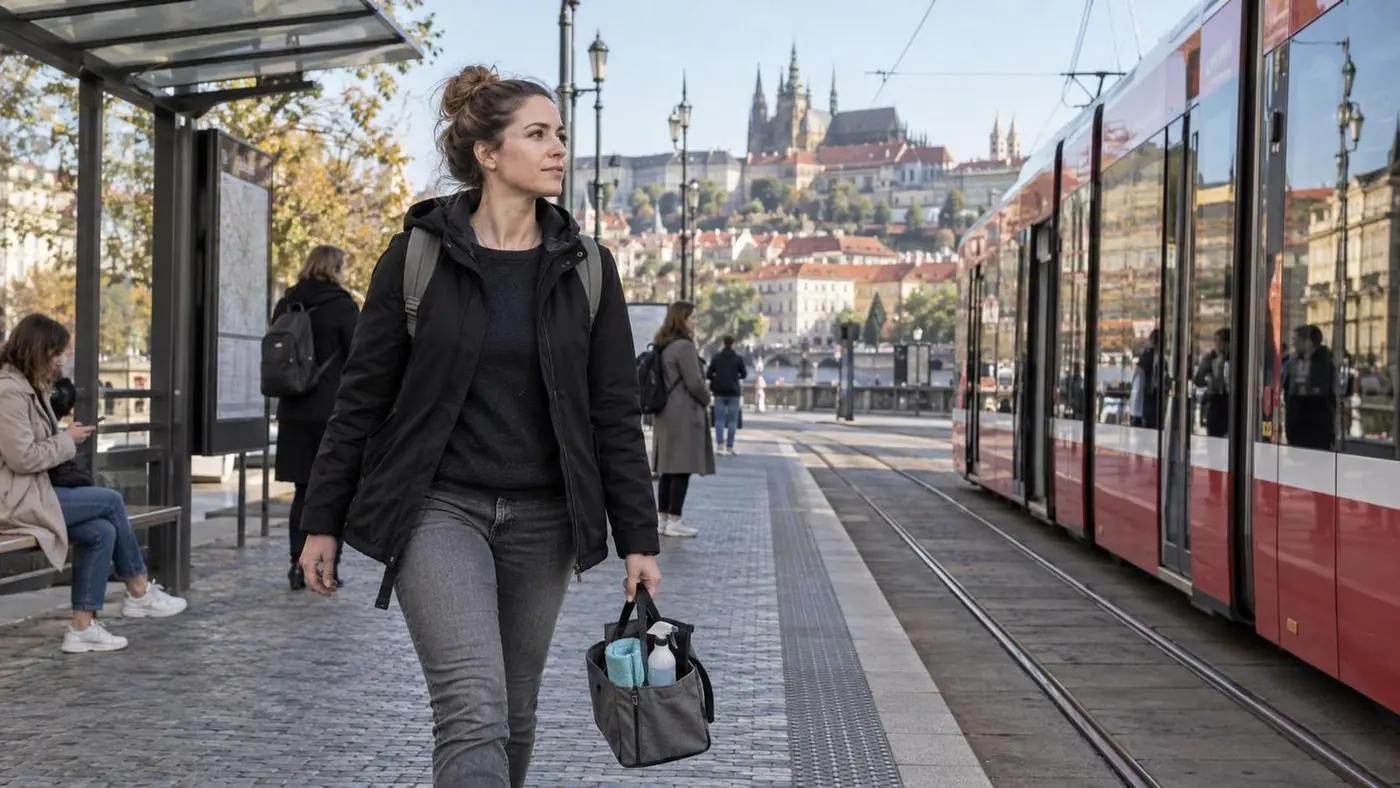
Starting a cleaning business in Prague does not require a car. It does require restraint. If you accept one client in Dejvice, another in Pankrác and a third near Černý Most, your earnings will disappear between platforms and bus stops. A workable first route is smaller: one service zone, a portable cleaning kit, appointments that connect, and a minimum job price that pays for the time around the clean as well as the work itself.
Draw a service zone you can actually cover by public transport
"All of Prague" sounds attractive on a new service page. In a diary, it can be a mess. Prague's network is good, but a direct 25-minute metro ride is not a 25-minute journey. You still have to walk to the station, wait, find the right entrance and perhaps climb to a fourth-floor flat with no lift.
Measure travel door to door, preferably once with the bag you plan to carry. A route shown as 23 minutes in an app can easily occupy 35 or 40. That difference matters when it sits on both sides of a two-hour job.
For the first few clients, choose a compact area or one strong transport line. Vinohrady, Žižkov and Karlín can form a sensible cluster. District borders matter less than reliable connections.
Treat the first job in a new area as an anchor. Can it lead to another booking nearby? A lone two-hour clean that takes 55 minutes each way may block half a day. Saying no to it is not a lack of ambition. You are protecting room for clients you can reach reliably week after week.
A portable cleaning kit should cover the basics, not every emergency
A cleaning business without a car cannot run on a crate of products carried "just in case". Split the equipment into two groups: the light kit you bring and the larger items available at the client's property.
Your own kit might include:
- colour-coded microfibre cloths and a spare pair of gloves;
- sponges, bin bags, a small detail brush and a surface-safe scraper;
- two or three products you know well, decanted only when the maker's instructions allow it;
- shoe covers and a clean work top.
Small bottles need secure closures and clear labels. Never carry concentrate in a drinks bottle. An unmarked liquid is risky in a client's home and even worse on a crowded tram. Keep incompatible products apart and follow the safety instructions on the original packaging.
Ask the client to provide bulky equipment when practical: a working vacuum, mop, bucket and step stool. Confirm each item before the first visit. "Yes, we have a vacuum" is not enough if its filter is packed with dust and the floor head is missing. For a recurring job, leaving a labelled box of your cloths or an inexpensive mop at the property can be worth it.
Natural stone, oiled wood and delicate fittings may need a product that is not in your everyday bag. Agree on that before travelling or exclude work that cannot be done safely.
Your minimum job price has to cover travel and preparation
The fare is rarely the main problem. Unpaid time is. A two-hour clean might occupy three hours and fifteen minutes once you add the outward journey, messages, unpacking, packing and the trip to the next address.
Use a plain calculation:
cleaning time + travel + preparation and client communication = occupied time
Suppose you charge 800 CZK for two hours. Travel and preparation add 75 minutes. You have not earned 400 CZK an hour; you have earned about 246 CZK for each occupied hour, before products, insurance, tax and other business costs. The invoice figure hides that loss.
A minimum visit of three hours is one answer. A zone-based minimum charge is another. Pick a rule you can explain before the booking. For example: "The minimum visit value in my core zone is 1,200 CZK. For addresses outside it, I quote after checking the route and available appointment." That is clearer than inventing a cleaning service travel fee after the work is done.
Allow extra time in the first quote. After two or three visits, adjust the price from real records rather than a map estimate.
Build appointments into a route, not empty calendar boxes
An open space at 10:00 on Tuesday does not suit every enquiry. A calendar shows time, not hills, diversions or missed connections. Put the nearest stop, walking time and realistic departure time beside each booking.
Cleaning route planning is easier when the day has an anchor client. If Tuesday starts near Jiřího z Poděbrad, look for the next job in Vinohrady, Žižkov or on a direct tram line. Ten to fifteen minutes on foot is often safer than a shorter-looking journey with two transfers.
Leave at least 30 minutes between clients, and sometimes 45. You need to pack, wash your hands, change a work top, walk to the stop and absorb an ordinary delay. Back-to-back bookings look efficient until the first bathroom takes ten minutes longer. Then the rest of the day is spent apologising from a tram.
Recurring clients belong on area days. Monday might be Prague 6, Tuesday Vinohrady and Thursday Karlín or Holešovice. You do not need to explain the whole logistics system. Offer two available times that already fit the route. Most clients can choose when they are given useful notice.
What to agree with the client before the first journey
Small surprises are expensive when everything travels with you. "Third floor" may mean no lift. The entry code may open the street door but not the courtyard. The vacuum might be locked in a cellar while its owner is at work.
Before confirming the first visit, check:
- the full address, entrance number, floor, lift and key handover;
- access to water and somewhere to leave your coat and travel bag;
- the vacuum, mop, bucket and step stool, including their condition;
- unusual surfaces or tasks that need a specific product;
- a live phone contact for delays, transport closures or access problems.
Photos can make a quote more accurate, but ask for consent and request only what you need. A shower screen or worktop may help; family photographs will not. Treat the files as working material and tell the client when you will delete them.
One solo cleaner preparing for a small recurring job in Holešovice learned that the premises had a decent vacuum and a lockable cupboard. She brought cloths and products on day one, then left a labelled set there with permission. Every later trip was several kilograms lighter. That kind of saving never appears in a route planner, but your shoulders notice it.
When a car, taxi or equipment delivery starts to make sense
A car is not proof that the business has become professional. It is a cost that must buy something useful: saved time, more capacity or access to jobs that need machines. Count finance or depreciation, insurance, servicing, fuel, parking and the time spent looking for a space. In central Prague, a car may make the route slower.
For a post-renovation clean, a taxi or courier can move a machine for one day. A 350 CZK trip may be cheaper than owning a vehicle all month. Quote it openly as part of that job.
Use four weeks of real routes before deciding. How many paid hours did you turn down because of transport? How much time would a car genuinely save? Would it add two profitable bookings a week, or sit in a paid parking zone while you clean one flat? The feeling of looking more established does not cover the bill.
In the first months, a dense group of clients beats a dot in every corner of Prague. Keep the kit light, set a core zone, price the whole occupied period and give regular work a neighbourhood day. Those habits make starting a cleaning business without a car financially possible. They also show you, with actual numbers, when another form of transport is finally worth paying for.
If you are looking for cleaning rather than building the route yourself, ČistýKout is a Prague-based option. Send a no-obligation enquiry through the ČistýKout contact form with the address, scope and preferred timing so the visit can be planned sensibly for both sides.