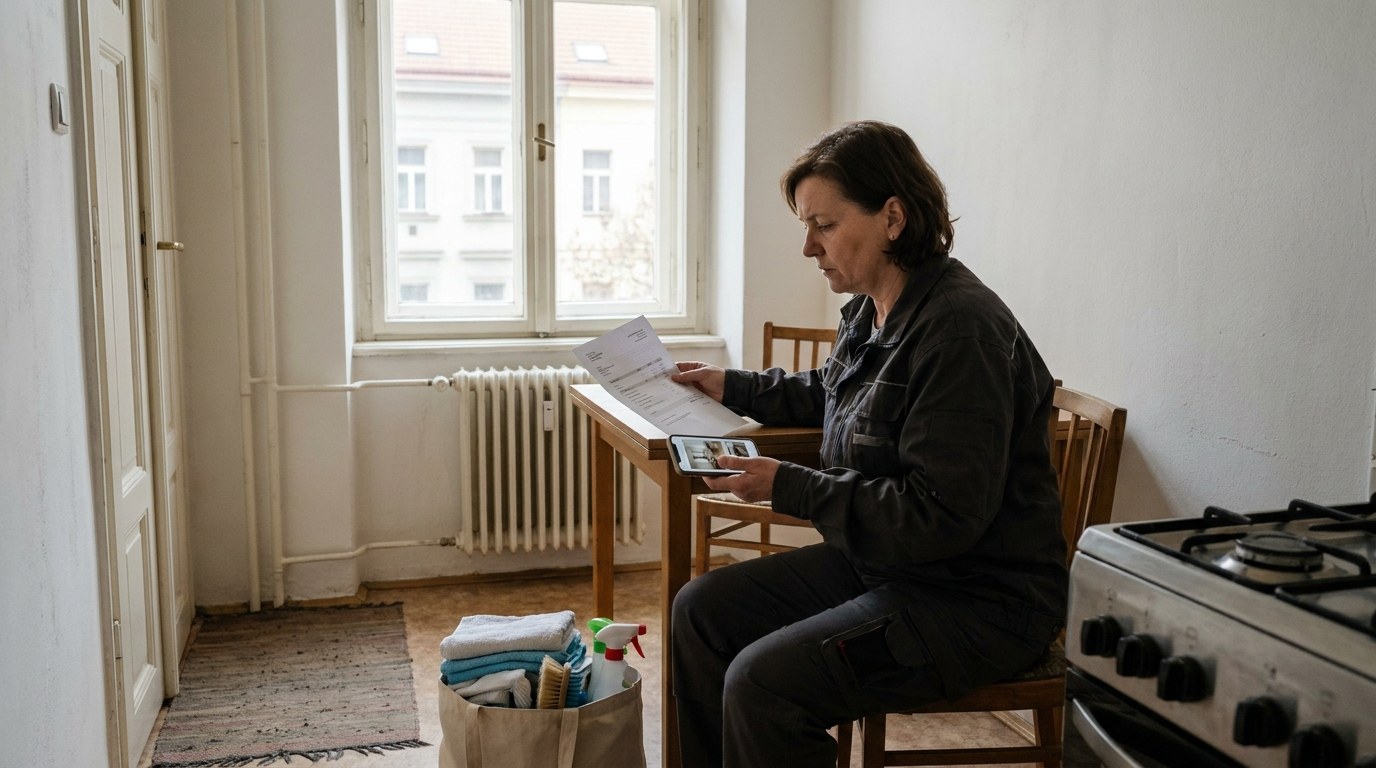
Pricing a one-off clean is often where even the most skilled cleaners start losing money before they even realize it. I see the same pattern over and over: a client sends a couple of nice photos, calls it a "standard" two-bedroom flat, mentions a tight budget, and expects an immediate "yes." But the truth is, one-off jobs are rarely standard. There is the travel, the supplies, the setup time, the hidden grime, and the very real risk that the flat looks nothing like those WhatsApp photos once you actually open the front door.
If you are working as a sole trader or running a small cleaning team in Prague, you don't just lose out on the hourly rate. You lose when you accept a poorly defined job and end up subsidizing it with your own time, products, and patience. That is why this shouldn't be just another generic article about pricing. The real question is simpler: how do you spot a weak enquiry early, set a minimum cleaning fee without sounding defensive, and either reshape the job or decline it without turning the conversation into an argument?
Why one-off cleaning is usually underquoted
Regular clients become easier after the second or third visit. You already know the layout, how long the bathroom takes, whether the kitchen is a battle against grease or just a few crumbs. A one-time clean is different. You are quoting with incomplete information, and that is exactly why one-off cleaning quotes go wrong so often.
Clients almost always underestimate the actual condition
Most of the time, they aren't trying to deceive you. They just see their own home through familiar eyes. A client writes "nothing major" and means a bathroom with six months of limescale, greasy upper kitchen cabinets, and a floor that hasn't seen a proper mop since Christmas. In move-out cleans or post-renovation jobs, the gap between "standard" and "reality" is even wider.
A cleaner in Prague 6 described a job to me that perfectly illustrates this. The client promised a "quick freshen-up" before family arrived for the weekend. Once she arrived, it turned into a five-hour struggle with a filthy oven, a lime-crusted shower, and a fridge that no one had mentioned. If she had stuck to the original quote without a buffer, she would have been working essentially for free.
Travel, materials, and prep vanish in the client's math
When a client hears a quote, they usually divide it by the estimated hours and decide if it "sounds expensive." The problem is that the price for a one-off clean isn't just the time spent with a cloth in hand. It includes travel across Prague, parking, loading equipment, restocking chemicals, washing mop heads later, and all the admin before and after the visit.
Take a simple example: a job in Modřany for CZK 1,800 might look workable at first glance. But if you're traveling from the other side of town, bringing a vacuum, paying for parking, and spending an extra hour because the condition was "generously" described, your margin disappears faster than you can say "underpriced."
Photos are useful, but they aren't evidence
Photos help, but they also hide plenty. A client sends a close-up of a shiny sink but forgets the greasy extractor hood. You get a wide shot of the living room, but you can't see the dust on the skirting boards, the pet hair in the carpets, or the fact that there's no hot water in the flat. In Airbnb rentals and investment properties, this is a common story.
That's why I treat photos as a guide, not a contract. If the condition on arrival is clearly different from what was sent, there must be room to adjust the price or the scope. If you don't manage this upfront, you'll walk straight into a job that doesn't pay for your effort.
Signals that the job probably isn't worth taking
Not every low-budget enquiry is a bad one. Some are just small. But some start smelling like trouble from the very first message. The earlier you spot them, the fewer headaches you'll have later.
The budget is far below reality
If someone asks for a full clean of a three-room flat in Prague for CZK 1,000 including windows, that isn't a "negotiation challenge." It's a mismatch. You don't need to prove your flexibility; you need to recognize that the job and your business model don't belong together. A minimum cleaning fee isn't about being arrogant—it's about protecting your schedule from jobs that drain your energy without leaving any profit.
For one-off work, it makes sense to have a "floor" price. In Prague, many providers set this around CZK 2,200 to CZK 3,000 depending on travel and equipment. If saying that number makes you nervous, the solution isn't to lower it; it's to explain what it covers. When you negotiate against yourself, you've already lost.
The scope keeps moving
The first message sounds simple. Then the oven is added. Then the fridge. Then the balcony. Then "while you're there," could you also do the inside of the wardrobes? This is where profitability dies. An unclear scope is more expensive than a low hourly rate because the client will gladly fill any empty space with their own expectations.
A good rule is to confirm the scope in writing. What's included, what's excluded, what triggers a surcharge, and what requires a site visit. This level of structure doesn't scare off serious clients—it usually reassures them that you are a professional.
The client pushes for a discount before anything else
A client who asks for a discount three times before even booking a slot is rarely done negotiating. This is often the same type of customer who will question every extra minute, complain about details without context, and expect premium service for free.
This doesn't mean every price-sensitive client is a problem. Prague is expensive, and people compare quotes—that's normal. The difference is in the tone. Some clients want to understand the value; others are just probing to see how far you'll bend. When you feel that second pattern, you need a plan for declining the job professionally instead of arguing.
How to set a minimum without sounding overpriced
Many cleaners don't actually struggle with the math; they struggle with saying the numbers out loud. But a well-set minimum gives clients certainty, not chaos.
A minimum job fee makes business sense
A minimum fee isn't a penalty for a small flat. It covers the fixed cost of just showing up. Even a studio apartment requires communication, travel, unloading, setup, and final checks. If you ignore these costs, small one-off jobs will wreck your week's economics.
A calm explanation works best: "For one-off cleaning, we have a minimum visit fee of CZK 2,400 because it covers travel within Prague, equipment, and the base preparation time for the job." That isn't defensive; it's clear and honest.
Heavy dirt needs its own pricing lane
The worst move is pretending that stubborn limescale, baked-on grease, or nicotine residue will somehow fit into a standard price. It won't. These jobs eat up time, products, and energy.
You don't need a twenty-line price list. You just need a simple structure: standard one-off clean, heavily soiled property, and add-ons like appliances or windows. Clients handle surcharges much better when the reason is specific. They handle it much worse when the price changes on-site without a clear explanation.
Fixed quote versus hourly pricing
A fixed quote is easier to sell because it feels safe for the client. But it's only safe for you if the scope is truly clear. Hourly pricing protects you in uncertain situations, though many clients dislike it because they fear an "open-ended" bill.
What often works best is a framed range. Something like: "Based on the photos and description, I expect the job to land between CZK 2,800 and CZK 3,600. We will confirm the final number once I arrive, provided the condition matches what was sent." This approach gives the client a direction without forcing you to gamble on incomplete info.
How to say it professionally
This is where the business actually happens. You don't need sharper sales tactics; you need language that holds a boundary without sounding hostile.
Phrases that keep the line without starting a fight
You don't need to over-explain. Short, steady sentences work best.
- "At that budget, we wouldn't be able to deliver the quality we stand behind."
- "Based on your description, this is more than a basic one-off clean and requires a different budget."
- "To give you a fair result, I need to either adjust the scope or price it at the level the work requires."
- "We don't go below our minimum fee for one-time visits because that would mean cutting corners on quality."
None of these phrases attack the client. They simply define your limits.
Offer alternatives instead of a blunt "no"
A hard "no" has its place, but a reshaped offer often makes more business sense. If the budget doesn't cover the whole flat, offer just the kitchen and bathroom. If the client needs a reset, propose a deep first visit followed by regular cleaning every two weeks. You can also offer a paid site visit that gets deducted from the final invoice if they book.
This is the most practical shift you can make. You stop fighting over discounts and start changing the shape of the work. Suddenly, you aren't "too expensive"—you're just working within reality.
When it's better to walk away completely
Some enquiries aren't worth another message. If a client refuses to define the scope, wants an impossibly low price, or sounds combative from the first exchange, just walk away. These jobs rarely end well.
A clean decline can be very short: "Thank you for the enquiry. Based on the scope and budget described, we wouldn't be able to deliver the service at the quality we stand behind, so we won't be able to offer a booking this time." Done. No apologies needed.
How to turn a weak enquiry into a better deal
You don't have to throw every awkward lead away. Sometimes it just needs better framing.
Convert the job into regular cleaning
One-off jobs are often expensive because they are catching up on months of neglected maintenance. Once a client understands that, they are often open to a larger "reset" visit followed by a cheaper regular schedule. This is better for your margins and more sustainable for the client.
In Prague, this works especially well for busy households and rental properties. A one-off job shouldn't be a dead end; it should be the start of a stable arrangement.
Narrow the scope
If the client can't afford the whole property, that doesn't mean the lead is dead. It's often smarter to do the two most difficult zones (like the kitchen and bathroom) properly than to do the whole flat halfway. This protects your reputation and gives the client real value.
Charge for a site visit or insist on better input
For riskier or larger jobs, a paid site visit makes sense. It's not yet universal in the Czech market, but it saves a lot of friction. If you don't want to charge for the visit, insist on better materials: a video walkthrough or close-up photos of the bathroom, kitchen, and windows. The less "fog" there is before you start, the less likely you are to be rescuing a bad deal.
Ultimately, your one-off cleaning price is a test of whether you can protect your time and energy. Cheap jobs don't save businesses; they usually drain them. If you set your minimum, learn the warning signs, and offer clients structured options instead of nervous discounts, you'll find your work becomes both calmer and more profitable.
If you want to see how a clearer enquiry process looks in practice, ČistýKout is a Prague-based option worth checking out. Their contact form makes it much easier to define the scope before anyone starts guessing.