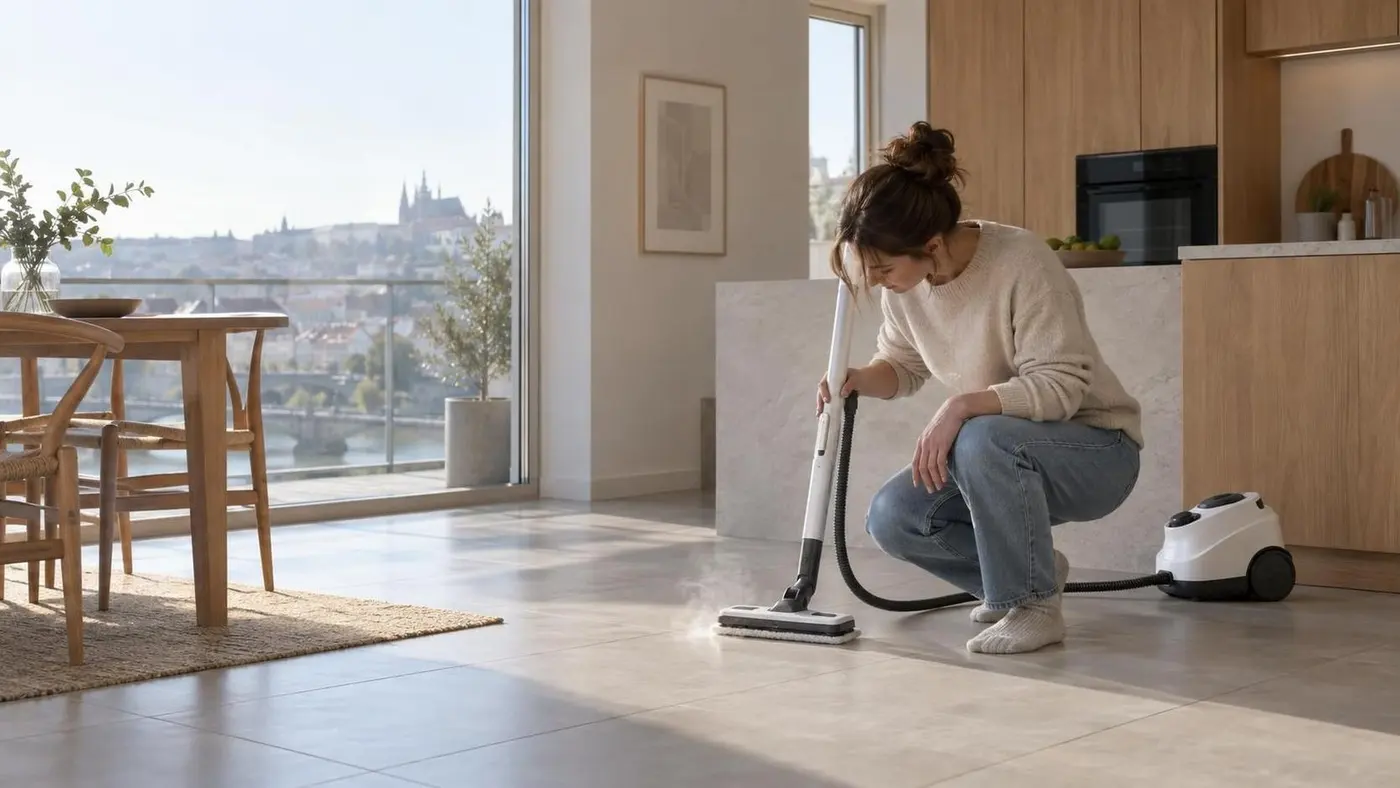
A steam cleaner can loosen greasy grout and reduce the amount of cleaning product you use. That does not make it safe for every surface. Steam brings heat, moisture and pressure at the same time. On the wrong material, it can lift a laminate edge, alter upholstery dye or push water into a layer that cannot dry. If you do not know exactly what you are cleaning, leave the trigger alone for now.
Why steam cleans and why it can also cause damage
Steam condenses when it reaches a cooler surface. The released heat softens residue, the water moistens it and the force from the nozzle moves the loosened dirt. This is useful on sound ceramic tile or a stainless steel oven rack. The same process also heats varnish, glue, sealant and the fibreboard hidden below a laminate surface.
So “wood or stone?” is not a detailed enough question. Check four things: the base material, its finish, the condition of the seams and the way the parts are fixed. A ceramic tile may be robust while the grout beside it is cracked. A sealed parquet board may be intact in the middle and chipped at the wall. Steam tends to find the weak point.
The care instructions for the floor, sofa or appliance take priority over general advice in the steam cleaner manual. Rules can differ between ranges made by the same flooring brand. Some water-resistant laminate allows low steam with a cloth over the outlet. Other ranges ban steam mops. There is no honest universal answer.
Wood, laminate and vinyl: the seams are usually the risk
A varnished wooden floor is not automatically steam safe. The finish needs to be continuous, the boards properly fitted and the edges closed. Keep steam away from unfinished, oiled or waxed wood unless the flooring maker says otherwise. Heat may disturb the finish, while condensed water can enter the timber. Damage does not always appear immediately. A board edge may lift as it dries.
Laminate is deceptive because its top layer can feel hard and waterproof. Beneath it is often a moisture-sensitive fibreboard core. Kärcher's parquet and laminate guidance allows steam only where the floor is correctly installed and moisture cannot enter joints or exposed edges. It also calls for the lowest setting, a covered floor head and constant movement. Those conditions matter more than the picture on the cleaner's box.
I once saw two boards beside a balcony door in a Vinohrady flat already beginning to separate. The owner wanted to hold the steam there longer to clean the dark line. That was exactly the place to put the machine away. A slightly cleaner seam was not worth a swollen floor.
The same restraint matters after decorating, when fine dust and dried paint drops sit on the floor. The guide to cleaning after painting without floor damage explains why dry removal should come before a carefully controlled damp step.
With vinyl, pay attention to glued tiles, welded seams and edges. Heat can soften adhesive or distort a thin surface. If the maker has not approved steam cleaning floors in that range, use a well-wrung cloth or the recommended mop instead. Turning up the power is not a safety margin.
Natural stone, grout and silicone do not react alike
“Stone” sounds indestructible. Polished granite, porous limestone and marble with tired sealer behave very differently, though. Identify the stone and check both the sealer and the supplier's care instructions. Moisture can settle in open pores. Repeated heating may also change a coating or expose an existing weakness.
Glazed ceramic tile is normally less complicated. Grout is another matter. Sound cement grout will usually tolerate a quick pass better than a crumbling joint hit by a narrow jet from close range. Around a bath or shower, inspect silicone for lifted edges and dark marks below the surface. Steam will not repair mould behind a failed seal. Holding a hot jet there may weaken it further.
For steam cleaner surface safety on stone and tile:
- identify the stone and confirm the sealer is sound;
- inspect grout, cracks and silicone joints;
- use a wider attachment at the lowest effective setting;
- keep moving and wipe away condensate;
- stop if the material darkens, dulls or changes texture.
Upholstery, mattresses and carpets need a fast drying route
Using a steam cleaner on upholstery is not the same as hot-water extraction with suction. Steam may freshen the face fabric or help with a small mark, but a standard machine does not pull all that moisture back out. Water can remain in the cover, padding or timber frame. A sofa in a cool Prague flat in November will dry very differently from one beside open windows in July.
Start with the care label. Upholstery codes often use W for water-based cleaning, S for solvent cleaning, WS for either and X for vacuum-only or professional care. Even a W code does not promise that the textile can take high heat. The furniture maker's instructions still matter.
Test the rear underside first. With a clean cloth attachment, use the lowest setting for one short pass. Blot with a white cloth and let the area dry fully. Look for colour transfer, a water ring, roughened fibres or loosened adhesive. Wet fabric naturally looks darker, so a two-minute check tells you very little.
If the problem is one local mark rather than a full refresh, use the lower-moisture method in how to clean a sofa at home without marks. It puts more emphasis on blotting and complete drying.
Do not steam memory foam, silk, velvet, old upholstery or a filling whose material is not identified on the care label without explicit maker approval. Kärcher's Czech steam-cleaner FAQ advises against using a steam cleaner on mattresses because moisture enters the material. Carpets bring another hidden layer: the backing or adhesive may be less tolerant than the visible pile. If the moisture has no quick way out, low-chemical cleaning has created a dampness problem instead.
Electronics, painted finishes and glued edges stay out of the jet
Steam and live electrical parts do not mix. Keep it away from sockets, switches, power strips, speakers, keyboards, remote controls and screens. On an oven or extractor hood, avoid the control panel, vents and seals. Bissell lists electronic displays and unsealed electrical connections as unsuitable areas, even though it permits steam on selected glass and metal appliance surfaces.
Treat painted furniture with similar caution. The broad glossy panel may survive brief contact while the glued ABS edge on a cabinet door begins to loosen. Steam can travel under protective film, self-adhesive covering and veneer. Hairline cracks in lacquer and old repairs are risk points you may not notice until moisture reaches them.
A controlled damp microfibre cloth is the better tool here. It should not drip. Hold it on the mark briefly, then wipe. For electronics, apply an approved cleaner to the cloth, never into an opening or seam, and disconnect the equipment first. Follow its manual rather than a social media demonstration.
The five-minute test before first use
Spend five minutes deciding before you clean a large area. It takes less time than dealing with a rippled floor or a permanent ring on a sofa.
- Name the exact material. “Wood” is not enough. Is it sealed parquet, oil, laminate, glued vinyl, marble or ceramic?
- Inspect the finish and joints. Look for worn coating, open edges, cracked grout, ageing silicone, film and adhesive.
- Read both manuals. Check the material maker and the steam cleaner. Where they conflict, follow the stricter limit. No manual does not mean permission.
- Test a hidden spot. Fit a clean cloth, choose the lowest setting and make one quick pass. Do not pause.
- Let it cool and dry completely. Then check colour, sheen, edges, softness and odour.
Do not use steam if you cannot identify the material, the surface is damaged, the maker prohibits it or the test produces any change. Vacuuming, a well-wrung cloth and a product approved for that finish may look less impressive on camera. They are often the safer answer to what not to steam clean.
The practical rule is to judge the whole construction, not only the layer you can see. If an expensive floor, stone finish or upholstered piece is uncertain, you do not have to experiment. ČistýKout is a Prague-based cleaning option; send a no-obligation request through the ČistýKout contact form and describe the material, its condition and the result you need.